BMJ 1994;308:81-106 (8 January)

Papers

Collaborative overview of randomised trials of antiplatelet therapy Prevention of death, myocardial infarction, and stroke by prolonged antiplatelet therapy in various categories of patients

,  Antiplatelet Trialists' Collaboration

Correspondence to: APT Statistical Secretariat, ICRF/BHF/MRC Clinical Trial Service Unit, Nuffield. Department of Clinical Medicine,Radcliffe Infirmary, Oxford OX2 6HE, or APT Clinical Secretariat,Department of Clinical Neurosciences, Western General Hospital, Edinburgh EH4 2XU.

Abstract

Objective : To determine the effects of "prolonged" antiplatelet therapy (that is, given for one month or more) on "vascular events" (non-fatal myocardial infarctions, non-fatal strokes, or vascular deaths) in various categories of patients.
Design : Overviews of 145 randomised trials of "prolonged" antiplatelet therapy versus control and 29 randomised comparisons between such antiplatelet regimens.
Setting : Randomised trials that could have been available by March 1990.
Subjects : Trials of antiplatelet therapy versus control included about 70 000 "high risk" patients (that is, with some vascular disease or other condition implying an increased risk of occlusive vascular disease) and 30 000 "low risk" subjects from the general population. Direct comparisons of different antiplatelet regimens involved about 10 000 high risk patients.
Results : In each of four main high risk categories of patients antiplatelet therapy was definitely protective. The percentages of patients suffering a vascular event among those allocated antiplatelet therapy versus appropriately adjusted control percentages (and mean scheduled treatment durations and net absolute benefits) were: (a) among about 20 000 patients with acute myocardial infarction, 10% antiplatelet therapy v 14% control (one month benefit about 40 vascular events avoided per 1000 patients treated (2P< 0.00001)); (b) among about 20 000 patients with a past history of myocardial infarction, 13% antiplatelet therapy v 17% control (two year benefit about 40/1000 (2P<0.00001)); (c) among about 10 000 patients with a past history of stroke or transient ischaemic attack, 18% antiplatelet therapy v 22% control (three year benefit about 40/1000 (2P<0.00001)); (d) among about 20 000 patients with some other relevant medical history (unstable angina, stable angina, vascular surgery, angioplasty, atrial fibrillation, valvular disease, peripheral vascular disease, etc), 9% v 14% in 4000 patients with unstable angina (six month benefit about 50/1000 (2P<0.00001)) and 6% v 8% in 16 000 other high risk patients (one year benefit about 20/1000 (2P<0.00001)).
Reductions in vascular events were about one quarter in each of these four main categories and were separately statistically significant in middle age and old age, in men and women, in hypertensive and normotensive patients, and in diabetic and non: diabetic patients. Taking all high risk patients together showed reductions of about one third in non-fatal myocardial infarction, about one third in non-fatal stroke, and about one sixth in vascular death (each 2P<0.00001). There was no evidence that non-vascular deaths were increased, so in each of the four main high risk categories overall mortality was significantly reduced. The most widely tested antiplatelet regimen was "medium dose" (75-325 mg/day) aspirin. Doses throughout this range seemed similarly effective (although in an acute emergency it might be prudent to use an initial dose of 160-325 mg rather than about 75 mg). There was no appreciable evidence that either a higher aspirin dose or any other antiplatelet regimen was more effective than medium dose aspirin in preventing vascular events. The optimal duration of treatment for patients with a past history of myocardial infarction, stroke, or transient ischaemic attack could not be determined directly because most trials lasted only one, two, or three years (average about two years). Nevertheless, there was significant (2P<0.00001) further benefit between the end of year 1 and the end of year 3, suggesting that longer treatment might well be more effective.
Among low risk recipients of "primary prevention" a significant reduction of one third in non: fatal myocardial infarction was, however, accompanied by a non-significant increase in stroke. Furthermore, the absolute reduction in vascular events was much smaller than for high risk patients despite a much longer treatment period (4.4% antiplatelet therapy v 4.8% control; five year benefit only about four per 1000 patients treated) and was not significant (2P=0.09).
Conclusions : Among a much wider range of patients at high risk of occlusive vascular disease than is currently treated routinely, some years of antiplatelet therapy - with aspirin 75-325 mg/day or some other antiplatelet regimen (provided there are no contraindications) - offers worthwhile protection against myocardial infarction, stroke, and death. Significant benefit is evident not only among patients with unstable angina, suspected acute myocardial infarction, or a past history of myocardial infarction, stroke, or transient ischaemic attack, but also among many other categories of high risk patients (such as those having vascular procedures and those with stable angina or peripheral vascular disease). There is as yet, however, no clear evidence on the balance of risks and benefits of antiplatelet therapy in primary prevention among low risk subjects.

Clinical implications

  • Clinical implications

  • Antiplatelet therapy protects a wider range of patients at high risk of occlusive vascular disease than is currently treated routinely: it should be considered for almost all with suspected acute myocardial infarction, unstable angina, or a history of myocardial infarction, angina, stroke, transient ischaemic attack, arterial bypass surgery, or angioplasty

  • There is, as yet, no clear evidence that antiplatelet therapy is indicated for routine use in "primary prevention" subjects at low risk of occlusive vascular events

  • Medium dose aspirin (75-325 mg/day) is the most widely tested antiplatelet regimen, and no other regimen appeared significantly more effective at preventing myocardial infarction, stroke, or death

Introduction

Previous Antiplatelet Trials And Aims Of Current Overview

It is reliably established that antiplatelet therapy reduces the risk of vascular death by about one sixth and the risk of non-fatal myocardial infarction and stroke by about one third in patients with unstable angina, suspected acute myocardial infarction, or a past history of myocardial infarction, stroke, or a transient ischaemic attack.*RF 1-4* There remains uncertainty, however, whether antiplatelet therapy is beneficial in other patient populations at high risk of occlusive vascular disease or in certain subgroups of these "high risk" populations (for example, among women or among patients who are old, hypertensive, or diabetic). It is also uncertain whether the benefits of long term antiplatelet therapy would outweigh the side effects among subjects in whom the risks of occlusive vascular disease are much lower (for example, primary prevention in the general population with no relevant medical history) and which antiplatelet regimens are most effective.

The aim of this second cycle of the worldwide Antiplatelet Trialists' Collaboration1 was therefore to assess the effects of antiplatelet therapy in more detail and in a much wider range of circumstances than before. This paper (part I in a series of three reports) describes the methods used in the collaborative overview process and then provides systematic overviews of the effects of "prolonged" antiplatelet therapy (that is, given for at least one month) in subjects at high risk and at low risk of occlusive vascular disease. The trials in high risk subjects are then subdivided more finely by the category of patients who were to be studied (prior myocardial infarction, acute myocardial infarction, prior stroke or transient ischaemic attack, and various other categories of patients considered to be at particular risk of vascular events because of their medical history). Where possible, the patients in those trials in high risk are also subdivided by certain personal characteristics (age, sex, blood pressure, diabetes) or by the type of antiplatelet regimen tested (aspirin at various doses, dipyridamole, ticlopidine, etc). In addition, the directly randomised comparisons of different antiplatelet regimens are reviewed. Randomised comparisons of different durations of treatment were not available, but the effects of antiplatelet therapy during year 1, during year 2, and during later times are examined separately to help assess any additional effects of more prolonged therapy.

Parts II and III will report overviews of 53 trials of antiplatelet therapy to maintain vessel patency after vascular procedures(super5) and 77 trials to prevent venous thromboembolism after general and orthopaedic surgery.6

Evidence That Can Be Generalised To A Wide Range Of Patients

Reliable detection (or refutation) of the sort of moderate sized benefits observed previously with antiplatelet therapy requires reliable exclusion both of moderate biases and of moderate random errors, either of which might obscure (or mimic) moderate treatment effects. Each requirement may be difficult to meet adequately without a proper overview of the unconfounded randomised trials, particularly if the aim is not only to distil clear findings from the overall material but also (by appropriate subgroup analyses) to help assess the generalisability of those findings.7 8

Analyses of the effects of treatment in particular subgroups will mainly involve "vascular events" (that is, non-fatal myocardial infarctions, non-fatal strokes, or vascular deaths) rather than vascular deaths alone. This is because such subgroup analyses may be statistically more reliable for vascular events (where, overall, there is a 13 standard deviation difference in favour of antiplatelet therapy; see results) than for vascular deaths alone (where there is "only" a six standard deviation difference in favour of antiplatelet therapy). Even for vascular events, however, separate analyses of the effects in an excessively large number of small subgroups of patients studied could well generate some false negative results merely by chance. Paradoxically, therefore, unless there are good reasons for expecting a difference in the direction of the effects of treatment in different settings the approximate benefit of antiplatelet therapy in some small subgroup of patients may best be assessed indirectly by approximate extrapolation from the proportional effect observed in a much wider class of patients.9

Materials and methods

Data Acquisition

Identification of all unconfounded randomised trials

The aim was to seek collaboration between the coordinators of all unconfounded randomised trials, published or unpublished,10 11 that could have been available for review by March 1990, in which antiplatelet therapy was compared with no antiplatelet therapy, or in which one antiplatelet regimen was compared with another (with the exception) of trials of antiplatelet therapy for patients with subarachnoid haemorrhage12 14 or for preventing pre-eclampsia15 or migraine16. Trials were to be included only if they were believed to have been randomised in a manner that precluded prior knowledge of the next treatment (for example, where allocation was not alternate or based on odd or even dates), and they were considered to be unconfounded if one treatment group differed from another only in the treatment of interest. Thus a trial in which antiplatelet therapy plus heparin was compared with the same heparin regimen would have been included whereas a trial of antiplatelet therapy plus heparin versus no treatment (or of antiplatelet therapy versus anticoagulant therapy) would not.

Relevant randomised trials were identified by computer aided literature searches (Medline and Current Contents), by manual searches of journals, by scrutiny of the reference lists of trial and review articles, by scrutiny of abstracts and meeting proceedings, by collaboration with the trials register of the International Committee on Thrombosis and Haemostasis, by inquiry among colleagues (particularly those who had coordinated other such studies), and by inquiry of various manufacturers of antiplatelet agents. This process and the correspondence with collaborating trialists that it engendered (see below) took several years. The aim was to include trials of agents whose primary mode of action on the vascular system was thought to be through inhibition of platelet aggregation or adhesion, or both: cyclo-oxygenase inhibitors (aspirin, flurbiprofen, ibuprofen, indobufen, naproxen, sulphinpyrazone, triflusal), phosphodiesterase inhibitors (dipyridamole, E5510, RA233), platelet calcium ion channel inhibitors (suloctidil), phospholipase inhibitors (hydroxychloroquine), thromboxane synthetase inhibitors, receptor blockers, or both (dazoxiben, piracetam, picotamide, ridogrel, sulotroban, daltroban, GR32191), and agents with direct effects on platelet membranes (ticlopidine). Agents known also to have a major vasodilating action (such as epoprostenol, oxpentifylline, ketanserin, naftidrofuryl) or major anticoagulant action (such as heparin or warfarin) were not to be included.

Definition of outcome measures

In this report the effects of antiplatelet therapy were to be assessed principally in terms of their effects on vascular events, defined as non-fatal myocardial infarctions, non-fatal strokes, or vascular deaths. Outcome events were to be counted as "non-fatal" only if the patient subsequently survived to the end of the study treatment period scheduled for that patient: otherwise, only the death was to be counted. Survivors could have suffered more than one type of non-fatal event. Causes of death were subdivided into "non-vascular" (that is, definitely non-vascular) and "vascular" (that is, definitely or possibly vascular, which includes all deaths attributed to cardiac, cerebral, haemorrhagic, embolic, other vascular, or unknown causes). Myocardial infarctions and strokes were to be counted if the investigator considered them to be either probable or definite. Transient ischaemic attacks (in brain or eye), angina, and "possible" myocardial infarctions or strokes were not to be counted as outcomes. Strokes (including subarachnoid haemorrhages) were to be counted only if symptoms persisted for at least 24 hours, and were subdivided into haemorrhagic (including those of "probably" haemorrhagic aetiology) and other (including those of probably ischaemic or of unknown aetiology). "Major" bleeds were those non-cerebral bleeds that required transfusion.

In trials among patients having vascular surgery or angioplasty or those having renal shunts or fistulas established, information on vessel or graft patency was sought (see part II5, and among all trials in which deep venous thromboses were looked for prospectively (usually among surgical patients) information on deep venous thromboses and pulmonary emboli was also sought (see part III6. Pulmonary emboli were to be counted if considered "probable" or "definite" by the investigator. There were differences between studies in the definitions of outcome measures, but because retrospective reclassification would have been impracticable (and potentially biased) the definitions preferred by the original investigators in each study were generally retained. The heterogeneity that this entailed does not invalidate the main overview results.17

"Summary data" from all contributing trials

For all studies that might have been randomised controlled trials of antiplatelet therapy a few simple details of trial design were requested from the principal investigators (including the exact method of treatment allocation, whether control patients received placebo, any other "blinding" of treatment allocation or outcome assessment, and the scheduled duration of trial treatment and of patient recruitment). Summary data were requested on the numbers of patients allocated to each treatment group and on the numbers of these who had suffered each of the outcomes of interest. These summary data were checked for internal consistency and for consistency with any published reports of the trials. When the data did not include information about outcome among all patients initially randomised or about all the outcomes of interest during the scheduled period of follow up, extra details were sought by correspondence with the principal investigators so that "intention to treat" analyses could be conducted. Before the final analyses, the data to be used were printed out for each trialist to check again.

Individual patient data from certain trial categories

For the trials among "low risk" subjects (that is, of primary prevention of vascular events) or among particular categories of "high risk" patients (those with unstable angina, acute myocardial infarction, prior myocardial infarction, stroke or transient ischaemic attack) data were sought for each individual randomised patient. These concerned certain baseline entry characteristics (age or date of birth, sex, blood pressure, and whether diabetic or not); the allocated treatments; and the dates of randomisation, of the scheduled end of trial treatment, of the actual end of treatment, of the last follow up, and of the first occurrence of any of the important vascular events defined above. More specific information about any non-vascular deaths and about the degree of disability associated with any strokes was also sought. In trials that recruited stroke or transient ischaemic attack patients information was sought on the nature of these qualifying cerebral events. The data from each investigator were checked for internal consistency of individual patient records, for balance of group sizes overall and according to certain prognostic categories, for consistency with the summary tabulations provided for each trial, and for some other indicators of possible anomalies.8 Queries were referred back for clarification, and the complete set of information on each trial was also referred back for confirmation.

Statistical Methods

Proportional and absolute reductions

Both proportional and absolute reductions in clinical events can help in describing the size of any treatment effects. For example, overall in the 11 trials among patients with a history of myocardial infarction,*RF 18-40* 13% of the patients allocated antiplatelet therapy and 17% of the controls suffered a vascular event (myocardial infarction, stroke, or vascular death; fig 1). This absolute reduction of 4% (that is, about 40 vascular events prevented per 1000 patients treated) corresponds to a proportional reduction of about one quarter. Proportional reductions may be more widely generalisable to different medical circumstances, while absolute reductions may be more directly relevant to deciding whether to use treatment in particular medical circumstances. For these reasons both proportional and absolute reductions are described in the results.

Simplest summary of trial results: adjusted totals and adjusted percentages

Suppose that findings are to be combined from several trials that were all evenly randomised (that is, with about half the subjects in each trial allocated treatment and half control). A simple method of comparison would entail adding together all the treatment groups, adding together all the control groups, and, finally, comparing these two grand totals. If any of the trials had included deliberately uneven treatment allocation (for example, two thirds treatment, one third control), then it could first be adjusted to an evenly randomised comparison by counting the control group more than once. For example, in figure 1 for trials of antiplatelet therapy after myocardial infarction the small control group in the PARIS-I study(super22 23) would be counted fourfold to make it about the same size as the treatment group. The adjusted totals for the treatment and control groups would then be 262/1620 v 328/1624 in PARIS-I and 1331/9877 (13%) v 1693/9914 (17%) in all 11 trials together. In statistical principle these simple adjusted total may not be ideal (see below) but if, as here, the overall difference between treatment and control is very highly statistically significant, then such adjusted percentages (13% v 17%) may well provide a simple description of the effects of treatment that is sufficient for most practical medical purposes.

Comparisons of like versus like based on combination of "observed minus expected" differences in each separate trial

Figure 1 also illustrates the more formal statistical methods used to combine the results from different trials (using the actual numbers rather than adjusted numbers). These methods are completely robust, entailing no unjustified assumptions. A fuller description of the methods and of why they are more appropriate than other methods for such overviews of randomised trials is given elsewhere.17


View larger version (71K):
[in this window]
[in a new window]
 
FIG 1 - Proportional effects on vascular events (myocardial infarction, stroke, or vascular death) in 11 randomised trials of prolonged antiplatelet therapy (for one month or more) versus control in patients with prior myocardial infarction. O-E=Observed minus expected Asp=Aspirin. Dip=Dipyridamole. MI=Myocardial infarction (In most trials patients were allocated roughly evenly between treatment groups, but in some (for example, PARIS-I) more were deliberately allocated to active treatment. To allow direct comparisons between percentages suffering an event in each treatment group, in figure 1 and elsewhere adjusted totals have been calculated after converting any unevenly randomised trials to even ones by counting control groups more than once. Statistical calculations are, however, based on actual numbers from individual trials. Ratio of odds of an event in treatment group to that in control group is plotted for each trial (black square: area proportional to amount of statistical information contributed by trial) along with its 99% confidence interval (horizontal line). All black squares are to left of solid vertical line, indicating benefit (but benefit is significant at 2P<0.01 only where, in three trials, entire confidence interval is to left of line). Stratified overview of results of all trials (and 95% confidence interval) is represented by open diamond, indicating odds ratio of 0.75 (SD 0.04) or, equivalently, odds reduction of 25% (SD 4%))
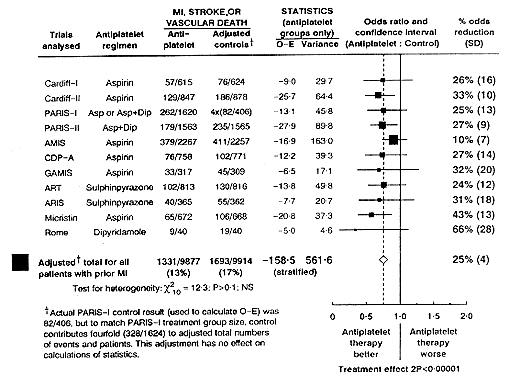
Within each separate trial the standard quantity "observed minus expected" (together with its "variance") is calculated for the numbers of events among treatment allocated patients.1 17 (Note that in an evenly randomised trial the observed minus expected value equals only half the number of events that appear to have been avoided by treatment.) To combine information from several different trials these observed minus expected values - one from each trial - can simply be added up. If treatment did nothing, then each of the separate observed minus expected values could equally well be positive or negative and their grand total would likewise differ only randomly from zero. On the other hand, if treatment reduced the risk of adverse outcome to some extent in most or all of the trials, then any individual observed minus expected value would be likely to be somewhat negative (that is, favouring treatment), so that when all these values are added up their grand total may be clearly negative. (These arguments do not assume that the size of the treatment effect is the same in all patients, or in all trials; indeed, it probably is not.) So, for example, in figure 1 the grand total of the individual observed minus expected values is -158.5. The negative sign indicates fewer vascular events in the patients allocated antiplatelet therapy than in the controls, and the numerical value of -158.5 suggests (very approximately) that about 320 vascular events were averted by treatment.

Variances and P values

The variance of the observed minus expected value is small in small trials and large in large, informative trials that estimate more accurately the proportional reduction in adverse events. Indeed, the variance of the observed minus expected value indicates the "statistical information content" of a trial.17 For the grand total of several observed minus expected values, the variance is given simply by the sum of their individual variances, and the standard deviation is the square root of this sum. In figure 1 the grand total of -158.5 has a variance of 561.6 and hence a standard deviation of 23.7, so it differs from zero by nearly seven of its standard deviations. This indicates a highly significant protective effect of antiplatelet therapy (two sided P value (2P) <0.00001), as a difference of only two standard deviations would have been enough for conventional statistical significance (2P<0.05). P values >=0.1 are denoted non-significant (NS).

Proportional odds reductions

The grand totals (G and V) of the individual observed minus expected values and of their variances can be used not only (as above) to calculate a P value to help test whether treatment has any effect but also to help describe the size of the treatment effect. This description entails calculating (by using the formula exp(G/V)) the "typical odds ratio," which gives the ratio of the odds of an unfavourable outcome among treatment allocated patients to the corresponding odd among controls, stratified by trial. In figure 1 allocation to antiplatelet therapy is associated with a typical odd ratio of 0.75, which corresponds to a reduction of 25% in the odds of a vascular event.

Proportional odds and risk reductions

When comparing outcome among treated and control patients in trial analyses where substantial proportions have not yet suffered the outcome of interest, "odds" reductions and "risk" reductions are not importantly different from each other as method: for describing the results. For example, if 100 control patients suffered a vascular event and 500 did not, then the odds of suffering an event would be one to five, or 0.20, while the risk would be one in six. In this instance it can be shown that a 25% odds reduction (from 0.20 to 0.15) would correspond to a 22% risk reduction (from 100/600 to 78/600). The percentage reduction in odds will always be slightly larger, but the similarity of these reductions (25% and 22%) confirms that it does not matter which is used to describe the trial results. Odds ratios for overviews are simpler to calculate, and so use is chiefly made of percentage reductions in odds in this report.

Standard deviations and confidence intervals

A convenient way of describing the statistical reliability of an odds reduction is to give its standard deviation (SD). For example, the overall odds reduction in figure 1 is given as 25% (SD 4%). Two standard deviations below and above 25% would yield 17% (one sixth) and 33% (one third), indicating that unless a rather unlikely (2P<0.05) chance event has occurred the odds reduction lies somewhere in the range between one sixth and one third. A more precisely calculated version of this "95% confidence interval" (with ends at exp(G/V +/- 1.96/V) is denoted by an open diamond in figure 1 and subsequent figures. The odds ratio observed in each of the parts that contribute to the total is plotted as a black square, with the areas of the squares chosen to be approximately proportional to the numbers of events (that is, the "statistical information content") in each trial. The horizontal line through each black square indicates the 99% confidence interval for the odds ratio - that is, the range of odds ratios with which that result is reasonably comfortably compatible. Because, appropriately,17 assumption free (that is, "fixed effect") statistical methods are used to combine trial results the standard deviations and confidence intervals describe the extent to which the play of chance during the randomisation process would be apt to affect the results, either of one particular trial or of an overview of several trials.

FIG 3 - Absolute effects of antiplatelet therapy (145 trials) on vascular events (myocardial infarction, stroke, or vascular death) in four main high risk categories of trial and in low risk (primary prevention) (Adjusted totals calculated after converting any unevenly randomised trials to even ones by counting control groups more than once, for calculating adjusted percentages and events prevented per 1000 patients allocated antiplatelet therapy. Statistical significance (2P) based on stratified analyses of original, unadjusted numbers in each trial (see statistical methods))


View larger version (36K):
[in this window]
[in a new window]
 
(Dagger)Months of A=Means of scheduled antiplatelet durations. No trial lasted under one month.

Description Of Trials

A total of 413 apparently randomised trials of antiplatelet therapy could have been identified by March 1990.*RF 18-20* On further investigation 49 were not properly randomised,*RF 313-363* 51 were confounded or had extremely large numbers of subjects lost to follow up or included a crossover design*RF 364-420* (plus A Lowenthal, personal communication), and two (Birmingham ticlopidine study and PACT) had never started. Data from one study (Zurich vein bypass study) were not available owing to the death of the investigator (A Bollinger, personal communication). Results from 53 studies, many of which were still in progress, were not available in March 1990*RF 276-313* and, although results from some are now available (and, for the larger


View larger version (65K):
[in this window]
[in a new window]
 
FIG 2 - Proportional effects of antiplatelet therapy (145 trials) on vascular events (myocardial infarction, stroke, or vascular death) in four main high risk categories of trial and in low risk (primary prevention). TIA = Transient ischaemic attack (Stratified ratio of odds of an event in treatment groups to that in control groups is plotted for each group of trials (black square) along with its 99% confidence interval (horizontal line). Overviews of results for certain subtotals (and 95% confidence intervals) are represented by diamonds. Odds reduction observed in particular groups of trials are given to right of solid vertical line) trials, are included in the appendices and discussion), they do not contribute to the main analyses. This left 257 eligible trials among 118 958 patients. Trials of less than one month of antiplatelet therapy were not to be included in the analyses in this report. They were, with few exceptions*RF 249-275* (see appendices 1 and 2), mostly designed to assess efficacy in terms of vessel or graft patency (see part II5 or in terms of the prevention of deep venous thrombosis or pulmonary embolism after surgery (see part III6.


View larger version (65K):
[in this window]
[in a new window]
 
FIG 4 (a-d) - Proportional effects of antiplatelet therapy (145 trials) on non-fatal myocardial infarction, non-fatal stroke, vascular death, and any death in four main high risk categories of trial and in low risk (primary prevention). Symbols and conventions as in figures 1 and 2

Appendices 1 and 2 give details of the 159 randomised trials of prolonged (that is, one month or more) antiplatelet therapy versus control among 96 935 patients (with individual patient data for 32 of these trials among 73 933 patients) and of the 32 trials comparing different prolonged antiplatelet regimens among 13 655 patients (with some patients in 16 of these trials also contributing to the comparison of antiplatelet versus control).*RF 18-248* For some trials the results differ from those originally published, generally because of the considerable efforts taken to obtain complete follow up data on all randomised subjects (see above), including not only events while treatment actually continued but also events before the scheduled end of trial treatment (which was on a common date for all patients in some trials and at a fixed interval after randomisation in others).

Results

Effects Of Antiplatelet Therapy On "Vascular Events"

Information about vascular events (non-fatal myocardial infarction, non-fatal stroke, or vascular death) was available from 145 trials among a total of 51 144 patients allocated antiplatelet therapy and 45 172 controls (adjusted control total 51 315; fig 2) and was known to be unavailable from 14 small trials among a total of only 619 patients. The total numbers of patients suffering a vascular event among those allocated antiplatelet therapy were 4835 (9.5%) of 51 144, while the corresponding adjusted total among the controls was 6108 of 51 315 (11.9%). In the formal statistical analysis the grand total of observed minus expected values was about - 600, indicating that about 1200 vascular events were prevented. Overall in these trials the typical reduction in the odds of suffering such events was 25% (SD 2%), which was very highly significantly favourable (13.1 standard deviations from zero; 2P<0.00001) (fig 2).

Although the 145 trials did not all indicate exactly the same odds reduction, the amount of scatter between their separate results was no greater than might be expected by chance if the true odds reduction in each study was exactly 25%. But when the trials were subdivided into five main categories, the proportional reductions seemed to be somewhat greater in the four "high risk" categories than in the one "low risk category" (P=0.001 for this heterogeneity; fig 2). The proportional reductions in vascular events were each about one quarter and highly significant (2P<0.00001) in each of the four high risk categories - namely, patients with a prior history of myocardial infarction, patients with suspected or definite acute myocardial infarction, patients with a prior history of stroke or transient ischaemic attack, and patients with other evidence of vascular disease or some condition associated with an increased risk of occlusive disease.


Effects of antiplatelet therapy on fatal and non-fatal strokes, aetiology
----------------------------------------------------------------------------------------------------------------
                                        Fatal + non-fatal strokes/No of subjects (combined %)
                                        ------------------------------------------------------------------------
Stroke aetiology and trial category                 Antiplatelet groups            Adjusted controls
----------------------------------------------------------------------------------------------------------------
      Probably or definitely haemorrhagic strokes (in trials with at least one haemorragic stroke recorded)
High risk:
  Prior myocardial infarction                         6+5/ 5 476 (0.2)             6+8/ 5 507 (0.3)
  Acute myocardial infarction                         6+0/ 8 821 (0.07)            1+1/ 8 830 (0.02)
  Prior stroke or transient ischaemic attack         20+5/ 3 897 (0.6)            10+7/ 3 953 (0.4)
  All other high risk                                12+5/ 2 333 (0.7)             5+6/ 2 352 (0.5)
Low risk:
  Primary prevention                                 19+25/14 466 (0.3)           10+14/14 454 (0.2)*
----------------------------------------------------------------------------------------------------------------
All such trials                                      63+40/34 993 (0.3)           32+36/35 096 (0.2)*
----------------------------------------------------------------------------------------------------------------
Other strokes (ischaemic or unknown aetiology; in trials with at least one haemorrhagic stroke recorded)
High risk:
prior myocardial infarction                          17+40/ 5 476 (1.0)           17+65/ 5 507 (1.5)*
Acute myocardial infarction                           8+29/ 8 821 (0.4)           14+51/ 8 830 (0.7)**
Prior stroke or transient ischaemic attack           73+306/ 3 897 (9.7)          86+396/ 3 953 (12.2)**
All other high risk                                   5+53/ 2 333 (2.5)           18+88/ 2 352 (4.5)***
Low risk:
Primary prevention                                   24+141/14 466 (1.1)          22+123/14 454 (1.0)
----------------------------------------------------------------------------------------------------------------
All such trials                                     127+569/34 993 (2.0)         157+723/35 096 (2.5)*****
----------------------------------------------------------------------------------------------------------------
                                 Strokes of any aetiology (in all trials with data on non-fatal strokes)
High risk:
Prior myocardial infarction                          26+82/ 8 375 (1.3)           32+129/ 8 372 (1.9)***
Acute myocardial infarction                          13+32/ 9 094 (0.5)           19+54/ 9 095 (0.8)**
Prior stroke or transient ischaemic attack          128+479/ 5 837 (10.4)        156+600/ 5 870 (11.2)****
All other high risk                                  28+103/ 9 600 (1.4)          38+186/ 9 698 (2.3)*****
Low risk:
Primary prevention                                   43+166/14 466 (1.4)          32+137/14 454 (1.2)
----------------------------------------------------------------------------------------------------------------
All such trials                                     238+862/47 372 (2.3)         277+1106/47 489 (2.9)*****
----------------------------------------------------------------------------------------------------------------
 *2P<0.05. **2P<0.01. ***2P<0.001. ****2P<0.0001. *****2P<0.00001.~
In these acute myocardial infarction trials,(*RF43 44*) cerebral
haemorrhage was found only among patients allocated fibrinolytic
therapy, among whom proportions affected were 6/4526 (0.13%) versus
2/4530 (0.04%).

As the proportional reductions were bigger among the high risk patients, the absolute risk reductions were very much bigger (ranging from 23 to 38 vascular events averted per 1000 high risk patients allocated antiplatelet therapy; fig 3) than among the low risk "primary prevention" subjects studied. For the latter group, the proportional reduction was less extreme (10% (SD 6%) and the absolute risk in the control group was low (only 4.8% of controls suffered an event during about five years of follow up; fig 3). Hence the absolute benefit of antiplatelet therapy seemed small (only about four vascular events averted for every 1000 patients treated for five years), and even this small benefit among such low risk subjects was statistically uncertain (2P=0.09).

Effects On Different Measures Of Outcome

Myocardial infarction

The information on non-fatal myocardial infarction was only about 95% complete, but the reductions in non-fatal myocardial infarction were so significantly and substantially different from zero that the unavailability of some data is unlikely to be important. Non-fatal myocardial infarctions were recorded in 122 trials, and the typical odds reduction produced by allocation to active treatment was 34% (SD 3%) (2P<0.00001; fig 4). This reduction in non-fatal myocardial infarction was highly statistically significant, not only in each of the four high risk categories but also in the low risk category, which suggests that a similar proportional reduction in myocardial infarction can be expected in a very wide range of settings.

Stroke

For non-fatal stroke, the information was also about 95% complete (124 trials provided results) and the typical odds reduction observed overall was large (25% (SD 4%)) and highly significant (2P<0.00001; fig 4). The reduction in non-fatal stroke among high risk patients was very definite (31% (SD 5%)) and about the same size as the reduction in myocardial infarction. There was no significant heterogeneity between the proportional odds reductions in stroke in the four high risk categories (fig 4), but the effects were very different in high risk and low risk subjects (P=0.00002 for heterogeneity). Indeed, in the low risk primary prevention studies the effect of antiplatelet therapy on non-fatal stroke appeared unfavourable. This unfavourable result was, however, statistically uncertain, and the true effect on stroke in such low risk subjects might still be about zero.

In addition to the 2000 non-fatal strokes recorded, about 500 fatal strokes were recorded during the scheduled treatment periods. Subdivision of all strokes, fatal or not, with respect to what is known of their aetiology (table) indicated that a probable small increase in haemorrhagic strokes was outweighed by a larger and very definite reduction in other strokes. The table shows that haemorrhage was considered to be the probable or definite aetiology of about 25% of fatal strokes but only about 5% of non-fatal strokes. This may help explain why the apparent effect on fatal strokes (15% (SD 9%) reduction; NS) was non-significantly smaller than the effect on non-fatal strokes (25% (SD 4%) reduction; 2P<0.00001).

Reliable analyses of disabling and other non-fatal strokes were not separately available because in only 15 trials (14 high risk, one low risk227 could non-fatal strokes be divided into those that were "disabling" (that is, severe interference to daily life persisting for some months after the stroke occurred) and those that were not. In these 14 high risk trials, antiplatelet therapy was associated with a 24% (SD 9%) reduction (2P<0.01) in disabling or fatal stroke and a 17% (SD 10%) reduction (2P=0.09) in non-disabling stroke with subsequent survival, the standard deviations of both reductions being large.

Vascular deaths

All but one of the 145 trials provided information on mortality, most deaths being attributed to vascular causes (which, by definition, include unknown causes). The overall effect of antiplatelet therapy on such "vascular" deaths was highly significantly favourable (6.7 standard deviations from zero; 2P<0.00001), and the typical reduction in the odds of vascular death was 17% (SD 3%). Similar proportional reductions were observed in the four high risk categories, but little net effect on vascular death was observed in the primary prevention trials, and the difference between the definite mortality reduction in the high risk categories and the lack of apparent effect in the low risk primary prevention trials approached significance (P=0.07; fig 4).

Non-vascular and total deaths

There was also a slight but non-significant tendency for there to be fewer non-vascular deaths among patients allocated antiplatelet therapy than among controls (figs 4, 5). Consequently, total (all cause) mortality was significantly (1P<0.01) reduced in each high risk category of patients but not in low risk subjects (fig 4). If antiplatelet therapy has some unanticipated protective or adverse effect on some specific type of non-vascular death, a crude overall analysis of non-vascular mortality might well yield an uninformatively non-significant result. Fatal non-cerebral bleeding was recorded only rarely (11/51069 (0.02%) patients among those allocated antiplatelet therapy versus 18/51 246 (0.04%) adjusted controls; NS) but there was a significant excess of three per 1000 "major" non-fatal non-cerebral bleeds (214/37 772 (0.6%) v 116/37 817 (0.3%); 2P<0.00001).


View larger version (22K):
[in this window]
[in a new window]
 
FIG 5 - Absolute effects of antiplatelet therapy on various outcomes in 11 trials in patients with prior (but not acute) myocardial infarction, five trials in patients with acute myocardial infarction (suspected or definite), 17 trials in patients with prior stroke or transient ischaemic attack, and three trials in people at low risk (primary prevention). Conventions as in figure 3. In "any death" columns non-vascular deaths are represented by lower horizontal lines (and may be calculated by subtracting vascular deaths from any deaths)

In all but one228,229 of the 32 trials for which individual patient data were obtained more specific details about the causes of other non-vascular deaths were available. Separate analysis of those trials also indicated a non-significant shortfall in all non-vascular deaths (352 observed, 378.2 expected) among antiplatelet allocated patients that was similar to that seen overall (679 observed, 699.3 expected; fig 4), with slightly, though non-significantly, fewer deaths both from cancer (183 observed, 196.6 expected) and from other non-vascular causes (169 observed, 181.6 expected). Site specific data on cancer deaths were not available, so the suggestion that aspirin might prevent intestinal cancer421 or that it might cause renal cancer422 could not be addressed directly (although analyses of one of the longest of the randomised trials of aspirin did not find any evidence of an excess of renal cancer423.

Effects In Different Categories Of Patients Patients with history of myocardial infarction

The weighted (by study size) mean duration of antiplatelet therapy in trials among about 20 000 patients with a prior history of myocardial infarction was 27 months, and allocation to antiplatelet therapy produced a highly significant reduction (2P<0.00001) of about 36 per 1000 in the risk of suffering another vascular event (fig 3). The standard deviation of this risk reduction was only 6, so the real risk reduction was unlikely to be less than about 20 or 30 per 1000. Moreover, here, as in other statistically definite trial results, the benefits of actually taking treatment tend to be underestimated by clinical trials because some patients did not comply fully with their random allocation (see discussion). Among patients with a prior history of myocardial infarction there were large and highly significant reductions in non-fatal reinfarction (18 (SD 4) prevented per 1000; 2P<0.00001; (fig 5)) and in vascular death (13 (SD 5) per 1000; P<0.005: total mortality also significantly reduced) and a smaller but still highly significant reduction in non-fatal stroke (6 (SD 2) per 1000; 2P=0.0005).

Patients with suspected or definite acute myocardial infarction

For acute myocardial infarction the overview was again based on almost 20 000 patients, nearly all of whom were in the ISIS-2 trial of one month of 160 mg aspirin daily in suspected acute myocardial infarction.43 Allocation to antiplatelet therapy produced a highly significant reduction (2P<0.00001) of 38 per 1000 in the risk of suffering a subsequent vascular event (fig 3), again with a fairly small standard deviation. Most of this reduction was in vascular deaths (24 (SD 4) prevented per 1000; 2P<0.00001 (fig 5)), but there was also a highly significant reduction in non-fatal reinfarction during the month of treatment (12 (SD 2) per 1000; 2P<0.00001) and a smaller but still significant reduction in non-fatal stroke (2 (SD 1) per 1000; 2P<0.02).

Patients with history of stroke or transient ischaemic attack

Among more than 10 000 patients with a prior history of stroke or transient ischaemic attack, allocation to a mean duration of 33 months of antiplatelet therapy produced a highly significant (2P<0.00001) reduction of 37 per 1000 in the risk of suffering another vascular event (fig 3), with a standard deviation of 8. Compared with patients after a myocardial infarction, patients after a stroke or transient ischaemic attack are at relatively high absolute risk of stroke recurrence and at relatively low absolute risk of non-fatal myocardial infarction. Among such patients, therefore, there was a large and highly significant absolute reduction in non-fatal stroke (20 (SD 6) prevented per 1000; 2P<0.0005 (fig 5)) plus a somewhat smaller but still highly significant reduction in non-fatal myocardial infarction (9 (SD 3) per 1000; 2P=0.001). Although the reduction of 11 (SD 6) per 1000 vascular deaths was only marginally significant (2P<0.05) on its own, the highly significant reductions in non-fatal vascular events and the significant (2P<0.01) reduction in all cause mortality strongly reinforce the conclusion that prolonged antiplatelet therapy reduces both the vascular and all cause mortality in patients with a history of stroke or transient ischaemic attack.

For 10 of the 12 such trials that provided individual patient data it was possible to categorise patients into those who had presented with completed stroke and those who had presented with transient ischaemic attack only. The proportional reduction in important vascular events in these cerebrovascular trials was 22% (SD 5%) overall and was similar for patients presenting with a completed stroke (23% (SD 7%) reduction; 2P<0.001) and for those presenting with only a transient ischaemic attack (22% (SD 7%) reduction; 2P<0.01).

Low risk "primary prevention" subjects

Among about 28 000 low risk "primary prevention" subjects studied, allocation to an average of just over five years of antiplatelet therapy produced a small but highly significant (2P<0.0005) reduction of 5 (SD 2) per 1000 in non-fatal myocardial infarction (fig 5), but the reduction in vascular events was slightly smaller and less clearly significant (figs 2, 3; 2P=0.09). In contrast with the highly significant reduction in non-fatal strokes among high risk subjects there was no evidence of any decrease in non-fatal strokes among these low risk subjects - rather the reverse (2 (SD 1) per 1000 increase; NS).

When the aetiology of all strokes (fatal and not; table) observed among low risk subjects was considered there was not only a small, marginally significant (2P<0.05) excess of strokes attributed to haemorrhagic causes but also a non-significant excess of "other" strokes. This may be because other strokes included those of unknown cause, a few of which may have been haemorrhagic and caused by antiplatelet therapy. But as a large proportion of these other strokes were confirmed as occlusive, the adverse effects on stroke among these low risk subjects may well have been inflated to some extent by chance. Haemorrhagic strokes are more likely to be fatal, and a small excess of these with antiplatelet therapy among the low risk primary prevention subjects may account, at least in part, for the lack of any significant difference in vascular mortality (table, fig 5).

Other high risk patients

The remaining 20 000 high risk patients represented a mixed category of conditions associated with an increased risk of vascular events. Among them, the mean duration of antiplatelet therapy was only about half as long as in the post-myocardial infarction or post-stroke or transient ischaemic attack trials. Hence, although the event rates per month (and the benefits of antiplatelet therapy per month; see below) were about as large as in those trials, the cumulative rates of vascular events (and hence the cumulative benefits of antiplatelet therapy) were only about half as great. The benefits were, however, statistically definite (2P<0.00001; fig 3); allocation to an average of 16 months of antiplatelet therapy in these other high risk patients producing a reduction of 23 per 1000 in the risk of suffering a vascular event, again with a small standard deviation (SD 4). Among these patients there were separately significant reductions in non-fatal myocardial infarction, non-fatal stroke, vascular death, and total mortality (fig 4).

Figure 6 subdivides this fourth large category of high risk patients into 14 subcategories, comparing their results with each other and with the first three large categories (prior myocardial infarction, acute myocardial infarction, prior stroke or transient ischaemic attack). Patients in each of these three large categories and 14 small subcategories were, for one reason or another, at high risk of occlusive vascular disease. Thus in view of the overall results for high risk patients (odds reduction 27% (SD 2%)) some protection might be expected from antiplatelet therapy for each subcategory. But if there were a real benefit that was of roughly similar size in each subcategory, then what was likely to be observed was significant benefit in a few, non-significant benefit in most, and no particularly striking evidence of heterogeneity around the overall odds reduction of about a quarter (indicated by the vertical broken line in figure 6).

This is exactly what is shown in figure 6. Although almost all of the subcategory results appear to favour treatment, the reductions are conventionally significant at 2P<0.01 (as indicated by the 99% confidence intervals not crossing the solid vertical line) only for patients with unstable angina (182 v 285 events; 2P<0.00001), for those who had undergone percutaneous transluminal coronary angioplasty (32 v 61 events; 2P=0.002), and for those who had undergone heart valve surgery (46 v 79 events; 2P<0.01) and not for the other 11 subcategories. But there was no significant evidence of heterogeneity between the


View larger version (79K):
[in this window]
[in a new window]
 
FIG 6 - Proportional effects of antiplatelet therapy on vascular events in 142 trials in high risk patients subdivided by type of trial. Symbols and conventions as in figures 1 and 2. CABG=Coronary artery bypass grafting. PTCA=Percutaneous transluminal coronary angioplasty. CAD=Coronary artery disease

results in figure 6, and the most appropriate conclusion may well be that antiplatelet therapy is likely to be protective for any high risk patients with clinically evident occlusive vascular disease, unless there is some special contraindication (see discussion, which includes those major trials that became available only after March 1990).

Subdivision by other characteristics in high risk patients

In those trials in high risk patients where data for each subject were available, treatment produced similar proportional reductions in middle age and old age, in men and women, in hypertensive and normotensive patients, and in diabetic and non-diabetic patients (fig 7). None of these characteristics are therefore contraindications to antiplatelet therapy for patients who have occlusive vascular disease. In particular, women seem to derive about as much benefit as men, and elderly patients seem in the short term to derive even more benefit than middle aged patients might do (although, as middle aged patients have a long life expectancy, their long term benefit may be greater).


View larger version (68K):
[in this window]
[in a new window]
 
FIG 7 - Absolute effects of antiplatelet therapy on vascular events in the 29 trials in high risk patients with separate information available on each patient subdivided by age and sex and by diastolic blood pressure and diabetes. Conventions as in figure 3

Comparisons Of Different Antiplatelet Regimens Direct comparisons between different regimens

Any real differences between two antiplatelet regimens are likely to be smaller than the differences between antiplatelet and no antiplatelet treatment. Hence tens of thousands of patients may need to be randomised directly between different antiplatelet regimens to ensure (by large numbers) small enough random errors and to avoid (by direct randomisation) important biases. Unfortunately, the numbers so far randomised between one antiplatelet regimen and another have been much smaller than this.

Figure 8 gives the four comparisons, where, in aggregate, at least 1000 patients were randomised, though the largest included only a few thousand patients. There was no significant difference between the protective effects of higher aspirin doses (500-1500 mg daily) and of medium aspirin doses (75-325 mg daily), but these direct randomised comparisons were based on only 396 vascular events in three trials. So, although these comparisons of different aspirin doses do not show any need for more than 300 or 325 mg daily (and a dose much higher than this would be significantly more gastrotoxic69,70, they cannot prove that no worthwhile differences exist (for example, of 10% or 20% in either direction). Similarly, in the direct comparisons of aspirin alone versus aspirin plus dipyridamole, of aspirin versus sulphinpyrazone, or of aspirin versus ticlopidine the differences in the combined outcome measure of vascular events were not statistically significant (though moderate differences cannot be ruled out).


View larger version (37K):
[in this window]
[in a new window]
 
FIG 8 - Direct comparisons of proportional effects on vascular events of different antiplatelet regimens in trials in over 1000 high risk patients. Symbols and conventions as in figures 1 and 2

Indirect comparisons between different regimens

The effects of different regimens can also be compared indirectly by comparing the size of the protective effect observed in the trials of one particular antiplatelet regimen versus control with the size of the protective effect in trials of another antiplatelet regimen versus control. Such indirect comparisons need to be interpreted more cautiously, for although many of the biases inherent in non-random methods (such as those involving historical controls) are avoided, some potential for bias remains.17 This potential may, however, be reduced by restricting attention to the 142 trials of antiplatelet therapy versus control in high risk patients and by comparing proportional rather than absolute risk reductions. When this was done (fig 9) the effects of the different antiplatelet drug regimens that have been tested in these trials appeared remarkably homogeneous. None of these groups of antiplatelet regimens appeared to be much more or less effective than any other, irrespective of whether they were characterised just by the drugs they contain or, for aspirin, by the daily dosage. (The formal statistical comparisons confirm that there was no significant heterogeneity between the protective effects of the seven different drug combinations in figure 9.)


View larger version (87K):
[in this window]
[in a new window]
 
FIG 9 - Indirect comparisons of proportional effects on vascular events of different antiplatelet regimens in 142 trials in high risk patients. Symbols and conventions as in figures 1 and 2. Sulph = Sulphinpyrazone

Aspirin regimens were much the most widely tested in such trials, accounting for two thirds of the data in figure 9. Overall, aspirin was associated with a highly significant 25% (SD 2%) proportional reduction (2P<0.00001) in vascular events, with at least as great an apparent effect in trials of medium daily doses of 75-325 mg daily (less than 160 mg daily (mostly 75-150 mg), 26% (SD 11%) reduction (2P=0.01); 160-325 mg daily, 28% (SD 3%) reduction (2P<0.00001) as in trials of higher doses (500-1500 mg daily, 21% (SD 4%) reduction (2P<0.00001)). These aspirin trials, together with two more recent studies of 75 mg/day(super 277 279) (see discussion), provide substantial evidence that in emergency use (for example, in acute myocardial infarction(super43) doses as low as 160 mg are effective and that in long term use doses as low as 75 mg daily are effective; however, they provide no substantial evidence about daily doses of less than 75 mg.

The numbers studied in trials of the six other antiplatelet drug combinations were smaller, so that estimates of the sizes of the protective effects were less accurate than for aspirin alone. For three combinations (aspirin plus sulphinpyrazone, dipyridamole alone, and suloctidil alone) the numbers studied were so small that although the apparent effects were about as great as for aspirin, the confidence intervals included zero. For the three other drug regimens (aspirin plus dipyridamole, sulphinpyrazone alone, and ticlopidine alone) the numbers studied were larger and the protective effects were significantly different from zero; they were not, however, significantly different from each other or from the size of the reduction that can be produced by aspirin alone.

Duration Of Antiplatelet Treatment

No large randomised trials have compared different durations of antiplatelet treatment. Some information may be gained by determining whether in trials where treatment was prolonged the absolute benefits of treatment continued to grow with time. But such comparisons would eventually become somewhat biased against an effective treatment (see discussion). Hence whatever further divergence there may be between treatment and control in later years tends to underestimate the benefits that would be seen in an appropriately randomised comparison between stopping and continuing treatment.

For the trials of more than one year of antiplatelet therapy among patients with prior myocardial infarction, stroke, or transient ischaemic attack in which information was available on the times of each individual event, figure 10 shows the apparent effects of treatment in each separate year. The largest amounts of data, and the largest benefit, were seen in the first year, but the further benefit just during year 2 was highly significant (the odds reduction during that year alone was 24% (SD 5%); 2P<0.0001), and even after year 2 there appeared to be some additional benefit (if non-significant). These year by year risk reductions are plotted17 in figure 11, which shows that the absolute benefit among such high-risk patients was already substantial by the end of the first year, that it grew significantly larger by the end of year 3, and that there was no evidence that treatment stopped being protective. Figure 11 also shows substantial benefits at the end of only one month of treatment in patients with acute myocardial infarction (2P<0.00001) and at the end of six months of treatment in patients with unstable angina (2P<0.00001), but in primary prevention the absolute annual benefit even after five years was still small and not conventionally significant (2P = 0.08).


View larger version (44K):
[in this window]
[in a new window]
 
FIG 10 - Proportional effects on vascular events in trials among patients with prior myocardial infarction, stroke, or transient ischaemic attack showing additional benefits during different time periods of antiplatelet therapy. (Twenty one trials with more than one year of treatment and separate information on each patient.) Symbols and conventions as in figures 1 and 2. In the three primary prevention trials, comparable stratified observed minus expected and variance statistics were minus 12.5 and 51.3 (year 1); minus 7.2 and 56.1 (year 2); minus 3.5 and 50.3 (year 3); minus 12.2 and 51.4 (year 4); and 0.3 and 70.4 (year 5)


View larger version (25K):
[in this window]
[in a new window]
 
FIG 11 - Years to first vascular event after randomisation (stroke, myocardial infarction, or vascular death) in the 32 trials of antiplatelet therapy with separate information on each patient (Adaptation of standard life table method permitting unbiased combination of information from heterogeneous trials17 was used to plot year by year results from figure 10 for high risk patients with previous myocardial infarction, stroke, or transient ischaemic attack and for primary prevention among low risk subjects. Median treatment duration was used to plot overall results from figure 6 for trials in acute myocardial infarction (one month) and in unstable angina (six months))

Discussion

Benefit In a Wide Range Of Patients At High Risk Of Occlusive Vascular Disease

These results strongly reinforce and extend the results of the first cycle of the Antiplatelet Trialists' Collaboration.1 Antiplatelet therapy has been shown to reduce the risk of "vascular events" (non-fatal myocardial infarction, non-fatal stroke, or vascular death) by about one quarter, not just among patients with unstable angina, acute myocardial infarction, or a past history of myocardial infarction, stroke, or transient ischaemic attack but also in the large category of other patients at increased risk of occlusive vascular disease (that is, patients having coronary vascular procedures and patients with stable angina, valvular heart disease, atrial fibrillation, or peripheral vascular disease). Vascular mortality and all cause mortality were also significantly reduced by antiplatelet therapy in these high risk patients, and compared with these benefits the absolute risk of fatal and major non-fatal bleeds was small.424

Because these proportional risk reductions were statistically reliable and appeared approximately homogeneous over the wide range of settings studied in these trials, protective effects of antiplatelet therapy against occlusive vascular disease should be expected for a range of high risk patients that is even wider than just those categories in which this overview provides direct evidence of benefit. This important conclusion depends partly on the definiteness and consistency of the evidence of benefit in all categories of high risk patients that have been studied extensively (fig 2) and partly on the common sense notion that if antiplatelet therapy averts a certain proportion of occlusive vascular events in one category of patients, then although the proportion averted in another category may not be identical it is unlikely to be vastly different - and, in particular, is extremely unlikely to be zero. (The mathematical theory of James-Stein estimators 9 provides formal statistical support for this emphasis on the overall results.) It would therefore be inappropriate to draw conclusions about each small subcategory that are based only on the results from that subcategory.

Compare, for example, the apparently contrasting effects in figure 6 of antiplatelet therapy on vascular events in the trials among patients with coronary artery disease who had undergone percutaneous transluminal coronary angioplasty (32/663 v 61/669, an apparent halving of risk that was highly significantly different from zero) and among those who had undergone coronary artery bypass grafting (124/2529 v 127/2546, showing no apparent difference from zero). It is not reasonable to suppose that antiplatelet therapy halves vascular events during the months after angioplasty but has no effect on them in the months after bypass surgery, especially as we know (part II5) that some months of antiplatelet therapy after bypass surgery produces a massively significant reduction in the likelihood (measured angiographically) of the bypass becoming occluded.

Consequently, even though this overview of existing data does not provide direct evidence of benefit among certain categories of patient at high risk of occlusive vascular disease that have not been extensively studied, it provides indirect evidence that the net effects would be beneficial, unless there is some particular reason to expect serious side effects. It is possible to extrapolate too far and so reach mistaken conclusions that lead to inappropriate treatment, but it is also possible that taking too formal a view of the existing evidence and not extrapolating far enough may lead to inappropriately restrictive treatment policies that deny antiplatelet therapy to many patients who would benefit. Thus the information from trials in this overview may provide useful guidance in the treatment of a far wider range of high risk patients than just those studied, although the further the extrapolation the more desirable it might be to have direct evidence.

In particular, directly randomised evidence will certainly be needed in those conditions (such as acute stroke) where there are special risks of bleeding with antiplatelet therapy that might outweigh the reduction in occlusive disease (and for acute stroke this is currently being sought in the international stroke trial425).

In other circumstances, however, it would be reasonable to infer that, provided there was no definite contraindication, antiplatelet therapy would probably be of net benefit for all categories of patients who are currently at high risk of occlusive vascular disease. Support for this conclusion is provided by studies reported after March 1990. For example, this overview included only about 600 patients with stable angina and did not on its own show clearly for such patients that antiplatelet therapy reduced the risk of vascular events. But after adding the recently reported results for vascular events from the SAPAT study in stable angina279 (111/1009 aspirin v 159/1026 placebo; appendix 1) and the United States Physicians' health study426 of patients who had stable angina at entry (24/178 aspirin v 25/155 placebo) there was a highly significant 33% (SD 9%) benefit (2P<0.0005) among the new total of 3000 patients with stable angina, which was similar to the benefit in other high risk patient categories.

In contrast, for people whose absolute rates of ischaemic events are low (for example, "primary prevention" among apparently healthy people) or for people who are at particularly high risk of a major haemorrhagic event (for example, those with a recent history of possible cerebral haemorrhage) even a small increase in serious haemorrhagic events might outweigh the expected decrease in ischaemic events. For example, in the low risk primary prevention studies conducted so far, the non-significant reduction in vascular events (2P=0.09;fig3) combines a definite reduction in non-fatal myocardial infarction (29% (SD 8%) decrease; 2P<0.0005), a possible increase in non-fatal stroke (21% (SD 13%) increase; NS), and no apparent effect on vascular mortality (2% (SD 10%) reduction). Because of this uncertainty and because the numbers to whom this could be relevant are so large, more directly randomised evidence is needed on whether long term prophylactic antiplatelet therapy produces any worthwhile net benefit in "primary" prevention, both among subjects with raised levels of coronary risk factors (hypercholesterolaemia, hypertension, renal disease, etc) and among those without. Both are being sought (for example, in the thrombosis prevention trial,309 the planned British Hypertension Society study, and the United States Women's Health study427.

Benefit Irrespective Of Age, Sex, Blood Pressure, And Diabetes

In those studies of high risk subjects in which individual patient data were obtained, separate analyses were planned among older (aged 65 or over) and younger patients, among women and men, among hypertensive (diastolic blood pressure 90 mm Hg or over) and "normotensive" patients, and among diabetic and non-diabetic patients. In each case antiplatelet therapy for high risk patients appeared to reduce the odds of vascular events by a roughly similar proportion (fig 7). Thus the notion that women might not benefit from antiplatelet therapy (which arose from data dependent subgroup analyses of a few trials*RF 57-59* is contradicted by these much more reliable, prospectively planned overview analyses. Older patients, patients with hypertension, and diabetics tend to be at higher than average risk of vascular events, and if the proportional benefit is similar, then the absolute benefits of antiplatelet therapy may be greater than average among them (fig 7), certainly in the first few years of treatment. (Additional evidence among diabetic patients has recently been provided by the large ETDRS trial of five years of aspirin282; no special hazards of antiplatelet therapy for diabetics were seen283 and vascular events appeared to be reduced, though not significantly (350/1856 v 379/1855 (NS); appendix 1).)

Lack Of Evidence Of Differences Between Different Antiplatelet Regimens

Most of the trials tested aspirin, although a substantial minority tested other drugs. Two main questions may therefore be addressed. Firstly, if aspirin is to be used as the only drug, which range of doses seems most promising? Secondly, is some other antiplatelet drug or combination of drugs better than aspirin alone?

Aspirin pharmacology

Within a few days of beginning treatment with at least 75 mg aspirin daily the enzyme cyclo-oxygenase is virtually completely inhibited, both in platelets (producing an antithrombotic effect) and in arterial walls (which may possibly produce some impairment of the antithrombotic effect by reducing prostacyclin production in the vascular endothelium, although the relevance of this is disputed).*RF 428-431* It is not known whether doses somewhat lower than this have a greater or lesser therapeutic effect. At 75 mg or more daily, however, across the 20-fold range of doses up to 1500 mg/day that have been studied widely in the trials in this overview, the pharmacological evidence on cyclooxygenase gives no reason to expect any material difference either on platelets or on vessel walls between different daily doses. Nevertheless, to achieve virtually complete inhibition immediately, aspirin treatment in emergency situations such as acute myocardial infarction, unstable angina, or crescendo transient ischaemic attack should perhaps begin for the first few days with a daily dose of at least 160 mg (as in the ISIS-2 trial43 or even about 300 mg.432

Aspirin regimens

The randomised evidence now available for comparing the effects of different antiplatelet regimens on the incidence of vascular events includes not only the trials in figures 8 and 9 but also five, more recent, major trials of aspirin (SALT,277 SAPAT,279 ETDRS,282 Dutch TIA,284 and EAFT293, the results of which are given in appendices 1 and 2. These increase from 3000 to 6000 the total number in figure 9 of high risk patients in trials of less than 160 mg aspirin daily. A total of 5000 of these patients were in trials of exactly 75 mg/day, and among them there was a very definite reduction in vascular events (351/2495 v 470/2517; odds reduction 29% (SD 7%) (2P<0.0001)). Thus as well as the clear evidence in figure 9 that doses of 160-325 mg aspirin daily are effective (odds reduction 28% (SD 3%)), there is now strong evidence that doses of 75-160 mg/day are similarly effective. There is as yet, however, no statistically reliable trial evidence about the main effects of much lower doses. Indeed, in the only major trial that directly compares these lower doses with higher doses284 the results for vascular events were compatible with a difference of 10-15% in either direction (appendix 2).

With respect to much higher doses, figures 8 and 9 suggest that doses of about 1000 mg/day (that is, at least 10 times more than is needed to inhibit cyclooxygenase dependent platelet aggregation), which were widely studied in the earlier trials, are no more effective than the "medium" doses of 75-325 mg/day that have now been more widely studied. It has been suggested that only for patients with a prior stroke or transient ischaemic attack433 doses as high as 1000 mg/day may be preferable, although the trials provide little evidence for this. Even if attention were restricted just to patients with such cerebrovascular disease (including those in the recently reported SALT trial of 75 mg aspirin daily; appendix 1) there would be no significant difference between the protective effects of medium and of high doses of aspirin. However, the amount of evidence just on cerebrovascular patients in aspirin trials is too limited for further subdivision of it into different aspirin regimens to be reliably informative. More important, in the unrestricted analyses in figures 2, 4, and 7 (and 9) there is approximate homogeneity of the effects of antiplatelet therapy, indicating that evidence from different types of patients can and should be combined. Hence it is neither necessary nor appropriate to review the evidence on aspirin dosage from cerebrovascular patients independently of that from other high risk patients.

Other antiplatelet regimens

After aspirin alone, the three most widely studied antiplatelet regimens in these trials were aspirin plus dipyridamole in combination, sulphinpyrazone, and ticlopidine. Significant reductions in vascular events were seen with each of these. But neither the directly randomised comparisons of them against aspirin alone (fig 8) nor the indirect comparisons between the trials of them versus control and the trials of aspirin versus control (fig 9) provided clear evidence of any greater or lesser effects with regimens based on these other drugs than with regimens based on aspirin alone.

Implications

Medium dose aspirin (75-325 mg/day) is now the most widely tested antiplatelet regimen and hence has the most extensive evidence of benefit among high risk patients. No other drug regimen in these trials has been shown to be significantly more effective than aspirin alone (figs 8, 9), and the protective effects of aspirin seem to be at least as great with medium doses as with higher and hence more gastrotoxic424 doses (fig 8, 9). At present, therefore, on grounds of convenience and proved efficacy a medium dose aspirin regimen might be a reasonable first choice for patients who need routine antiplatelet therapy, except for the small minority with a clear contraindication to aspirin (for example, definite allergy or severe gastric symptoms even with medium dose enteric coated formulations). For these, some other antiplatelet drug (for example, ticlopidine) might be more appropriate.

The lack of any statistically significant differences between various antiplatelet regimens does not necessarily mean that those regimens are exactly equivalent. For example, although the direct comparisons of aspirin plus dipyridamole versus aspirin alone indicated that dipyridamole produces no worth-while additional reduction in vascular events (316/2661 with aspirin plus dipyridamole v 312/2656 with aspirin alone; fig 8), it does not prove this. Similarly, although the direct comparisons of ticlopidine versus aspirin are non-significantly favourable to ticlopidine, the results are consistent with ticlopidine being either a little better or a little worse than aspirin. But figures 8 and 9 suggest that if there are real differences between one antiplatelet regimen and another in their effects on vascular events, then these differences are unlikely to be large. If, therefore, antiplatelet regimens are to be shown to differ from each other then direct randomised comparisons may be needed that are (in aggregate) of sufficient size, with a total of a few thousand vascular events, to detect the sort of moderate additional effects (perhaps involving odds reductions of only about 10% or, at most, 20%) that could realistically be hoped for in comparisons of other antiplatelet treatments against 75-325 mg aspirin daily.

Optimal Duration Of Antiplatelet Treatment

It is difficult to determine directly from the trials how long antiplatelet therapy should be continued, as there are as yet no large directly randomised comparisons of different durations of treatment. For those trials among patients with a history of myocardial infarction, stroke, or transient ischaemic attack that provided individual patient data, information was available on events occurring during the first, second, and subsequent years of the scheduled treatment period. There was an apparent pattern (figs 10, 11), of a greater effect during the earlier years which superficially suggested that the additional effects of antiplatelet therapy become smaller as treatment is continued. There are, however, difficulties in interpreting such patterns.

Firstly, as time goes by, non-compliance with allocated treatment (that is, stopping antiplatelet therapy in the treatment group and starting it in the control group, perhaps when non-fatal events occur) tends to increase so that any underestimation of the effects of actually using treatment provided by these "intention to treat" analyses tends to be more serious during later years (see below). Secondly, patients remaining at risk of a first event in the treatment group include some who would, in the absence of treatment, already have suffered a vascular event, biasing the comparisons in later years. In the absence of evidence to the contrary from some extensive direct randomised comparisons of different durations of antiplatelet therapy, therefore, it may be prudent to consider indefinite continuation of antiplatelet therapy in patients who remain at high risk of occlusive vascular events, unless some clear contraindication develops.

Size Of Reductions In Risk Produced By Therapy

Figure 11 illustrates the results of the intention to treat analyses that have, to avoid bias, been used throughout this overview. But because there is likely to be some non-compliance in both treatment and control groups in large trials, these analyses slightly underestimate the size of the effect produced by actually taking antiplatelet treatment. This is true for non-fatal events (such as the first non-fatal myocardial infarction or non-fatal stroke during the trial) that are typically of sudden onset, but it may be even more true for vascular death, as death may be preceded by some illness that results in deviations from the allocated trial treatment. Indeed, in some studies the occurrence of a non-fatal vascular event was to be a reason for stopping trial medication. Conversely, control patients thought to be at some particular risk of death, perhaps because they have suffered a non-fatal vascular event, may start taking antiplatelet treatment. In the main trials of prolonged antiplatelet therapy among patients with a history of prior myocardial infarction, stroke, or transient ischaemic attack the average compliance one year after randomisation appeared to have been no more than 80% (and in the months just before a vascular death it may well have been even less).1 Hence the proportional reductions of about 15% in vascular death and 30% in non-fatal vascular events observed in these trials may reflect proportional reductions of about 20% and 35% respectively with actual use of antiplatelet therapy.

From a medical viewpoint what chiefly matters is not the proportional reduction in risk but the absolute reduction in risk. The results of the overview suggest that, at least among patients at particular risk of occlusive vascular disease (but possibly not in primary prevention among healthy subjects), the proportional risk reductions may be roughly similar in different categories of patients. Consequently, in estimating the absolute reduction in risk likely to be produced by antiplatelet therapy what matters most may not be whether the proportional reduction in vascular death is 15% or 20% but whether the absolute risk is "high" or "low." In patients at particularly high risk of vascular events the benefits of the actual use of antiplatelet therapy are large. For example, among 1000 patients with acute myocardial infarction about 40 vascular events would typically be prevented during the first month and about a further 40 would be prevented in the next couple of years. And similar sized benefits are likely to be seen with prolonged antiplatelet therapy after stroke or transient ischaemic attack.

Even in a patient population at intermediate risk (such as patients with a history of stable angina, other cardiac disease, atrial fibrillation, or peripheral vascular disease), with "only" about a 5% risk of vascular death and an additional 5% risk of a non-fatal vascular event during two years of treatment, antiplatelet therapy would be expected to prevent about 10 deaths and 20 non-fatal events for every 1000 such patients treated. These benefits, which are now extraordinarily definitely established, compare very favourably to those of other treatments that are currently in wide use. Hence unless some specific contraindication exists, antiplatelet therapy should be considered routinely for all patients whose medical history implies a significant risk of occlusive vascular disease over the next few months or years.

Since the inception of this collaboration several years ago, staff and computing have been provided for the clinical secretariat in Edinburgh by grants from the Medical Research Council (United Kingdom), the Chest, Heart, and Stroke Association (United Kingdom and Scotland), and Edinburgh University (Sir Stanley and Lady Davidson Fund); and for the statistical secretariat by the Clinical Trial Service Unit (Nuffield Department of Clinical Medicine, University of Oxford), which is supported by the Medical Research Council, the British Heart Foundation, and the Imperial Cancer Research Fund, and by a Harvard visiting professorship for R Peto. In addition, support was provided (in ignorance of the final results) by Boehringer Ingelheim (UK), Ciba Geigy (USA), EISAI (Europe), European Aspirin Foundation, Glaxo (UK), Glenbrook Laboratories Division of Sterling Drugs (USA), ICI (UK), Lilly (UK), Reckitt and Colman (UK), and Sanofi (Europe).

Collaborators

Argentina: R Altman, L Carreras, R Diaz, E Figueroa, E Paolasso, J C Parodi. Australia: J F Cade, G Donnan, M J Eadie, T P Gavaghan, E F O'Sullivan, D Parkin, J T G Renny, C Silagy. Austria: H Vinazzer, F Zekert. Belgium: H Adriaensen, J M Bertrand-Hardy, M Bran, J L David, J Dricot, E Lavenne-Pardonge, R Limet, A Lowenthal, M Moriau, S Schapira, P Smets, J Symoens (deceased), R Verhaeghe, M Verstraete. Brazil: A Atallah. Canada: H Barnett, R Batista, J Blakely, J A Cairns, R Cote, J Crouch, G Evans, J M Findlay, M Gent, Y Langlois, J Leclerc, J Norris, G F Pineo, P J Powers, R Roberts, L Schwartz, J Sicurella, W Taylor, P Theroux, A G Turpie, R D Weisel. China: J Cui, L Liu. Czechoslovakia: J Pirk. Denmark: C Bay, G Boysen, J B Knudsen, P Petersen, P S Sorensen, H K Tonnesen, Finland: P T Harjola. France: J C Arcan, B Balkau, J Blanchard, J-P Boissel, B Boneu, M G Bousser, M Brochier, M Cloarec, G Cribier, M Dechavanne, P Drouin, E Eschwege, B Guiraud-Chaumeil, R Hugonot, A Leizorovicz, Y Loria, L Michat, J Mirouze, E Panak, J Pasteyer, A Rascol, L Revol, M Roy, J Selles, G Slama, C Starkman, M Teule, N Thibult, M Verry. Germany: F W Albert, K Andrassy, K Breddin, R Eckel, A Encke, J Frohlich, B Hartung, H W Heiss, H Hess, B Hofling, D Krause, G Latta, H Linke, D Loew, R Lorenz, K Middleton, G Novak, M Oldendorf, N Pfluger, D Raithel, R Reuter, G Schettler, J Schnitker, W Schoop, H Stiegler, K Uberla, G Vogel, M Weber, I Welbers, E Zeitler. Greece: G Arapakis. Hong Kong: T Chan, C K Mok. Hungary: R Szabo. India: N P Misra, K Reddy. Ireland: G A FitzGerald. Italy: A Apollonio, F Balsano, A Basellini, L Candelise, M Catalano, N Ciavarella, G Ciuffetti, S Coccheri, M Cortellaro, G Corvi, V Coto, G Davi, R De Caterina, T Diperri, C Fieschi, R Gentile, L Gregoratti, P Gresele, M Lavezzari, A Libretti, B Magnani, G Nenci, G Pagano, C Patrono, L Pedrini, M Pini, Prandoni, F Romeo, F Rovelli, G Rudelli, G Ruvolo, G P Signorini, G Tognoni, F Violi. Japan: T Fujimori, M Kageyama, T Katsumura, S Kitamura, K Maeda, A Suzuki, H Tohgi, S Uchiyama, H Utsumi. Mexico: A M Garcia. Netherlands: A Algra, G J H Den Ottolander, A J Funke Kupper, J van Gijn, H Hart, L J Kappelle, P J Koudstaal, T Lemmens, J Lodder, M Pannebakker, P W Serruys, A Van den Belt, J Van der Meer, A B Van der Vijgh, F W A Verheugt, G Veth. Norway: J Dale, K-A Johannessen, E Thaulow. Romania: P Popescu, N Tiberiu. Spain: J R Domenech Aznar, E Esmatjes, P Guiteras, J Lasierra, P Lopez-Trigo, A Oriol, L Pomar, E Rocha, F de la Gala Sanchez, J Sancho-Rieger, G Sanz. Sweden: U L F Berglund, C Blomstrand, M Boberg, M Britton, C-E Elwin, C Helmers, J Holm, L Janzon, S Juul-Moller, H Mulec, J E Olsson, S Persson, G Rasmanis, A Rosen, K Samuelsson, J Soreff, N Wahlgren, L Wallentin. Switzerland: H R Baur, M Bokslag, A Bollinger, B Meier, M Pfisterer, N Pfluger. Thailand: C Sitthi-Amorn. United Kingdom: E J Acheson, P Appleby (secretariat), A W Asscher, A Aukland, C Baigent (secretariat), S Bala, A H Barnett, P Bell (secretariat), S Bews, G V R Born, J P Branagan, N Brooks, M J Brown, N L Browse, R Capildeo, M Carmalt, A E Carter, I Chalmers, M Clarke, R J Clarke, C A C Clyne, R Collins (secretariat), E D Cooke, G Coutts, D H Cove, P S Crowther, W F Cuthbertson, D De Bono, C Dickerson, J P Dickinson, R Doll, J A Dormandy, D Dunbabin (secretariat), S Ell, P Elphinstone (secretariat), P Elwood, V Englishby, B Farrell (secretariat), C Fiskerstrand, M Flather, T Foley, T Foulds, K M Fox, P Franks, H Fraser (secretariat), T Gardecki, M Gawel, A E Gent, A H Gershlick, J Godwin (secretariat), M Goldman, C Gray, D Gray, R Gray, H Handoll (secretariat), G Hankey, M J G Harrison, N Henderson, S Heptinstall, S F Hobbiger, E W Jones, N A G Jones, S Jost, D Julian, J Kellett, R C Kester, G Lowe, J Mackenzie (secretariat), C N McCollum, G Mead (secretariat), T W Meade, D Mendelow, J C Miller, G K Morris, C Nichol, M Noble, J R O'Brien, M Ogier (secretariat), S Parish (secretariat), M J Parry, R Peto (secretariat), J Powell, P Pozzilli, N Qizilbash, A Rahman, S M Rajah, D H Richards, S Richards, R Ripley (secretariat), V C Roberts, F C Rose, R W Ross Russell, P C Rubin, C V Ruckley, P Sandercock (secretariat), M D M Shaw, K M Shaw, J H Shelley, J Slattery (secretariat), P Sleight, S J Smith, P Stewart-Long, P M Sweetnam, M J B Tansey, H Tindall, J Turney, H M Tyler, N C Varey, M P Vessey, M G Walker, M A Walker, C P Warlow (secretariat), R G Wilcox, H Willems, E H Wood, E Wyn-Jones. United States: H P Adams, B Barton, R F Bedford, B L Bick, S Bingham, B G Brown, T Bryant, J Buring, C F Cabot, P Canner, J Chesebro, O D Chrisman, G P Clagett, J A Colwell, M Dyken, D Ellis, W S Fields, C Furberg, V Fuster, S Goldman, J Granett, R M Green, D Green, R Hardy, L A Harker, W H Harris, R G Hart, W K Hass, C Hennekens, D Hill, M Hume, M C Igloe, G Johnson, S Jonas, G Knatterud, T R Kohler, N J Lembo, D Lewis, E Lockhart, P Majerus, M T McEnany, R McKenna, J L Mehta, J S Meyer, B Molony, T Moritz, D M Nicoloff, G Nycz, H Ono, G A Pantely, S J Phillips, P Ridker, J T Robertson, R Rothbart, E W Salzman, R D Sautter, R C Schlant, J A Schoenberger, M V Sengekontacket, G Sharma, P Steele, K P Steinnagel, J Stratton, J M Sullivan, G Timmis, J F Toole, M D Walker, S Weisman, C W White, M Wirecki, D Wombolt, R Wong, S Yusuf, K Zadina, D Zucker.

Writing Committee

Oxford: R Collins, R Peto, C Baigent. Edinburgh: P Sandercock, D Dunbabin, C Warlow.


Appendix 1

  ---------------------------------------------------
Individual results of unconfounded randomised comparisons of prolonged
antiplatelet therapy (scheduled duration one month or more) with control
(A upsilion C)
   -----------------------------------------------------------------------------------------------------------------------------------------------------------------------------------------------------------------------------------
                                                                                                                        Non-fatal
                                                                                                         No of          myocardial  Non-fatal  Vascular death    Vascular    Pulmonary  Non-vascular    Non-fatal     Lost to
                                                                                                        patients        infarction   stroke     or not known      events      embolism     death       major bleed   follow up
                            Reference     Data                                            Months    ----------------   ------------ ----------- ---------------  ----------- ----------- -----------  ------------- ------------------
Trial name dagger              No       provided (double dagger)   Regimen[elp]          Scheduled    A      C[elp]       A     C    A    C      A      C         A     C     A     C     A     C        A     C     A     C
   -----------------------------------------------------------------------------------------------------------------------------------------------------------------------------------------------------------------------------------
                                                                                                          Prior myocardial infarction
Cardiff-I                    18,19       AS--                       A300                    13        615     624         10    15   -    -      47     61        57    76    1     0     2     4        -     -     3     2
Cardiff-II                   20,21       ASBD                       A900                    12        847     878         31    64   -    -      98    122       129   186    1     1     5     5        -     -     0     0
PARIS-I                      22,23       ASBD                       A972,A+Dip              41       1620     406x4[elp] 103    34   14   3     147     45       262    82    1     0    26     7        -     -     0     0
PARIS-II                     24          ASBD                       A990+dip                23       1563    1565         64   104   18  30      98    105       179   235    3     1    13     9        -     -     6     2
AMIS                         25,26       ASBD                       A1000                   38       2267    2257        140   173   29  49     214    199       379   411    0     1    32    20        -     -     5     4
CDP-A                        27-29       ASBD                       A972                    22        758     771         27    32    7   9      43     61        76   102    1     0     2     4        -     -     0     0
GAMIS                        30-32       AS-D                       A1500                   17        317     309         11    15    0   0      22     30        33    45    -     -     5     2        -     -   112   103
ART                          33-36       ASBD                       Sp                      20        813     816         33    38    4  10      65     82       102   130    0     0     9     7        -     -     0     0
ARIS                         37          ASBD                       Sp                      30        365     362         14    26    1   4      25     25        40    55    0     0     4     2        0     0     3     2
Micristin                    38,39                                  A1500                   24        672     668         22    35    9  15      34     56        65   106    6     8    15    15        2     2    11    13
Rome                         40                                     Dip                     72         40      40          5     7    -   -       4     12         9    19    0     0     0     0        -     -     0     0
                                                                                                         Acute myocardial infarction
Gent AMI                     41                                     Dip                      1         60      60          2     4    1   0       8      3        11     7    2     0     1     0        -     -     2     2
ISIS pilot                   42          AS-D                       A325/48 h                1        313     306          7     9    1   2      25     35        33    46    -     -     0     0        1     1    47    61
ISIS-2                       43          AS-D                       A160                     1       8587    8600         74   161   29  52     815   1026       915  1236    1     1     2     7       24    18   250   251
French                       44                                     Flurbiprofen             6        234     230          7    23    -   -       2      3         9    26    0     0     0     0        1     1     0     0
Dutch-sulphinpyrazone        45                                     Sp                       1         50      50          0     0    0   0       2      4         2     4    0     0     0     0        0     0     0     0
Dutch-aspirin                46-48       AS-                        A100                     3         50      50          2     6    1   0       9     12        12    18    0     1     0     0        0     0     0     0
Huddinge                     49                                     A167                    12         10      10          0     0    0   0       0      0         0     0    0     0     0     1        0     0     0     0
Jones                        50                                     Dazoxiben                1         60      60          -     -    -   -      10     11        10    11    0     1     -     -        -     -     0     0
Knusden-A                    51                                     Ticlopidine              3         24      19          0     0    0   0       0      0         0     0    0     0     0     0        0     0     0     0
{Cardiff-III}                249                                    A300 (once only)        <1       1249    1281          -     -    -   -     159    172       159   172    0     0     0     0        -     -   422   403
{Johannessen}                250                                    A150+Dip                <1         11       9          0     0    0   0       0      0         0     0    0     0     0     0        0     0     0     0
{Wilcox}                     251                                    Sp                      <1         49      49          -     -    -   -       5      1         5     1    0     0     0     0        -     -     0     0
{Den Ottolander}             252                                    A1500+RA233             <1         14      14          0     0    0   0       3      3         3     3    2     2     -     -        0     0     0     0
{GRAND}                      253                                    GR32191B                <1         63      64          0     2    0   0       3      5         3     7    0     0     0     0        0     0     1     0
{Frankfurt}                  254                                    A1320, A+Dip            <1         25      14x2        0     0    0   0       1      1         1     1    0     1     0     0        0     0     0     0
                                                                                                        Prior stroke/transient ischaemic attack
AITIA                        52-54       AS-                        A1300                   17        162     157          4     2   12  20      10     13        26    35    -     -     0     3        3     0    59    51
Reuther                      55,56       AS-D                       A1500                   24         30      30          0     0    2   2       0      3         2     5    -     -     0     0        0     1     0     0
Canadian cooperative[elp]    57-59       ASBD                       A1300, Sp, A+Sp         34        446     139x3       16     0   58  15      29     15       100    30    0     0    12     2        -     -    16     4
Toulouse-TIA                 60,61       AS-                        A900, A+Dip             34        284     156x2        0     2    5   7      18      7        23    16    -     -    11     5        -     -    15    15
AICLA                        62,63       ASBD                       A990, A+Dip             36        400     204x2        4     9   32  25      25     12        61    46    0     0    11     6        0     0     0     0
Danish cooperative           64          ASBD                       A1000                   33        101     102          2     8   14  12       8      8        23    27    -     -     3     2        0     0     0     0
Britton                      65          AS-D                       A1500                   24        253     252         11    10   22  18      28     29        59    55    -     -     6     8        3     0     2     2
Danish low dose              66          ASBD                       A50-100 (average 54)    23        150     151          0     2    8  12      13      7        21    21    -     -     1     3        -     -    46    44
ESPS-1                       67,68       ASBD                       A975+Dip                23       1250    1250         21    35   83 128      79    105       183   263    5     5    28    50        -     -    12     8
UK-TIA                       69,70       ASBD                       A300, A1200             50       1621     814x2       39    32  126  83     180     86       342   193    0     1    41    36        9     0     5     4
Stoke                        71,72                                  Dip                     25         85      84          -     -   12  11      11      9        23    20    0     0     2     0        -     -    15    12
Memphis                      73                                     Sp                      48         73      75          -     -   10   6       9     16        19    22    0     0     0     0        -     -     0     0
Blakely-stroke               74          AS-                        Sp                      38        143     147          0     1    3   2      30     39        33    42    0     0    16    13        -     -    12    12
CATS                         75,76                                  Ticlopidine             28        531     541          9    15   64  85      35     43       108   143    2     0    31    22        -     -     3     1
Gent-stroke                  77          AS-                        Suloctidil              25        222     225          3     4   23  22      21     31        47    57    -     -    16    17        0     0     0     3
Ross Russell                 78                                     Ticlopidine              3         11      11          0     0    0   0       0      0         0     0    0     1     0     0        0     0     0     0
Birningham-B                 79                                     Sp                       4         50      50          0     0    0   2       1      2         1     4    0     0     0     0        1     0     9     1
Charing Cross                80                                     Sp                      18         25      30          -     -    5   5       0      2         5     7    0     0     0     0        -     -     0     0
{Toulouse-II}                255                                    A990+Dip                <1         40      40          -     -    -   -       7      5         7     5    1     0     0     0        -     -     0     0
{McKenna-III}                256                                    Ticlopidine             <1         27      26          0     0    2   0       0      2         2     2    0     2     0     0        0     0     0     0
[SALT]                       277                                    A75                     32        676     684         36    40   77 102      50     51       163   193    -     -    11    18       10     6     0     0
                                                                                                               Acute stroke
Tokyo                        81                                     Ticlopidine              2         15      14          -     -    2   1       0      2         2     3    0     0     0     0        0     0     0     0
{Ciuffetti}                  257                                    Ticlopidine             <1         15      15          0     0    0   0       0      0         0     0    0     0     0     0        0     0     0     0
                                                                                                        Carotid endarterectomy
{Toronto}                    258                                    A990+Dip                <1         10      12          0     0    0   2       0      0         0     2    0     0     0     0        0     0     0     0
{Bologna}                    259                                    Ticlopidine             <1         14      17          0     0    0   0       0      1         0     1    0     0     0     0        0     0     0     0
{McCollum}                   260                                    Indobufen               <1         20      20          -     -    -   -       -      -         -     -    -     -     -     -        -     -     0     0
                                                                                                         Unstable angina
VA pilot                     82          ASBD                       A324                     3         26      24          0     1    0   0       1      3         1     4    0     0     0     0        0     0     0     0
VA main                      83          ASBD                       A324                     3        661     677         27    49    3   2      15     24        45    75    0     0     0     0        0     0     0     4
Canadian                     84          ASBD                       A1300, Sp, A+Sp         20        416     139x3       24     7    4   0      28     13        54    20    0     0     3     0        1     0     3     1
RISC                         85-87                                  A75                     14        474     471         36    69    1   0       9     16        46    85    0     0     2     2        0     0     0     0
ALDUSA pilot                 88                                     A325, A40               12         56      28x2        5     0    1   0       1      1         7     1    0     0     0     0        -     -     0     0
STAI(dagger)(dagger)         89,90       ASBD                       Ticlopidine              5        314     338         15    30    0   2       8     16        23    48    0     0     0     0        -     -    74    87
Prandoni                     91          ASBD                       A50+Dip                 12         44      44          5    11    0   0       1      0         6    11    0     0     1     0        -     -     0     0
{Theroux}                    261                                    A650                    <1        243     236          6    12    0   0       0      2         6    14    -     -     0     0        4     2     0     0
{Florida UA}                 262                                    Ticlopidine             <1         12      12          2     2    0   0       0      0         2     2    0     0     0     0        0     0     0     0
                                                                                                        Post-coronary artery bypass grafting
McEnany                      92                                     A1200                   18         71      77          0     2    0   0       1      3         1     5    2     1     0     0        0     0     0     0
Brooks                       93,94                                  A990+Dip                12        160     160          -     -    -   -       8      4         8     4    0     0     0     0        3     1     0     0
Mayo-A                       95-97                                  A975+Dip                12        202     205          -     -    -   -       5      6         5     6    0     0     -     -        0     1     0     0
Liege-I                      98-100                                 Ticlopidine              3         75      75          0     0    0   1       0      1         0     2    3     1     0     0        0     0     0     1
Liege-II                     101, 102                               Ticlopidine             12         88      87          1     3    0   2       2      1         3     6    1     2     0     2        0     0     0     0
Pantely                      103                                    A975+Dip                 6         18      30          0     0    0   0       0      0         0     0    0     1     0     0        0     0     3     2
Wadsworth                    104                                    A975,A+Dip              12         96      51x2        -     -    1   1       2      1         3     2    0     0     0     0        -     -     0     0
Lorenz                       105, 106                               A100                     4         29      31          0     1    0   1       2      2         2     4    0     1     0     0        0     0     0     0
VA cooperative CABG          107, 108                               A325,A975,Sp,A975+Dip   12        619     153x4       40    11    5   3      22      2        67    16    5     3     4     3       30     2    44     8
Brussels                     109                                    A200+Dip                12         24      25          1     2    0   1       1      0         2     3    0     0     0     0        -     -     4     5
GESIC                        110                                    A150,A+Dip               1        741     371x2        -     -    -   -      22      5        22     5    5     1     0     0       16     5     0     0
Basle                        111                                    A50+Dip                  9         62      63          0     1    -   -       0      0         0     1    0     0     0     0        0     0     0     0
Leeds-B                      112                                    A990+Dip                 6         61      64          0     0    0   0       1      1         1     1    0     0     0     0        1     1     0     0
Czech                        113                                    A1000+Dip               12         47      46          0     2    0   0       0      1         0     3    0     0     0     0        0     0     0     0
Thaulow                      114                                    A1000+Dip                3         34      35          0     2    0   0       1      1         1     3    1     0     0     0        2     0     0     0
Guiteras                     115                                    A150+Dip                 7         72      68          0     0    0   0       5      3         5     3    0     1     0     2        0     0     7     4
Sydney                       116                                    A324                    12         68      69          -     -    -   -       -      -         -     -    -     -     -     -        1     0     0     0
Des Moines                   117                                    A20+Dip                 12         60      54          -     -    0   1       -      -         0     1    -     -     -     -        -     -     0     0
Zurich                       118                                    Ticlopidine              3         50      50          4     7    0   0       0      0         4     7    0     0     0     0       12     2     0     0
Knudsen-B                    119                                    Ticlopidine              6          9      10          -     -    -   -       -      -         -     -    -     -     -     -        1     0     0     0
Romeo                        120                                    Ticlopidine              3         20      20          -     -    -   -       0      0         0     0    0     0     0     0        -     -     0     0
Cade                         121                                    Sp                       6         22      22          -     -    -   -       -      -         -     -    -     -     -     -        -     -     0     0
Green                        122                                    A600                     1         12      15          -     -    -   -       -      -         -     -    -     -     -     -        -     -     0     0
{Baur}                       263                                    Sp                      <1        130     125          8     3    0   0       1      0         9     3    0     0     0     0        0     0     0     0
{Kohn}                       264                                    Ticlopidine             <1         21      12x2        -     -    -   -       0      0         0     0    0     0     0     0        1     0     0     0
{Toronto dipyridamole-I}     265                                    Dip                     <1         20      20          1     0    -   -       0      0         1     0    0     0     0     0        -     -     0     0
{Toronto dipyridamole-II}    266                                    A975+Dip, Dip           <1         40      18x2        -     -    -   -       -      -         -     -    -     -     -     -        -     -     0     0
                                                                                                       Post-percutaneous transluminal coronary angioplasty
TACT                         123                                    Ticlopidine              6        177     173          5    10    1   1       1      0         7    11    1     0     0     0        0     0     0     0
Toronto                      124                                    A990+Dip                 6        187     189          7    25    0   0       0      0         7    25    0     0     0     0        0     0     6     4
White                        125, 126                               A650+Dip, ticlopidine    6        245     127x2       14    10    0   1       2      1        16    12    0     0     0     0        0     0     0     0
Finci                        127                                    Sulotroban               6         54     53           2     0    0   0       0      1         2     1    0     1     0     0        0     0     0     0
                                                                                                       Stable angina/coronary artery disease
Atlanta                      128                                    Dip                      6         30     30           3     4    1   0       1      0         5     4    0     0     0     0        0     0     0     0
Becker                       129                                    Dip                      6         14     13           0     0    0   0       1      0         1     0    1     0     0     0        0     0     0     0
Mayo-B                       130                                    A975+Dip                54        185    185          10    22    0   4      11     12        21    38    0     0     0     0        0     0     0     0
Berglund                     131, 132                               Ticlopidine              2         21     17           0     0    0   0       0      0         0     0    0     0     0     0        0     0     0     0
Mexican                      133                                    Dip                      3         20     20           -     -    -   -       -      -         -     -    -     -     -     -        -     -     0     0

Continued on next page

                                                                                                                   Stable angina/coronary artery disease (continued)
Wirecki                      134                                    Dip                      7         28     28           0     0    0   0       0      0         0     0    0     0     0     0        0     0     0     0
Brown                        135                                    A975+Dip                18         24     23           -     -    -   -       -      -         -     -    -     -     -     -        -     -     0     0
{Parry}                      267                                    Dazoxiben, A250         <1         12      6x2         -     -    -   -       -      -         -     -    -     -     -     -        -     -     0     0
[SAPAT]                      279                                    A75                     50       1009   1026          40    61   21  27      53     71       111   159    -     -    29    35       11     8     0     0
                                                                                                       Atrial fibrillation
SPAF                         136-138                                A325                    30        552    568           8     8   16  36      25     35        49    79    0     0    14    15        6     8     0     0
AFASAK                       139, 140                               A75                     12        336    336           -     -   10  13      23     21        33    34    2     1     5     9        1     0     0     0
[EAFT]                       293                                    A300                    27        404    378           8     8   87  85      29     34       124   127    -     -    24    21        4     3     0     0
                                                                                                       Rheumatic valve disease
Steele-RHD                   141                                    Sp                      48         78     76           0     0    2  10       7      7         9    17    0     0     0     1        0     0     2    16
                                                                                                       Valve surgery
Sullivan                     142, 143                               Dip                     12         79     84           2     1    3   9      10      8        15    18    2     0     2     2        2     5     0     0
Altman                       144                                    A500                    24         65     69           0     0    0   3       2      3         2     6    0     0     0     1        4     3     0     0
Norwegian                    145                                    A1000                   24         75     73           0     1    4   5       2      4         6    10    0     0     1     2        0     0     2     2
PACTE                        146, 147                               Dip                     12        183    202           0     1    1   2      10     25        11    28    0     0     0     9        0     1    46    36
Leeds-A                      148                                    Dip                     27         68     87           0     0    1   7       6      7         7    14    0     0     2     0        -     -     0     0
Starkman                     149                                    Dip                     12        132    127           -     -    -   -       5      3         5     3    0     0     0     0        -     -    33    14
Ciavarella                   150                                    Dip                      1         25     25           -     -    -   -       -      -         -     -    -     -     -     -        -     -     0     0
                                                                                                       Intermittent claudication
VA cooperative               151, 152                               A975+Dip                48        110    121          10     8    2   7      24     25        36    40    0     0    13    12        1     1     0     3
Hess                         153                                    A990, A+Dip             24        160     80x2         2     0    0   3       3      0         5     3    0     0     2     0        0     0     0     0
STIMS                        154                                    Ticlopidine             67        346    341          45    42   18  19      28     47        91   108    1     0    20    19        0     0     0     0
Aukland                      155                                    Ticlopidine             12         33     32           0     1    0   0       1      1         1     2    0     0     0     0        0     0     7     4
ACT                          156, 157                               Ticlopidine              6         83     86           0     0    0   3       0      0         0     3    0     0     1     1        0     0     0     0
US ticlopidine               158                                    Ticlopidine              6        100    103           0     1    1   1       1      3         2     5    0     0     0     0        1     0     0     0
Stiegler                     159                                    Ticlopidine             24         57     57           0     0    0   0       1      1         1     1    0     0     1     0        0     0     0     0
Schoop-I                     160-162                                A990, A+Dip             60        200    100x2         4     3    2   0       8      4        14     7    1     1     2     0        3     0    10     4
Kakkar                       163                                    Suloctidil               6         18     22           0     1    0   0       0      0         0     1    0     0     0     1        0     0     1     2
Katsumura                    164                                    Ticlopidine              1         93    100           0     0    0   0       0      1         0     1    0     0     0     1        0     0     0     0
Coccheri                     165                                    Ticlopidine             21         76     75           1     0    0   1       0      1         1     2    0     0     1     2        0     0     5     4
Hurlow                       166                                    Ticlopidine              2         30     10x3         0     0    0   0       0      1         0     1    0     0     0     0        0     0     0     0
Louvain-I                    167                                    Suloctidil               2         15     15           -     -    -   -       0      1         0     1    -     -     0     0        -     -     0     0
Munich-A                     168                                    A1500                   24         92     84           2     2    1   0       2      4         5     6    1     0     1     0        2     0     0     0
Munich-B                     168                                    A1500                   24         42     40           1     0    0   1       3      1         4     2    0     1     1     1        1     1     2     2
Domenech Aznar               169                                    Trifusal                 6         50     50           -     -    -   -       -      -         -     -    -     -     -     -        -     -     0     0
London-A                     170                                    Ticlopidine             12          8      6           -     -    -   -       -      -         -     -    -     -     -     -        -     -     0     0
London-B                     171                                    Ticlopidine              2         15      8x2         -     -    -   -       -      -         -     -    -     -     -     -        -     -     0     0
Portsmouth-B                 172                                    Ticlopidine              6         17     18           0     0    0   0       0      0         0     0    0     0     0     0        0     0     0     0
Bourde                       173, 174                               Ticlopidine              1         14     12           0     0    0   0       0      0         0     0    0     0     0     0        0     0     0     0
Holm                         175                                    Suloctidil               9         20     20           0     0    0   0       0      0         0     0    0     0     0     0        0     0     4     4
Cloarec                      176                                    Ticlopidine              6         66     66           0     0    0   0       0      0         0     0    0     0     0     0        0     0     3     3
Signorini                    177                                    Indobufen                6         28     24           0     0    0   0       0      0         0     0    0     0     0     0        0     0     0     0
Krause                       178                                    Ticlopidine              3         19     19           -     -    -   -       0      0         0     0    0     0     0     0        -     -     1     2
Drouin                       179                                    Ticlopidine              2         10     10           -     -    -   -       -      -         -     -    -     -     -     -        -     -     0     0
Louvain-II                   180                                    Suloctidil               6         27     24           0     0    0   0       0      0         0     0    0     0     0     0        0     0     4     2
[ADEP]                       294                                    Picotamide              18       1150   1154          13    16   10  11      15     18        38    45    -     -     5     4        -     -    57    59
                                                                                                       Non-coronary grafting
Rochester                    181                                    A975, A+Dip             12         32     17x2         0     0    1   0       2      0         3     0    0     0     0     0        1     0     0     0
McCollum                     182                                    A660+Dip                30        286    263          14     6   14  16      25     39        53    61    0     4    15     7        3     3     9    16
Kester                       183, 184                               A990+Dip                12         33     32           0     0    0   0       4      0         4     0    0     0     0     0        0     0     9     1
Kohler                       185                                    A975+Dip                24         50     50           -     -    -   -       2      2         2     2    0     0     2     0        -     -     4     2
Loew bypass                  186, 187                               A1500                   12        215    213           0     0    0   0       0      0         0     0    0     0     0     0        1     2     0     0
Schettler                    188                                    Sp                       6         33     30           0     1    0   0       2      0         2     1    0     0     0     0        -     -     0     0
Blakely-PVD                  189                                    Sp                      36         75     90           0     0    0   1       1      2         1     3    0     1     0     0        -     -     0     0
Basellini                    190                                    Ticlopidine              6         25     25           0     0    0   0       0      0         0     0    0     0     1     0        0     1     1     0
Goldman                      191, 192                               A990+Dip                12         22     31           -     -    -   -       0      2         0     2    0     0     0     0        -     -     0     0
{Zekert-IV}                  268                                    A1500                   <1        148    150           0     0    0   0       1      3         1     3    1     4     3     2        0     1     0     0
{Harjola}                    269                                    A1500, A+Dip, Dip       <1        300    100x3         -     -    -   -       -      -         -     -    -     -     -     -        -     -     0     0
                                                                                                       Peripheral angioplasty
Heiss                        193, 194                               A300+Dip, A990+Dip       6        132     67x2         3     2    1   1       1      1         5     4    0     0     0     0        0     0     3     3
Bern/Zurich                  195                                    Suloctidil              12         62     61           -     -    0   0       0      0         0     0    0     0     2     2        1     0     0     0
                                                                                                       Renal haemodialysis
Pineo                        196-198                                Sp                       6         30     32           -     -    -   -       1      3         1     3    0     0     0     0        2     1     1     3
Majerus                      199                                    A160                     5         19     25           -     -    -   -       1      1         1     1    0     0     0     0        0     0     0     0
Andrassy                     200                                    A500                     1         47     45           0     0    0   0       0      0         0     0    0     0     0     0        2     2     0     0
Japanese-A                   201                                    Ticlopidine              3         50     57           0     0    0   0       0      1         0     1    0     0     1     0        0     0     0     0
Portsmouth-A                 202                                    Ticlopidine              3         24     26           0     0    0   0       0      0         0     0    0     0     0     0        0     0     0     0
Edinburgh                    203                                    Ticlopidine              1         13     12           0     0    0   0       0      0         0     0    0     0     0     0        0     0     0     0
London-C                     204                                    Ticlopidine              1          8     10           0     0    0   0       0      0         0     0    0     0     0     0        0     0     0     0
Swedish                      205                                    Ticlopidine              1         21     21           0     0    0   0       0      0         0     0    0     0     0     0        0     0     0     0
Heidelberg-A                 206                                    Ticlopidine              1         36     33           -     -    -   -       0      0         0     0    0     0     0     0        0     1     0     0
Norfolk                      207                                    Sp                       3          8      8           -     -    -   -       0      1         0     1    0     0     0     0        0     0     0     1
                                                                                                       Diabetes
Birmingham-A                 208                                    Ticlopidine              2         20      8x2         0     1    0   0       0      0         0     1    0     0     0     0        0     0     1     0
London diabetes              209                                    Ticlopidine             12         38     40           0     0    0   1       1      1         1     2    0     0     0     0        0     0     1     1
Dutch                        210                                    Sp                      32         30     31           1     1    1   1       2      0         4     2    0     0     0     0        0     0     0     0
DAMAD                        211                                    A990, A+Dip             36        318    157x2        21     5    -   -       3      3        24     8    0     0     1     1        -     -    19    14
TIMAD                        212                                    Ticlopidine             32        220    215           1     3    2   2       1      2         4     7    0     0     2     2        0     0    55    42
BTRS                         213                                    Ticlopidine             48         49     51           0     1    0   0       0      0         0     1    0     0     0     0        0     0     0     0
Nyberg                       214                                    Ticlopidine             12         12     11           0     0    0   0       1      0         1     0    0     0     0     0        0     0     0     0
Turin                        215                                    Dip                     36         16     15           -     -    -   -       -      -         -     -    -     -     -     -        -     -     0     0
Barnett                      216                                    UK38, 485                4         18     18           -     -    -   -       -      -         -     -    -     -     -     -        -     -     3     3
[ETDRS](??)                  283, 283                               A650                    60       1856   1855          55    72   67  53     253    281       375   406    -     -    87    85        -     -    15    19
                                                                                                       Deep venous thrombosis prophylaxis
Erfurt-A                     217, 218                               A1500                    1        357    357           0     0    0   0       0      3         0     3    0     3     0     0        3     0     3     6
Erfurt-B                     218                                    A1500                    2         44     44           0     0    0   0       5      5         5     5    5     5     0     0        0     0     0     0
Chicago                      219                                    A600+Dip                 1         13     15           0     0    0   0       0      0         0     0    0     0     0     0        1     0     0     0
Denver-I                     220                                    Sp                       3         14     14           0     0    0   0       0      1         0     1    0     0     0     0        -     -     0     2
Denver-II                    221                                    A1200+Dip               18         19     19           0     0    0   0       0      0         0     0    0     1     0     0        0     0     0     0
Ontario DVT                  222                                    Sp                       8         15     16           -     -    -   -       -      -         -     -    -     -     -     -        -     -     0     0
                                                                                                       Miscellaneous
Hugonot-A                    223                                    Ticlopidine              2        109    115           0     0    2   0       1      1         3     1    0     1     1     1        0     0     0     0
Hugonot-B                    223                                    Ticlopidine              2        195    194           0     0    0   0       1      0         1     0    0     0     0     0        0     0    63    66
Meyer                        224                                    A325                    36         37     33           0     0    2   8       3      5         5    13    0     0     0     0        0     0     0     0
Dutch Ocular                 225                                    Ticlopidine              6         48     41           0     0    0   0       0      0         0     0    0     0     0     0        0     0     4     3
{Bedford}                    270                                    A600                    <1         31     31           0     0    0   0       0      0         0     0    0     0     0     0        0     0     0     0
                                                                                                       Low risk (primary prevention)
Geriatric                    226         ASBD                       Sp                      43        142    150           -     -    -   -      43     41        43    41    -     -    35    33        -     -     0     0
UK doctors                   227         ASBD                       A500                    70       3429   1710x2        87    38   57  23     147     79       288   140    4     0   123    72       20     7     2     0
US physicians                228, 229    ASBD                       A325/48 h               60      11037  11034         129   211  109  91      91     92       321   387   27    23   126   135       48    27     0     0
   -----------------------------------------------------------------------------------------------------------------------------------------------------------------------------------------------------------------------------------
 - Data not supplied.
 (dagger) Trials named within bracesn {} were those with duration less than one month (excluding short trials of deep venous thrombosis prophylaxis after surgery, reviewed in part III). Trials named within square brackets [] were
major trials (around 1000, patients or more) for which results became available after March 1990 desdline for overview.
 (double dagger) For trials with individual patient data only: A=age, S=sex, B=blood pressure, D=diabetes, -=data not supplied.
 (??)=Aspirin (expressed with daily dosage in mg). Dip=Dipyridamole. Sp=Sulphinpyrazone.
 (parrallel to)``x2,'' ``x3,'' ``x4'' denote control groups counted twice, thrice, four times in adjusted totals to balance larger treatment groups.
 (??)Non-fatal event in early treatment diabetic retinopathy study defined as ``survival to scheduled end of study or death from another cause.''
 (dagger)(dagger) patients lost to follow up included 60 upsilon 56 withdrawals and 14 upsilon 31 lost to mortality follow up after non-fatal myocardial infarction.
 (double dagger)(double dagger)Data not available for 64 patients ruled ineligible after randomisation.


Appendix 2

   ------------------------------------------------------
Unconfounded randomised trials comparing one prolonged antiplatelet regimen with another (A1 upsilon A2)
   -----------------------------------------------------------------------------------------------------------------------------------------------------------------------------------------------------------------------------------
                                                                                                                  Non-fatal
                                                                                                      No of       myocardial   Non-fatal   Vascular death   Vascular    Pulmonary   Non-vascular  Non-fatal    Lost to
                                                                                                    patients      infarction    stroke      or not known     events      embolism     death      major bleed  follow up
                               Reference                                                  Months   -----------   ------------  ----------  --------------  -----------  ----------- ------------  ----------   ---------
Trial name dagger                 No            Regimen double dagger                   scheduled   A1      A2     A1    A2    A1    A2      A1      A2     A1     A2     A1   A2    A1     A2    A1    A2    A1    A2
   -----------------------------------------------------------------------------------------------------------------------------------------------------------------------------------------------------------------------------------
                                                                                                                 Prior myocardial infarction
PARIS-I                          22,23           A+Dip upsilon A972                          41    810     810     54    49     8     6      74      73    134    128     0     1    14     12     -     -     0     0
                                                                                                                 Acute myocardial infarction
Misra                            229             A1150+Dip upsilon Sp                         2     25      25      0     0     0     0       2       1      2      1     0     0     0      0     0     0     0     0
{Pisa}(dagger)                   275             A50 upsilon A324                            <1      5       5      -     -     -     -       -       -      -      -     -     -     -      -     -     -     0     0
{Hart}                           271             A+Dip upsilon A1500                         <1     44      46      -     -     -     -       0       0      0      0     0     0     0      0     -     -     0     0
{Frankfurt}                      254             A+Dip upsilon A1320                         <1     11      14      0     0     0     0       0       1      0      1     0     0     0      0     0     0     0     0
                                                                                                              Prior stroke/transient ischaemic attack
Canadian cooperative             57-59           Sp upsilon A1300                            34    156     144      8     4    29    17      12      11     47     32     0     0     5      3     -     -     6     2
Canadian cooperative             57-59           A1300+Sp upsilon Sp                         34    146     156      4     8    12    29       6      12     21     47     0     0     4      5     -     -     8     6
Canadian cooperative             57-59           A+Sp upsilon A1300                          34    146     144      4     4    12    17       6      11     21     32     0     0     4      3     -     -     8     2
Toulouse-TIA                     60,61           A+Dip upsilon A900                          34    137     147      0     0     1     4      11       7     12     11     -     -     5      6     -     -     3    12
AICLA                            62,63           A+Dip upsilon A990                          36    202     198      2     2    16    16      12      13     30     31     0     0     5      6     0     0     0     0
UK-TIA                           69,70           A300 upsilon A1200                          50    806     815     21    18    63    63      91      89    174    168     0     0    18     23     5     4     2     3
TASS                             231,232         Ticlopidine upsilon A1300                   42   1529    1540     83    75   156   189     131     131    370    395     5     2    44     67     1    12     7     7
Japanese-B                       233,234         Ticlopidine upsilon A500                    12    170     170      1     1     7    13       1       2      8     16     0     0     0      0     -     -     0     0
ATIAIS                           235             Sp upsilon A1000                            22     63      64      1     0     2     2       2       1      5      3     1     0     0      0     0     0     2     1
ACCSG                            236-238         A+Dip upsilon A1300                         30    448     442     11    10    38    45      31      31     79     85     0     0    15      8     -     -    17    21
{Capildeo}                       272             A+Dip upsilon A900                          <1     88      95      0     0     0     0       6       3      6      3     1     0     3      2     1     0     0     0
{Dutch TIA}(dagger)              284             A30 upsilon A283                            31   1555    1576     36    27    87   105     105     107    225    235     -     -    55     44     -     -     0     0
                                                                                                                      Unstable angina
Canadian                         84              Sp upsilon A1300                            20    140     139      6     9     0     1      14       8     20     17     0     0     1      1     0     0     1     2
Canadian                         84              A1300+Sp upsilon Sp                         20    137     140      9     6     3     0       6      14     17     20     0     0     1      1     1     0     0     1
Canadian                         84              A+Sp upsilon A1300                          20    137     139      9     9     3     1       6       8     17     17     0     0     1      1     1     0     0     2
ALDUSA pilot                     88              A40 upsilon A325                            12     28      28      1     4     1     0       0       1      2      5     0     0     0      0     -     -     0     0
                                                                                                               Post-coronary artery bypass grafting
Sharma                           239             A+Dip upsilon A975                          12     60      64      -     -     -     -       0       0      0      0     0     0     0      0     -     -     0     0
Wadsworth                        104             A+Dip upsilon A975                          12     49      47      -     -     0     1       1       1      1      2     0     0     0      0     -     -     0     0
VA Cooperative CABG              107,108         A+Dip upsilon A975                          12    162     155     10    10     1     2       7       6     18     18     2     1     3      0     6     7    16     9
VA Cooperative CABG              107,108         A+325 upsilon A975                          12    154     155     11    10     2     2       5       6     18     18     0     1     1      0    12     7    11     9
VA Cooperative CABG              107,108         Sp upsilon A975, A325                       12    148     309      9    21     0     4       4      11     13     36     2     1     0      1     5    19     8    20
VA Cooperative CABG              107,108         A975+Dip upsilon Sp                         12    162     148     10     9     1     0       7       4     18     13     2     2     3      0     6     5    16     8
GESIC                            110             A+Dip upsilon A150                           1    368     373      -     -     -     -       9      13      9     13     3     2     0      0     8     8     0     0
SINBA                            240             Indobufen upsilon A975+Dip                  12    290     279      0     4     0     0       1       4      1      8     0     1     0      1     0     0     0     0
{Toronto dipyridamole-II}        266             A975+Dip upsilon Dip                        <1     19      21      -     -     -     -       -       -      -      -     -     -     -      -     -     -     0     0
                                                                                                         Post-percutaneous transluminal coronary angioplasty
White                            125,126         A650+Dip upsilon ticlopidine                 6    123     122      5     9     0     0       0       2      5      11     0    0     0      0     0     0     0     0
Mufson                           241             A80 upsilon A1500                            6    253     242      9     9     0     0       0       0      9       9     0    0     0      0     0     0     0     0
SIAC                             242             Indobufen upsilon A325                       6    161     162      4     3     0     0       0       1      4       4     0    0     1      1     0     0     0     0
Riess                            243             BM 13,177 upsilon A500                       3      7       7      -     -     -     -       -       -      -       -     -    -     -      -     -     -     0     0
{Lembo}                          273             A+Dip upsilon A975                          <1    129     139      7     4     0     0       1       0      8       4     0    0     0      0     0     0     0     0
                                                                                                              Stable anginalcoronary artery disease
{Parry}                          267             Dazoxiben upsilon A250                      <1      6       6      -     -     -     -       -       -      -       -     -    -     -      -     -     -     0     0
                                                                                                                   Intermittent claudication
Hess                             153             A+Dip upsilon A990                          24     80      80      0     2     0     0       2       1      2       3     0    0     1      1     0     0     0     0
Libretti                         244             A+Dip upsilon A600                           6     27      27      1     1     0     0       1       2      2       3     0    0     0      0     0     0     1     2
Schoop-I                         160-162         A+Dip upsilon A990                          60    100     100      1     3     1     1       6       2      8       6     0    1     2      0     3     0     8     2
Schoop-II                        245             Ticlopidine upsilon A1500                   24     31      31      0     0     0     0       0       3      0       3     0    0     0      2     0     0     0     0
London-B                         171             Ticlopidine 250 upsilon ticlopidine 500      2      7       8      -     -     -     -       -       -      -       -     -    -     -      -     -     -     0     0
                                                                                                                    Non-coronary grafting
Rochester                        181             A+Dip upsilon A975                          12     16      16      0     0     1     0       2       0      3       0     0    0     0      0     0     1     0     0
Bollinger                        246             A+Dip upsilon A1000                         24     41      40      3     0     1     0       2       0      6       0     0    0     1      2     0     0     0     0
{Harjola}                        269             A1500+Dip upsilon Dip                       <1    100     100      -     -     -     -       -       -      -       -     -    -     -      -     -     -     0     0
{Harjola}                        269             A+Dip upsilon A1500                         <1    100     100      -     -     -     -       -       -      -       -     -    -     -      -     -     -     0     0
{Harjola}                        269             Dip upsilon A1500                           <1    100     100      -     -     -     -       -       -      -       -     -    -     -      -     -     -     0     0
                                                                                                                    Peripheral angioplasty
Heiss                            193,194         A300+Dip upsilon A990+Dip                    6     66      66      3     0     1     0       0       1      4       1     0    0     0      0     0     0     1     2
{Hess-PTA}                       274             A+Dip upsilon A990                          <1     55      55      0     0     0     0       0       0      0       0     0    0     0      0     0     0     0     0
                                                                                                                    Renal haemodialysis
Albert                           247             Sp upsilon A1500                             1     19      17      0     0     0     0       0       0      0       0     0    0     0      0     0     2     0     0
Heidelberg-B                     248             Ticlopidine upsilon A                        1     10      10      -     -     -     -       -       -      -       -     -    -     -      -     -     -     0     0
                                                                                                                          Diabetes
DAMAD                            211             A+Dip upsilon A990                          36    161     157     10    11     -     -       2       1     12      12     0    0     0      1     -     -    14     5
   -----------------------------------------------------------------------------------------------------------------------------------------------------------------------------------------------------------------------------------
 - Data not supplied.
 (Dagger)Trials named within braces {} were those with duration less than one months (excluding short trials of deep venous thrombosis prophylaxis after surgery, reviewed in part III). Trials named within square brackets [] were
major trials (around 1000 patients or more) for which results became available after March 1990 deadline for overview.
 (Double dagger)A=Aspirin (expressed with daily dosage in mg). Dip=Dipyridamole. Sp=Sulphinpyrazone.

  1. Antiplatelet Trialists' Collaboration. Secondary prevention of vascular events by prolonged antiplatelet therapy. BMJ 1988;296:320-31.
  2. Aspirin after myocardial infarction [editorial]. Lancet 1980;i: 1172-3.
  3. Hennekens C, Buring JE, Sandercock P, Collins R, Peto R. Aspirin and other antiplatelet agents in the secondary and primary prevention of cardiovascular disease. Circulation 1989;80:749-56. [Free Full Text]
  4. Fuster V, Dyken ML, Vokonas PS, Hennekens C. Aspirin as a therapeutic agent in cardiovascular disease. Circulation 1993;87:659-75. [Free Full Text]
  5. Antiplatelet Trialists' Collaboration. Collaborative overview of randomised trials of antiplatelet therapy - II: maintenance of vascular graft or arterial patency by antiplatelet therapy. BMJ (in press).
  6. Antiplatelet Trialists' Collaboration. Collaborative overview of randomised trials of antiplatelet therapy - III: reduction in venous thrombosis and pulmonary embolism by antiplatelet prophylaxis among surgical and medical patients. BMJ (in press).
  7. Peto R. Why do we need systematic overviews of randomized trials? Stat Med 1987;6:233-40.
  8. Collins R, Gray R, Godwin J, Peto R. Avoidance of large biases and large random errors in the assessment of moderate treatment effects: the need for systematic overviews. Stat Med 1987;6:245-50. [Medline]
  9. Efron B, Morris C. Stein's paradox in statistics. Sci Am 1977;236: 119-27.
  10. Simes RJ. Publication bias: the case for an international registry of clinical trials. J Clin Oncol 1986;4:1529-41. [Abstract/Free Full Text]
  11. Dickersin K. The existence of publication bias and risk factors for its occurrence. JAMA 1990;263:1385-9. [Abstract/Free Full Text]
  12. Mendelow AD, Stockdill G, Steers AJW, Hayes J, Gillingham FJ. Double-blind trial of aspirin in patients receiving tranexamic acid for subarachnoid haemorrhage. Acta Neurochir (Wien) 1982;62:195-202.
  13. Shaw MDM, Foy PM, Conway M, Pickard JD, Maloney P, Spillane JA, et al Dipyridamole and postoperative ischemic deficits in aneurysmal subarachnoid hemorrhage. J Neurosurg 1985;63:699-703. [Medline]
  14. Ono H, Mizukami M, Kitamura K, Kikuchi H. Subarachnoid haemorrhage Agents Actions 1984;15(suppl):259-72.
  15. Collins R. Antiplatelet agents for IUGR and pre-eclampsia. In: Chalmers I, ed. Oxford database of perinatal trials. Version 1.3. Disk issue 8. Autum 1992. Record 4000. Oxford: Update Software, 1992.
  16. Davis P. Aspirin and migraine. In: Fryers GR, ed. Aspirin - towards 2000 London: Royal Society of Medicine, 1990:103-8. (International congres and symposium series, No 168.)
  17. Early Breast Cancer Trialists' Collaborative Group. Treatment of early breas cancer. Vol 1. Worldwide evidence 1985-1990. Oxford: Oxford University Press, 1990:12-8.
  18. Elwood PC, Cochrane AL, Burr ML, Sweetnam PM, Williams GH, Welsh E, E, et al. A randomised controlled trial of acetylsalicylic acid in the secondary prevention of mortality from myocardial infarction. BM 1974;i: 436-40.
  19. Elwood PC. Trial of acetylsalicylic acid in the secondary prevention of mortality from myocardial infarction. BMJ 1981;282:481.
  20. Elwood PC, Sweetnam PM. Aspirin and secondary mortality after myocardia infarction. Lancet 1979;ii:1313-5.
  21. Elwood PC, Sweetnam PM. Aspirin and secondary mortality after myocardia infarction. Circulation 1980;62(suppl V):53-8.
  22. Persantine-Aspirin Reinfarction Study (PARIS) Research Group. The Persantine-aspirin reinfarction study. Circulation 1980;62(suppl V): 85-8.
  23. Persantine-Aspirin Reinfarction Study (PARIS) Research Group. Persantin and aspirin in coronary heart disease. Circulation 1980;62:449-61. [Abstract/Free Full Text]
  24. Klimt CR, Knatterud GL, Stamler J, Meier P. Persantine-aspirin reinfarction study. Part II. Secondary coronary prevention with Persantine and aspirin. J Am Coll Cardiol 1986;7:251-69. [Abstract]
  25. Aspirin Myocardial Infarction Study (AMIS) Research Group. AMIS: a randomized controlled trial of aspirin in persons recovered from myocardial infarction. JAMA 1980;243:661-9. [Abstract/Free Full Text]
  26. Aspirin Myocardial Infarction Study (AMIS) Research Group. AMIS: the aspirin myocardial infarction study: final results. Circulation 1980;62 (suppl V):79-84.
  27. Coronary Drug Project (CDP) Research Group. The coronary drug project: design, methods and baseline results. Circulation 1973;47 (suppl 1):1-49.
  28. Coronary Drug Project (CDP) Research Group. Aspirin in coronary heart disease. J Chronic Dis 1976;29:625-42. [Medline]
  29. Coronary Drug Project (CDP) Research Group. Aspirin in coronary heart disease. Circulation 1980;62(suppl V):59-62.
  30. Uberla K, Multicenter two years prospective study on the prevention of secondary myocardial infarction by ASA in comparison with phenprocoumon and placebo. In: Breddin K, ed. Acetylsaliclic acid in cerebral inschaemia and coronary heart disease. Stuttgart: Schattauer, 1978:159-69.
  31. Breddin K, Loew D, Lechner K, Uberla KK, Walter E. Secondary Prevention of myocardial infarction: a comparison of acetylsalicylic acid, placebo and phenprocoumon. Haemostasis 1980;9:325-44. [Medline]
  32. Breddin K, Loew D, Lechner K, Uberla KK, Walter E, on behalf of the German-Austrian Myocardial Infarction (GAMIS) Study Group. The German-Austrian aspirin trial: a comparison of acetylsalicylic acid, placebo and phenprocoumon in secondary prevention of myocardial infarction. Circulation 1980;62(suppl V):63-72.
  33. Anturane Reinfarction Trial (ART) Research Group. Sulfinpyrazone in the prevention of sudden death after myocardial infarction. N Engl J Med 1980;302:250-6. [Abstract]
  34. Temple BA, Pledger GW. The FDA's critique of the Anturane reinfarction trial. N Engl J Med 1980;303:1488-92. [Medline]
  35. Anturane Reinfarction Trial (ART) Research Group. The Anturane reinfarction trial: reevaluation of outcome. N Engl J Med 1982;306: 1005-8.
  36. Sherry S. The Anturane reinfarction trial. Circulation 1980;62(suppl V):73-8.
  37. Anturan Reinfarction Italian Study (ARIS) Research Group. Sulphinpyrazone in post-myocardial infarction. Lancet 1982;i:237-42.
  38. Vogel G, Fischer C. Huyke R. Reinfarktprophylaxe mit azetylsalizylsaure. Folia Haematol (Leipz) 1979;106:797-803.
  39. Vogel G, Fischer C, Huyke R. Prevention of reinfarction with acetysalicylic acid. In: Breddin HK, Loew D, Uberla K, Dorndoff W, Marx R, eds. Prophylaxis of venous peripheral cardiac and cerebral vascular diseases with acetylsaliclic acid. Stuttgart: Shattauer, 1981:123-8.
  40. Gentile R, Lagana B, Calcagni S, Borgia MC, Baratta L. Efficacy of platelet inhibiting agents in the prevention of reinfarction in smoker patients. In: Proceedings of X world congress on cardiology, Washington, 1986;302. (Abstract 1724.)
  41. Gent AE, Brook CG, Foley TH, Miller TN. Dipyridamole: a controlled trial of its effect in acute myocardial infarction. BMJ 1968;iv:366-8.
  42. ISIS (International Studies of Infarct Survival) Pilot Study Investigators. Randomized factorial trial of high-dose intravenous streptokinase, of oral aspirin and of intravenous heparin in acute myocardial infarction. Eur Heart J 1987;8:634-42. [Abstract/Free Full Text]
  43. ISIS-2 (Second International Study of Infarct Survival) Collaborative Group. Randomised trial of intravenous streptokinase, oral aspirin, both, or neither among 17 187 cases of suspected acute myocardial infarction: ISIS-2. Lancet 1988;ii:349-60.
  44. Brochier ML, for the Flurbiprofen French Trial. Evaluation of flurbiprofen for prevention of reinfarction and reocclusion after successful thrombolysis or angioplasty in acute myocardial infarction. Eur Heart J 1993;14:951-7. [Abstract/Free Full Text]
  45. Funke Kupper AJ, Verheugt FWA, Jaarsma W, Roos JP. Failure of sulphinpyrazone to prevent left ventricular thrombosis in patients with AMI treated with oral anticoagulants. In: Proceedings of X world congress on cardiology, Washington, 1986:419. (Abstract 2414.)
  46. Funke Kupper AJ, Verheugt FWA, Peels CH, Galema TW. Effect of low dose acetyl salicylic acid on the frequency and hematologic activity of left ventricular thrombus in anterior wall acute myocardial infarction. Am J Cardiol 1989;63:917-20. [Medline]
  47. Verheugt FWA, van-der-Laarse A, Funke Kupper AJ, Sterkman LGW, Galema TW, Roos JP. Effects of early intervention with low-dose aspirin (100 mg) on infarct size, reinfarction and mortality in anterior wall acute myocardial infarction. Am J Cardiol 1990;66:267-70. [Medline]
  48. Verheugt FWA, Funke Kupper AJ, Galema TW, Roos JP. Low dose aspirin after early thrombolysis in anterior wall acute myocardial infarction. Am J Cardiol 1988;61:904-6. [Medline]
  49. Rasmanis G, Vesterqvist O, Green K, Edhag O, Henriksson P. Effects of intermittent treatment with aspirin on thromboxane and prostacyclin formation in patients with acute myocardial infarction. Lancet 1988;ii:245-7.
  50. Jones EW. A study of dazoxiben in the prevention of venous thrombosis after suspected myocardial infarction (MD thesis). Nottingham: University of Nottingham, 1985.
  51. Bjerre Knudsen J, Kjoller E, Skagen K, Gormsen J. The effect of ticlopidine on platelet functions in acute myocardial infarction. A double blind controlled trial. Thromb Haemost 1985;53:332-6. [Medline]
  52. Fields WS, Lemak NA, Frankowski RF, Hardy RJ. Controlled trial of aspirin in cerebral ischemia. Stroke 1977;8:301-14. [Abstract/Free Full Text]
  53. Fields WS, Lemak NA, Frankowski RF, Hardy RJ. Controlled trial of aspirin in cerebral ischemia. Part II: surgical group. Stroke 1978;9: 309-18.
  54. Lemak NA, Fields WS, Gary HE Jr. Controlled trial of aspirin in cerebral ischemia: an addendum. Neurology 1986;36:705-10. [Abstract/Free Full Text]
  55. Reuther R, Dorndorf W. Aspirin in patients with cerebral ischaemia and normal angiograms or non-surgical lesions. In : Breddin K, Dorndorf W, Loew D, Marx R, eds. Acetylsalicylic acid in cerebral ischaemia and coronary heart disease. Stuttgart: Schattauer, 1978:97-106.
  56. Reuther D, Dorndorf W, Loew D. Behandlung transitorisch-ischamischer attacken mit acetylsalicylsaure. Munchener Medizinische Wochenschrift 1980;122:795-8.
  57. Canadian Co-operative Study Group. A randomised trial of aspirin and sulfinpyrazone in threatened stroke. N Engl J Med 1978;299:53-9. [Abstract]
  58. Gent M, Barnett HJM, Sackett DL, Taylor DW. A randomized trial of aspirin and sulfinpyrazone in patients with threatened stroke. Results and methodologic issues. Circulation 1980;62(suppl V):97-105.
  59. Whisnant JP, Matsumoto N, Elveback LR. The Canadian trial of aspirin and sulphinpyrazone in threatened stroke. Am Heart J 1980;99:129-30. [Medline]
  60. Guiraud-Chaumeil B, Rascol A, David J, Boneu B, Clanet M, Bierme R. Prevention des recidives des accidents vasculaires cerebraux ischemiques par les anti-agregants plaquettaries. Rev Neurol (Paris) 1982;138:367-85.
  61. Rascol A, Guiraud-Chaumeil B, Boneu B, David J, Clanet M. A long-term randomised trial of anti-aggregating drugs in threatened stroke. In: Rose FC, ed. Advances in stroke therapy. New York: Raven Press, 1982:147-53.
  62. Bousser MG, Eschwege E, Haguenau M, Lefauconnier JM, Thibult N, Touboul D, et al. "AICLA" controlled trial of aspirin and dipyridamole in the secondary prevention of athero-thrombotic cerebral ischemia. Stroke 1983;14:5-14. [Abstract/Free Full Text]
  63. Bousser MG, Eschwege E, Haguenau M, Lefauconnier JM, Thibult N, Touboul D, et al. Essai cooperatif controle de prevention secondaire des accidents ischemiques cerebraux lies a atherosclerose par I'aspirine et le dipyridamole. Presse Med 1983;12:3049-57.
  64. Sorensen PS, Pedersen H, Marquardsen J, Petersson H, Heltberg A, Simonsen N, et al. Acetylsalicylic acid in the prevention of stroke in patients with reversible cerebral ischemic attacks. A Danish cooperative study. Stroke 1983;14:15-22. [Abstract/Free Full Text]
  65. Britton M, Helmers C, Samuelsson K. High-dose acetylsalicylic acid after cerebral infarction - a Swedish co-operative study. Stroke 1987;18:325-34. [Abstract/Free Full Text]
  66. Boysen G, Soelberg-Sorensen P, Juhler M, Andersen AR, Boas J, Olsen JS, et al. Danish very-low-dose aspirin after carotid endarterectomy trial. Stroke 1988;19:1211-5. [Abstract/Free Full Text]
  67. ESPS Group. The European stroke prevention study (ESPS). Principal endpoints. Lancet 1987;ii:1351-4.
  68. ESPS Group. European stroke prevention study. Stroke 1990;21: 1122-30.
  69. UK-TIA Study Group. United Kingdom transient ischaemic attack (UK-TIA) aspirin trial: interim results. BMJ 1988;296:316-20.
  70. UK-TIA Study Group. The United Kingdom transient ischaemic attack (UK-TIA) aspirin trial: final results. J Neurol Neurosurg Psychiatry 1991;54:1044-54. [Abstract/Free Full Text]
  71. Acheson J, Danta G, Hutchinson EC. Controlled trial of dipyridamole in cerebral vascular disease. BMJ 1969;i:614-5.
  72. Acheson J, Danta G, Hutchinson EC. Platelet adhesiveness in patients with cerebral vascular disease. Atherosclerosis 1972;15:123-7. [Medline]
  73. Robertson JT, Dugdale M, Salky N, Robinson H. The effect of a platelet inhibiting drug (sulfinpyrazone) in the therapy of patients with transient ischemic attacks (TIAs) and minor strokes. Thrombosis et Diathesis Haemorrhagica 1975;34:598. [Medline]
  74. Blakely JA. A prospective trial of sulfinpyrazone and survival after thrombotic stroke. In: Proceedings of VII international congress on thrombosis and haemostasis. 1979:161. (Abstract 42.)
  75. Gent M, Blakely JA, Easton JD, Ellis DJ, Hachinski VC, Harbison JW, et al. The Canadian American ticlopidine study (CATS) in thromboembolic stroke. Stroke 1988;19:1203-10. [Abstract/Free Full Text]
  76. Gent M, Easton JD, Hachinski V, Panak E, Sicurella J, Blakely JA, et al. The Canadian American ticlopidine study (CATS) in thromboembolic stroke. Lancet 1989;i:1215-20.
  77. Gent M, Blakely JA, Hachinski V, Roberts RS, Barnett HJM, Bayer NH, et al. A secondary prevention randomized trial of suloctidil in patients with a recent history of thromboembolic stroke. Stroke 1985;16:416-24. [Abstract/Free Full Text]
  78. Ross Russell RW. The effect of ticlopidine in patients with amaurosis fugax. Guildford: Sanofi Winthrop, 1985. (Sanofi internal report 105062/0051.)
  79. Roden S, Low-Beer T, Carmalt M, Cockel R, Green I. Transient cerebral ischaemic attacks - management and prognosis. Postgrad Med J 1981;57:275-8. [Abstract/Free Full Text]
  80. Gawel M, Rose FC. Use of sulphinpyrazone in the prevention of restroke and stroke in man. In: Rose FC, ed. Advances in stroke therapy. New York: Raven Press, 1982:158.
  81. Utsumi H. Evaluation of utility of ticlopidine, an antiplatelet agent, for acute cerebral infarction. Guildford: Sanofi Winthrop, 1984. (Sanofi internal report 001.6.128.)
  82. Lewis HD, for the Veterans Administration Cooperative Study Group. Unstable angina: status of aspirin and other forms of therapy. Circulation 1985;72(suppl V):155-60.
  83. Lewis HD, Davis JW, Archibald DG, Steinke WE, Smitherman TC, Doherty J, et al. Protective effects of aspirin against acute myocardial infarction and death in men with unstable angina. Results of a Veterans Administration cooperative study. N Engl J Med 1983;309:396-403. [Abstract]
  84. Carins JA, Gent M, Singer J, Finnie KJ, Froggatt GM, Holder DA, et al. Aspirin, sulfinpyrazone, or both in unstable angina. Results of a Canadian multicenter trial. N Engl J Med 1985;313:1369-75. [Abstract]
  85. RISC Group. Risk of myocardial infarction and death during treatment with low dose aspirin and intravenous heparin in men with unstable coronary artery disease. Lancet 1990;336:827-30. [Medline]
  86. Wallentin LC, Research Group on Instability in Coronary Artery Disease in Southeast Sweden (RISC). Aspirin (75 mg/day) after an episode of unstable coronary artery disease: long-term effects on the risk for myocardial infarction, occurrence of severe agina and the need for revascularization. J AM Coll Cardial 1991;18:1587-93. [Abstract]
  87. Nyman I, Larsson H, Wallentin L, Research Group on Instability in Coronary Artery Disease in Southeast Sweden (RISC). Prevention of serious cardiac events by low-dose aspirin in patients with silent myocardial ischaemia. Lancet 1992;340:497-501. [Medline]
  88. ALDUSA (Aspirin at Low dose in Unstable Angina) pilot study. Report from the coordinating center (Unite de Pharmacologie Clinique, Lyon). 1987. Unpublished.
  89. Balsano F, Rizzon P, Violi F, Scrutinio D, Cimminiello C, Aguglia F, et al, for Studio della Ticlopidina nell'Angina Instabile Group. Antiplatelet treatment with ticlopidine in unstable angina: a controlled multicenter clinical trial. Circulation 1990;82:17-26. [Abstract/Free Full Text]
  90. Scrutinio D, Lagioia R, Rizzon P, on behalf of Studio della Ticlopidina nell'Angina Instabile Group. Ticlopidine treatment for patients with unstable angina at rest. A further analysis of the study of ticlopidine in unstable angina. Eur Heart J 1991;12(suppl G):27-9.
  91. Prandoni P, Milani L, Barbiero M, Cardaioli P, Barbaresi F, Zonzin P, et al. A combination of dipyridamole with low-dose aspirin in the treatment of unstable angina. A multicenter pilot double-blind study. Minerva Cardioangiolica 1991;39:267-73.
  92. McEnany MT, Salzman EW, Mundth ED, DeSanctis RW, Harthorne JW, Weintraub RM, et al. The effect of antithrombotic therapy on patency rates of saphenous vein coronary artery bypass grafts. J Thorac Cardiovasc Surg 1982;83:81-9. [Abstract]
  93. Brooks N, Wright J, Sturridge M, Pepper J, Magee P, Walesby R, et al. Randomised placebo controlled trial of aspirin and dipyridamole in the prevention of coronary vein graft occlusion. Br Heart J 1985;53:201-7. [Abstract/Free Full Text]
  94. Gershlick AH, Lyons JP, Wright JE, Sturridge MF, Layton CA, Balcon R. Long term clinical outcome of coronary surgery and assessment of the benefit obtained with postoperative aspirin and dipyridamole. Br Heart J 1988;60:111-6. [Abstract/Free Full Text]
  95. Chesebro JH, Clements IP, Fuster V, Elveback LR, Smith HC, Bardsley WT, et al. A platelet-inhibitor-drug trial in coronary-artery bypass operations: benefit of perioperative dipyridamole and aspirin therapy on early postoperative vein-graft patency. N Engl J Med 1982;307:73-8. [Abstract]
  96. Chesebro JH, Fuster V, Elveback LR, Clements IP, Smith HC, Holmes DR, et al. Effect of dipyridamole and aspirin on late vein-graft patency after coronary bypass operations. N Engl J Med 1984;310:209-14. [Abstract]
  97. Chesebro JH, Fuster V. Pathogenesis and prevention of aortocoronary bypass graft occlusion. Int J Clin Pharmacol Res 1986;6:261-7. [Medline]
  98. Chevigne M, David J-L, Rigo P, Limet R. Effect of ticlopidine on saphenous vein bypass patency rates: a double-blind study. Ann Thorac Surg 1984;37:371-8. [Abstract]
  99. Limet R, David J-L, Rigo P. Ticlopidine and coronary surgery. Agents Actions 1984;15(suppl):188-96.
  100. Limet R, Chevigne M, David J-L, Rigo P. Protective effect of ticlopidine on aorto-coronary bypass graft patency [abstract]. J Cardiovasc Surg (Torino) 1983;24:357-8.
  101. Limet R, David J-L, Magotteaux P, Larock M-P, Rigo P. Prevention of aorta-coronary bypass graft occlusion. Beneficial effect of ticlopidine on early and late patency rates of venous coronary bypass grafts: a double-blind study. J Thorac Cardiovasc Surg 1987;94:773-83. [Abstract]
  102. Limet R, David J-L, Magotteaux P, Larock M-P, Rigo P. Prevention of aorta-coronary bypass graft occulusion. Beneficial effect of ticlopidine on early and late patency rates of venous coronary bypass grafts: a double blind study. Acta Medica Internationalis 1988;5:47-54.
  103. Pantely GA, Goodnight SH, Rahimtoola SH, Harlan BJ, DeMots H, Calvin L, et al. Failure of antiplatelet and anticoagulant therapy to improve patency of grafts after coronary-artery bypass: a controlled, randomized study. N Engl J Med 1979;301:962-6. [Abstract]
  104. Brown BG, Cukingham RA, DeRouen T, Goede LV, Wong M, Fee HJ, et al. Improved graft patency in patients treated with platelet-inhibiting therapy after coronary bypass surgery. Circulation 1985;72:138-46. [Abstract/Free Full Text]
  105. Lorenz RL, von Schacky C, Weber M, Meister W, Kotzur J, Reichardt B, et al. Improved aortocoronary bypass patency by low-dose aspirin (100 mg daily). Effects on platelet aggregation and thromboxane formation. Lancet 1984;i:1261-4.
  106. Meister W, von Schacky C, Weber M, Lorenz RL, Kotzur J, Reichardt B, et al. Low-dose acetylsalicylic acid (100 mg/day) after aortocoronary bypass surgery: A placebo-controlled trial. Br J Clin Pharnacol 1984;17: 703-11.
  107. Goldman S, Copeland J, Moritz T, Henderson WG, Zadina K, Ovitt T, et al. Improvement in early asphenous vein graft patency after coronary artery bypass surgery with antiplatelet therapy: results of a Veterans Administration cooperative study. Circulation 1988;77:1324-32. [Abstract/Free Full Text]
  108. Goldman S, Copeland J, Moritz T, Henderson W, Zadina K, Ovitt T, et al. Saphenous vein graft patency 1 year after coronary artery bypass surgery and effects of antiplatelet therapy: results of a Veterans Administration cooperative study. Circulation 1989;80:1190-7. [Abstract/Free Full Text]
  109. Lavenne-Pardonge E, Col-de Beys C, Dion R, Ponlot R, Moriau M. Effect of antiaggregant on occlusion of asphenous graft coronary bypass. Thromb Haemost 1987;58:547.
  110. Sanz G, Parajon A, Alegria E, Coello I, Cardona M, Fournier JA, et al. Prevention of early aortocoronary bypass occlusion by low-dose aspirin and dipyridamole. Circulation 1990;82:765-73. [Abstract/Free Full Text]
  111. Pfisterer M, Burkart F, Jockers G, Regenass S, Schmitt HE, Skarvan K, et al. Trial of low-dose aspirin plus dipyridamole versus anticoagulants for prevention of aortocoronary vein graft occlusion. Lancet 1989;ii:1-8.
  112. Rajah SM, Salter MCP, Donaldson DR, Subba-Rao R, Boyle RM, Partridge JB, et al. Acetylsalicylic acid and dipyridamole improve the early patency of aorta-coronary bypass grafts. A double-blind, placebo-controlled, randomized trial. J Thorac Cardiovasc Surg 1985;90: 373-7.
  113. Pirk J, Vojacek J, Kovac J, Fabian J, Firt P. Improved patency the aortocoronary bypass by antithrombotic drugs. Ann Thorac Surg 1986;42:312-4. [Abstract]
  114. Thaulow E, Froysaker T, Dale J, Vatne K, Failure of combined acetylsalicylic acid and dipyridamole to prevent occlusion of aortocoronary venous bypass graft. Scand J Thorac Cardiovasc Surg 1987;21:215-20. [Medline]
  115. Guiteras P, Altimiras J, Aris A, Auge JM, Bassons T, Bonal J, et al. Prevention of aortocoronary vein graft attrition with low-dose aspirin and triflusal, both associated with dipyridamole. Eur Heart J 1989;10:159-67. [Abstract/Free Full Text]
  116. Gavaghan TP, Hickie JB, Krilis SA, Baron DW, Gebski V, Low J, et al. Increased plasma beta-thromboglobulin in patients with coronary artery vein graft occlusion: response to low dose aspirin. J Am Coll Cardiol 1990;15:150-8. [Medline]
  117. Phillips SJ, Kongtahworn C, Zeff RH, Beshany SE. N Engl J Med 1980;302:866. [Medline]
  118. Rothlin ME, Pfluger N, Speiser K. Clinical experience with antiplatelet drugs in aorto-coronary bypass surgery. Coronary Artery Disease Today 1982;557:413-9.
  119. Mortensen SA, Knudsen JB, Hjelms E, Efson F. Pre- and postoperative platelet inhibition with ticlopidine in connexion with coronary artery bypass surgery (CABG). Eur Heart J 1983;4(suppl 3):abstract 001.
  120. Romeo F, Ruvolo G. Ticlopidine in the prevention of the blockage of aortocoronary bypass. In: Proceedings of symposium satellite of 83rd congress of Italian Society of Internal Medicine. Rome, 1982;155-60.
  121. Cade JF, Doyle DJ, Chesterman CN, Morgan FJ, Rennie GC. Platelet function in coronary artery disease: effects of coronary surgery and sulfinpyrazone. Circulation 1982;66:29-32. [Abstract/Free Full Text]
  122. Green M, Hill D, Cohn K, Mielke CH. Variability of platelet function and its role in thromboembolic complications of aortocoronary grafts. Circulation 1973;47/48(suppl IV):57.
  123. Bertrand ME, Allain H, LaBlanche JM, on behalf of Investigators of TACT Study. Results of a randomized trial of ticlopidine versus placebo for prevention of acute closure and restenosis after coronary angioplasty (PTCA): the TACT study. Circulation 1990;82(suppl III):190.
  124. Schwartz L, Bourassa MG, Lesperance J, Aldridge HE, Kazim F, Salvatori VA, et al. Aspirin and dipyridamole in the prevention of restenosis after percutaneous transluminal coronary angioplasty. N Engl J Med 1988;318:1714-9. [Abstract]
  125. White CW, Chaitman B, Lassar TA, Marcus ML, Chisholm RJ, Knudson M, et al. Antiplatelet agents are effective in reducing the immediate complications of PTCA: results from ticlopidine multicenter trial. Circulation 1987;76(suppl IV):400. (Abstract 1591.)
  126. White CW, Knudson M, Schmidt D, Chisholm RJ, Vandormael M, Morton B, et al. Neither ticlopidine nor aspirin-dipyrimadole prevents restenosis post PTCA: results from a randomized placebo-controlled multicenter trial. Circulation 1987;76(suppl IV):213.
  127. Finci L, Hoflung B, Ludwig B, Bulitta M, Steffino G, Etti H, et al. Sulotroban during and after coronary angioplasty. A double-blind placebo controlled study. Zeitschrift fur Kardiologie 1989;78(suppl 3):50-4.
  128. Sbar S, Schlant RC. Dipyridamole in the treatment of angina pectoris. JAMA 1967;201:865-7. [Abstract/Free Full Text]
  129. Becker MC. Angina pectoris: a double blind study with dipyridamole. Journal of the Newark Beth Israel Hospital 1967;18:88-94.
  130. Chesebro JH, Webster MW, Smith HC, Frye RL, Holmes DR, Reeder GS, et al. Antiplatelet therapy in coronary disease progression: reduced infarction and new lesion formation. Circulation 1989;80(suppl II):266.
  131. Berglund U, Lassvik C, Wallentin L. Effects of the platelet inhibitor ticlopidine on exercise tolerance in stable angina pectoris. Eur Heart J 1987;8:25-30. [Abstract/Free Full Text]
  132. Berglund U, von Schenck H, Wallentin L. Effects of ticlopidine on platelet function in men with stable angina pectoris. Thromb Haemost 1985;54:808-12. [Medline]
  133. Mendiola Garcia A. Accion del dipiridamol sobre la reserva coronaria en pacientes con insuficiencia coronaria cronica. Invesigacion Medica Internacional 1980;7:3-14.
  134. Wirecki M. Treatment of angina pectoris with dipyridamole: a long-term double blind study. J Chronic Dis 1967;20:139-45. [Medline]
  135. Brown BG, Bolson EL, Pierce CD, Petersen RB, Wong M, Dodge HT. The progression of native coronary atherosclerosis is not altered by aspirin plus dipyridamole. Circulation 1983;68(suppl III):398.
  136. Stroke Prevention in Atrial Fibrillation Investigators. Design of a multicenter randomized trial for the stroke prevention in atrial fibrillation study. Stroke 1990;21:538-45. [Abstract/Free Full Text]
  137. Stroke Prevention in Atrial Fibrillation (SPAF) Investigators. Preliminary report of the stroke prevention in atrial fibrillation study. N Engl J Med 1990;322:863-8. [Abstract]
  138. Stroke Prevention in Atrial Fibrillation (SPAF) Investigators. Stroke prevention in atrial fibrillation study, final results. Circulation 1991;84:527-39. [Abstract/Free Full Text]
  139. Petersen P, Boysen G, Godtfredsen J, Andersen ED, Andersen B. Placebocontrolled, randomised trial of warfarin and aspirin for prevention of thromboembolic complications in chronic atrial fibrillation: the Copenhagen AFASAK study. Lancet 1989;i:175-80.
  140. Verheugt FWA, Galema TW. Warfarin to prevent thromboembolism in chronic atrial fibrillation. Lancet 1989;i:670.
  141. Steele P, Rainwater J. Favorable effect of sulfinpyrazone on thromboembolism in patients with rheumatic heart disease. Circulation 1980;62:462-5. [Free Full Text]
  142. Sullivan JM, Harken DE, Gorlin R. Pharmacologic control of thromboembolic complications of cardiac-valve replacement. N Engl J Med 1971;284:1391-4.
  143. Loeliger EA. Dipyridamole as an antithrombotic drug. N Engl J Med 1988;319:951-2. [Medline]
  144. Altman R, Boullon F, Rouvier J, Raca R, de la Fuente L, Favaloro R. Aspirin and Prophylaxis of thromboembolic complications in patients with substitute heart valves. J Thorac Cardiovasc Surg 1976;72:127-9. [Abstract]
  145. Dale J, Myhre E, Storstein O, Stormorken H, Efskind L. Prevention of arterial thromboembolism with acetylsalicylic acid: A controlled clinical study in patients with aortic ball valves. Am Heart J 1977;94: 101-11.
  146. Groupe de Recherche PACTE. Prevention des accidents thrombo-emboliques systemiques chez les proteurs de prostheses valvulaires artificielles. Essai cooperatif controle du dipyridamole. Coeur 1978;9:915-69.
  147. Pell E. Clinical studies using dipyridamole therapy to prevent thromboembolic accidents in individuals with artificial heart valves. Lyon: Claude Bernard University, 1975:2-51.
  148. Rajah SM, Sreeharan N, Rao S, Watson DA. Warfarin versus warfarin and dipyridamole on the incidence of arterial thromboembolism in prosthetic heart valve patients. In: Proceedings of VII international congress on thrombosis and haemostasis. London, 1979:160.
  149. Starkman C, Estampes B, Vernant P, Acar J. Prevention des accidents thromboemboliques systemiques chez les patients porteurs de prostheses valvularies artificielles. Arch Mal Coeur 1982;75:85-8.
  150. Ciavarella N, Antoncecchi S, D'Elia N. Dipyridamole e warfarina in pazienti portatori di protesi va volari cardiache artificiali: sperimentazione in doppio cieco. Cardiologia 1985;30:301-7. [Medline]
  151. Colwell JA, Bingham SF, Abraira C, Anderson JW, Comstock JP, Kwaan HC, et al. Veterans Administration Cooperative Study on antiplatelet agents in diabetic patients after amputation for gangrene:II. Effects of aspirin and dipyridamole on atherosclerotic vascular disease rates. Diabetes Care 1986;9:140-8. [Abstract]
  152. Colwell JA, Bingham SF, Abraira C, Anderson JW, Kwaan HC, Cooperative Study Group. VA cooperative study on antiplatelet agents in diabetic patients after amputation for gangrene:I. Design, methods, and baseline characteristics. Controlled Clin Trials 1984;5:165-83. [Medline]
  153. Hess H, Mietaschk A, Deichsel G. Drug-induced inhibition of platelet function delays progression of peripheral occlusive arterial disease. A prospective double-blind arteriographically controlled trial. Lancet 1985;i:415-9.
  154. Janzon L, Bergqvist D, Boderg J, Boderg M, Eriksson I, Lindgarde F, et al. Prevention of myocardial infarction and stroke in patients with intermittent claudication; effects of ticlopidine. Results from STIMS, the Swedish ticlopidine multicentre study. J Intern Med 1990;227:301-8. [Medline]
  155. Aukland A, Hurlow RA, George AJ, Stuart J. Platelet inhibition with ticlopidine in atherosclerotic intermittent claudication. J Clin Pathol 1982;35:740-3. [Abstract/Free Full Text]
  156. Destors JM, Arcan JC. Evaluation des medicaments par voie orale de la claudication intermittente des membres inferieurs a la phase III des essais cliniques. Choix retenus dans l'etude ACT. Therapie 1985;40:451-8. [Medline]
  157. Arcan JC, Blanchard J, Boissel JP, Destors JM, Panak E. Multicenter double-blind study of ticlopidine in the treatment of intermittent claudication and the prevention of its complications. Angiology 1988;39:802-11.
  158. Ellis DJ. Treatment of intermittent claudication with ticlopidine. In: Proceedings of international committee on thrombosis and haemostasis. 32nd Meeting, 1986;63:60. (Abstract addendum.)
  159. Stiegler H, Hess H, Mietaschk A, Trampisch HJ, Ingrish H. Einfluss von ticlopidin auf die periphere obliterierende arteriophie. Dtsch Med Wochenschr 1984;109:1240-3. [Medline]
  160. Schoop W, Levy H. Prevention of peripheral arterial occlusive disease with antiaggregants. Thromb Haemost 1983;50:137. 161. Schoop W, Levy H, Schoop B, Gaentzsch A. Experimentelle und klinische studien zu der sekundaren pravention der peripheren arteriosklerose. In: Bollinger A, Rhyner K, eds. Thrombozytenfunktionshemmer, wirkungsmechanismen, dosierung und praktische. Stuttgart: Thieme, 1983;49-58.
  161. Schoop W. Spatergebnisse bei konservativer therapie der arteriellen verschlusskrankheit. Der internist 1984;25:429-33. [Medline]
  162. Jones NAG, De Haas H, Zahavi J, Kakkar VV. A double-blind trial of suloctidil v placebo in intermittent claudication. Br J Surg 1982;69:38-40. [Medline]
  163. Katsumura T, Mishima Y, Kamiya K, Sakaguchi S, Tanabe T, Sakuma A. Therapeutic effect of ticlopidine, a new inhibitor of platelet aggregation, on chronic arterial occlusive diseases, a double-blind study versus placebo. Angiology 1982;33:357-67.
  164. Balsano F, Coccheri S, Libretti A, Nenci GG, Catalano M, Fortunato G, et al. Ticlopidine in the treatment of intermittent claudication: a 21-month double-blind trial. J Lab Clin Med 1989;114:84-91. 166. Stuart J, Aukland A, Hurlow RA, George AJ. Davies AJ. Ticlopidine in peripheral vascular disease. In: Proceedings of VI international congress of Mediterranean League Against Thrombosis. 1980;75-87. (Abstract 73.) [Medline]
  165. Adriaensen H. Medical treatment of intermittent claudication: a comparative double-blind study of suloctidil, dihydroergotoxine, and placebo. Curr Med Res Opin 1976;4:395-401. [Medline]
  166. Hess H, Keil-Kuri E. Theoretische grundlagen der prophylaxe obliterinerender arteriopathien mit aggregationshemmern and ergebnisse einer langzeitstudie mit ASS (Colfarit). In: Proceedings of Colfarit symposion III. Koln:1975:80-7.
  167. Domenech Aznar JR. Antiplatelet therapy for peripheral atherosclerosis of old patients. A double-blind long-term study. Haemostasis 1982;12:69.
  168. Roberts VC, Hamilton WAP, Graham J. Investigation of the effects of ticlopidine and exercise singly or in combination in patients with peripheral arterial disease. Guildord: Sanofi Winthrop, 1980. (Sanofi internal report 105062/0058.)
  169. Hamilton WAP, Cantle P, Collins J, Graham J, Turney J, Roberts VC, et al. The effect of ticlopidine on platelet function and blood flow in patients with intermittent claudication. In: Proceedings of international vascular symposium, London. 1981.
  170. Shaw K. Assessment of the effect of ticlopidine on diabetic pre-gangrene. Guildford:Sanofi Winthrop, 1983. (Sanofi internal report 001.6.241.)
  171. Bourde C, Eschwege E, Verry M. Controlled clinical trial of an antiaggregating agent, ticlopidine, in vascular ulcers of the leg. Thromb Haemost 1981;46:91. (Abstract 0271.)
  172. Bourde C, Giraud D. Correlations cliniques et telethermographiques dans les ulceres de jambe d'origine vasculaire traites par un anti-aggregant plaquettaire: la ticlopidine. JMM 1982;4:31-7.
  173. Holm J, Lindblad L, Schersten T, Suurkula M. Intermittent claudication: suloctidil vs placebo treatment. VASA 1984;13:175-8. [Medline]
  174. Cloarec M, Caillard P, Mouren X. Double-blind clinical trial of ticlopidine versus placebo in peripheral atherosclerotic disease of the legs. Thromb Res 1986;suppl VI:160.
  175. Signorini GP, Salmistraro G, Maraglino G. Efficacy of indobufen in the treatment of intermittent claudication. Angiology 1988;39:742-5.
  176. Krause D. Double-blind study - ticlopidine versus placebo - in intermittent claudication. Guildford: Sanofi Winthrop, 1983. (Sanofi internal report 001.6.170.)
  177. Drouin P, Stoltz JF, Pointel JP, Verry M, Gaillard S, Voisin P. Rheological and platelet abnormalities in diabetic peripheral arterial diseases. Their correction by an antiaggregating agent: ticlopidine. In: Proceedings of World Congress on Angiology, Athens, 1980:263-6.
  178. Verhaeghe R, Van Hoof A, Beyens G. Controlled trial of suloctidil in intermittent claudication. J Cardiovasc Pharmacol 1981;3:279-86. [Medline]
  179. Green RM, Roedersheimer LR, DeWeese JA. Effects of aspirin and dipyridamole on expanded ploytetrafluoroethylene graft patency. Surgery 1982;92:1016-26. [Medline]
  180. McCollum C, Alexander C, Kenchington G, Franks PJ, Greenhalgh R. Antiplatelet drugs in femoropopliteal vein bypasses: a multicenter trial. J Vasc Surg 1991;13:150-62. [Medline]
  181. Donaldson DR, Salter MCP, Kester RC, Rajah SM, Hall TJ, Sreeharan N, et al. The influence of platelet inhibition on the patency of femoro-popliteal Dacron bypass grafts. Vasc Surg 1985;19:224-30.
  182. Sheehan SJ, Salter MCP, Donaldson DR, Rajah SM, Kester RC. Five year follow-up of long-term aspirin/dipyridamole in femoropopliteal Dacron bypass grafts. Br J Surg 1987;74:330.
  183. Kohler TR, Kaufman JL, Kacoyanis G, Clowes AW, Donaldson MC, Kelly E, et al. Effect of aspirin and dipyridamole on the patency of lower extremity bypass grafts. Surgery 1984;96:462-6. [Medline]
  184. Boehme K, Loew D, Artik N. Planung, durchfuhrung und biometrische auswertung einer langzeitstudie mit azetylsalicylsaure. Med Welt 1977;28:1163-6. [Medline]
  185. Ehresmann U, Alemany J, Loew D. Prophylaxe von Rezidivverschlussen nach Revaskularisationseingriffen mit Acetylsalicylsaure. Med Welt 1977; 28:1157-62.
  186. Comberg HU, Janssen EJ, Diehm C, Zimmermann R, Harenberg J, Walter E, et al. Sulfinpyrazon (Anturan) versus placebo nach operativer rekonstruktion der oberschenkeletage bei arterieller verschlusskrankheit. Vasa 1983;12:172-8. [Medline]
  187. Blakely JA, Pogoriler G. A prospective trial of sulphinpyrazone after peripheral vascular surgery. Thromb Haemost 1977;38:238.
  188. Castelli P, Basellini A, Agus GB, Ippolito E, Pogliani EM, Colombi M, et al. Thrombosis prevention with ticlopidine after femoropopliteal thromboendarterectomy. Int Surg 1986;71:252-5. [Medline]
  189. Goldman MR, Hall C, Dykes J, Hawker RJ, McCollum CN. Does 111 indium-platelet deposition predict patency in prosthetic arterial grafts? Br J Surg 1983;70:635-8.
  190. Goldman MR, McCollum C. A prospective randomised study to examine the effect of aspirin plus dipyridamole on the patency of prosthetic femoropopliteal grafts. Vasc Surg 1984;18:217-21.
  191. Heiss HW, Mathias K, Beck AH, Konig K, Betzler B, Just H. Rezidivprophylaxe mit acetyl salicylsaure und dipyridamol nach perkutaner transluminaler angioplastie der beinarterien bei obliterierender arteriosklerose. Cor Vas 1987;1:25-34.
  192. Heiss HW, Just H, Middleton D, Deichsel G. Reocclusion prophylaxis with dipyridamole combined with acetyl salicylic acid following PTA. Angiology 1990;41:263-9.
  193. Mahler F, Schneider E, Gallino A, Bollinger A. Combination of suloctidil and anticoagulation in the prevention of reocclusion after femoropopliteal PTA. Vasa 1987;16:381-5. [Medline]
  194. Pineo GF, Kaegi A, Hirsh J, Gent M. Platelets, drugs and thrombosis of arteriovenous shunts. In: Platelets, drugs and thrombosis. Symposium. Hamilton 1972. Basle: Karger, 1975:276-83.
  195. Kaegi A, Pineo GF, Shimizu A, Trivedi H, Hirsh J, Gent M. Arteriovenousshunt thrombosis. Prevention by sulphinpyrazone. N Engl J Med 1974;290:304-6.
  196. Kaegi A, Pineo GF, Shimizu A, trivedi H, Hirsh J, Gent M. The role of sulfinpyrazone in the prevention of arterio-venous shunt thrombosis. Circulation 1975;52:497-9. [Abstract/Free Full Text]
  197. Harter H, Burch J, Majerus P, Stanford N, Delmez J, Anderson CF, et al. Prevention of thrombosis in patients on hemodialysis by low-dose aspirin, N Engl J Med 1979;301:577-9.
  198. Andrassy K, Malluche H, Bornefeld H, Comberg M, Ritz E, Jesdinsky H. Prevention of po clotting of av Cimino fistulae with acetylsalicylic acid. Klin Wochenschr 1974;52:348-9. [Medline]
  199. Kobayashi K, Maeda K, Koshikawa S, Kawaguchi Y, Shimizu N, Naito C. Antithrombotic therapy with ticlopidine in chronic renal failure patients on maintenance hemodialysis. A multicentre collaborative double blind study. Thromb Res 1980;20:255-61. [Medline]
  200. Ell S, Mihindukulasuriya JCL, O'Brien JR, Polak A, Vernham G. Ticlopidine in the prevention of blockage of fistulae and shunts. Haemostasis 1982;12:180.
  201. Fiskerstrand CE, Thompson IW, Burnet ME, Williams P, Anderton JL. Double-blind randomized trial of the effect of ticlopidine in arteriovenous fistulas for hemodialysis. Artif Organs 1985;9:61-3. [Medline]
  202. Dodd NJ, Turney JH, Weston MJ. Ticlopidine preserves vascular access for haemodialysis. In: Proceedings of VI international congress of Mediterranean League Against Thrombosis. Monte Carlo: 1980. (Abstract 326F.)
  203. Grontoft K, Mulec H, Gutierrez A, Olander R. Thromboprophylactic effect of ticlopidine in arteriovenous fistulas for hemodialysis. Scand J Urol Nephrol 1985;19:55-7. [Medline]
  204. Schnitker J, Koch HF. Multizentrische studie ticlopidin thromboseprophylaxe in der hamodialyse. Munich: LABAZ, 1983. (LABAZ internal report).
  205. Michie DD, Womboldt DG. Use of sulphinpyrazone to prevent thrombus formation in arterovenous fistulas and bovine grafts of patients on haemodialysis. Current Therapeutic Research 1977;22:196-204.
  206. Pollock A, Wright AD. The effect of ticlopidine on platelet function in patients with diabetic peripheral arterial disease. Guildford: Sanofi Winthrop, 1979. (Sanofi internal report 105062/0010.)
  207. Oakley NW, Dormandy JA, Flute PT. Investigation of the effect of ticlopidine in the incidence of cardiovascular events in selected high risk patients with diabetes. Guildford: Sanofi Winthrop, 1983. (Sanofi internal report 105062/0019.)
  208. Pannebakker MAG, Jonker JJC, Den Ottolander GJH. Influence of sulphinpyrazone on diabetic vascular complications. In: Proceedings of VI international congress of Mediterranean League Against Thrombosis. Monte Carlo, 1980. (Abstract 167.)
  209. DAMAD Study Group. Effect of aspirin alone and aspirin plus dipyridamole in early diabetic retinopathy. A multicenter randomized controlled clinical trial. Diabetes 1989;38:491-8. [Abstract]
  210. Mirouze J, on behalf of TIMAD Study Group. Ticlopidine in the secondary prevention of early diabetes-related microangiopathy: protocol of a multicenter therapeutic study (TIMAD study). Agents Actions 1984; 15(suppl):230-58.
  211. Belgian Ticlopidine Retinopathy Study Group (BTRS). Clinical study of ticlopidine in diabetic retinopathy. Ophthalmologica 1992;204:4-12. [Medline]
  212. Nyberg G, Larsson O, Westberg NG, Aurell M, Jagenburg R, Blohme G. A platelet aggregation inhibitor - ticlodipine - in diabetic nephropathy: a randomized double blind study. Clin Nephrol 1984;21:184-7. [Medline]
  213. Pagani A, Greco G, Tagliaferro V, Marena S, Pagano G. Dipyridamole administration in insulin-dependent diabetics with background retinopathy: a 36 month follow-up. Current Therapeutic Research 1989;45: 469-75.
  214. Barnett AH, Wakelin K, Leatherdale BA, Polak A, Toop M, Britton JR, et al. Specific thromboxane synthetase inhibition and albumin excretion rate in insulin-dependent diabetes. Lancet 1984;i:1322-5.
  215. Von Schreiber U, Hartung B. Postoperative thromboembolieprophylaxe bei patienten mit allgemeinchirurgischen operationen. Chirurg 1979;104: 1214-20.
  216. Hartung B, Schreiber U, Rodiger H. Testung des Thrombozytenaggregation-shemmers micristin auf seine Wirksamkeit als Thromboembolie prophylaktikum in der postperativen Phase nach chirurgischen Eingriffen. Folia Haematol (Leipz) 1979;106:810-27.
  217. Green D, Rossi EC, Yao JST, Flinn WR, Spies SM. Deep vein thrombosis in spinal cord injury: effect of prophylaxis with calf compression, aspirin, and dipyridamole. Paraplegia 1982;20:227-34. [Medline]
  218. Steele P, Ellis J, Genton E. Effects of platelet suppressant, anticoagulant and fibrinolytic therapy in patients with recurrent venous thrombosis. Am J Med 1978;64:441-5. [Medline]
  219. Steele P. Trial of dipyridamole-aspirin in recurring venous thrombosis. Lancet 1980;ii:1328-9.
  220. Evans GW. The use of platelet suppressive drugs on the incidence of recurrent venous thrombosis and transient cerebral ischaemia. In: Proceedings of III congress of International Society for Thrombosis and Hemostasis (Washington). 1972:40 (abstract.)
  221. Hugonot R.Psychometric study of Ticlid in the manifestations of intellectual deterioration in elderly subjects. Guildford: Sanofi Winthrop, 1983. (Sanofi internal report 001-6-117.)
  222. Meyer JS, Rogers RL, McClintic K, Mortel KF, Lotfi J. Randomized clinical trial of daily aspirin therapy in multi-infarct dementia. J Am Geriatr Soc 1989;37:549-55. [Medline]
  223. Houtsmuller AJ, Vermeulen JACM, Klompe M, Zahn KJ, Henkes HE, Baarsma GS, et al. The influence of ticlopidine on the natural course of retinal vein occlusion. Agents Actions 1984;15(suppl):219-29.
  224. Blakely JA, Gent M. Platelets, drugs and longevity in a geriatric population. In: Hirsh J. ed. Platelets, drugs and thrombosis. Basle: Karger, 1975:284-91.
  225. Peto R, Gray R, Collins R, Wheatley K, Hennekens CH, Jamrozik K, et al. Randomised trial of prophylactic daily aspirin in British male doctors. BMJ 1988;296:313-6.
  226. Steering Committee of the Physicians' Health Study Research Group. Preliminary report: findings from the aspirin component of the ongoing physicians' health study. N Engl J Med 1988;318:262-4. [Medline]
  227. Steering Committee of the Physicians' Health Study Research Group. Final report on the aspirin component of the ongoing physicians' health study. N Engl J Med 1989;321:129-35. [Abstract]
  228. Misra NP, Bhargava RK, Manoria PC, Dutra S, Nema V. Comparative trial of sulphinpyrazone and aspirin plus dipyridamole in acute myocardial infarction. Current Therapeutic Research 1983;34:558-66.
  229. Hass WK, Kamm B. The North American ticlopidine aspirin stroke study: structure, stratification variables, and patient characteristics. Agents Actions 1984;15(suppl):273-8.
  230. Hass WK, Easton JD, Adams HP, Pryse-Phillips W, Molony BA, Anderson S, et al. A randomised trial comparing ticlopidine hydrochloride with aspirin for the prevention of stroke in high-risk patients. N Engle J Med 1989;321:501-7.
  231. Tohgi H. The Japanese ticlopidine study in transient ischaemic attacks. Song Thrombose Vaisseaux 1990;special issue:19-22.
  232. Murakami M, Toyokura Y, Omae T, Gotoh F, Tazaki Y, Ohtomo E, et al. Effects of ticlopidine and aspirin on TIAs - a twelve month, double blind, comparative study. Igaku no Ayumi 1983;127:950-71.
  233. Candelise L, Landi G, Perone P, Bracchi M, Brambilla G.A randomized trial of aspirin and sulfilpyrazone in patients with TIA. Stroke 1982;13:175-9. [Abstract/Free Full Text]
  234. Fields WS, American-Canadilan Co-operative Study Group. Persantine aspirin trial in cerebral ischemia. Stroke 1983;14:99-103. [Abstract/Free Full Text]
  235. American-Canadian Co-operative Study Group. Persantine aspirin trial in cerebral ischemia. Part II: endpoint results. Stroke 1985;16:406-15. [Abstract/Free Full Text]
  236. Fields WS, American-Canadian Co-operative Study Group. Persantine aspirin trial in cerebral ischemia. Part III: risk factors for stroke. Stroke 1986;17:12-8. [Abstract/Free Full Text]
  237. Sharma GVRK, Khuri SF, Josa M, Folland ED, Parisi AF. The effect of antiplatelet therapy on saphenous vein coronary artery bypass graft patency. Circulation 1983;68(suppl II):218-21.
  238. Rovelli F, Campolo L, Cataldo G, de Gaetano G, Lauezzari M, Mannucci PM, et al. SINBA (studio indobufene nel bypass aortocoronarico) group. Italian multicenter study. Indobufen versus aspirin plus dipyridamole after coronary artery bypass surgery. Effects on graft patency 1 year after surgery. Circulation 1990;82 (suppl III):507. (Abstract 2015.)
  239. Mufson L, Black A, Roubin G, Wilentz J, Mead S, McFarland K, et al. A randomised trial of aspirin in PTCA. Effect of high vs low dose aspirin on major complications and restensis. J Am Coll Cardiol 1988;11:236.
  240. Volta SD, on behalf of SIAC (Studio Indobufene sull' Angioplastica Coronarica). Antiplatelet treatment in the prevention of restenosis after PTCA: an Italian multicenter study. Blood 1989;74:176.
  241. Riess H, Hofling B, von Arnim T, Hiller E. Thromboxane receptor blockade versus cyclooxygenase inhibition: antiplatelet effects in patients. Thromb Res 1986;42:235-45. [Medline]
  242. Libretti A, Catalano M. Treatment of claudication with dipyridamole and aspirin. Int J Clin Pharmacol Res 1986;6:59-60. [Medline]
  243. Schoop W. Open randomized study comparing ticlopidine with acetylsalicylic acid in the prevention of controlateral thrombosis in patients initially presenting with unilateral thrombosis. Guildford: Sanofi Winthrop, 1983. (Sanofi internal report 001.6.174.)
  244. Bollinger A, Brunner U. Antiplatelet drugs improve the patency rates after femoro-popliteal endarterectomy. Vasa 1985;14:272-9. [Medline]
  245. Albert FW, Schmidt U, Harzer R. Postoperative thromboseprophylaxe der Cimino-fistel mit sulfinpyrazone in vergleich zu acetylsalizylsaure. Krankenhausarzt 1978;51:712-8.
  246. Schnitker J, Koch H-F. Multizentrische studie ticlopidin rethrombosierungs-prophylaxe nack revision arteriovenoser fisteln oder shunts bei patienten mit terminaler niereninsuffizienz. Munich: LABAZ, 1983. (LABAZ internal report 0103-02.)
  247. Elwood PC, Williams WO. A randomised controlled trial of aspirin in the prevention of early mortality in myocardial infarction. J R Coll Gen Pract 1979;29:413-6. [Medline]
  248. Johannesen K-A, Stratton JR, Taulow E, Osterud B, Von Der Lippe G. Usefulness of aspirin plus dipyridamole in reducing left ventricular thrombus formation in anterior wall acute myocardial infarction. Am J Cordiol 1989;63:101-2.
  249. Wilcox RG, Richardson D, Hampton JR, Mitchell JRA, Banks DC. Sulphinpyrazone in acute myocardial infarction: studies on cardilac rhythm and renal function. BMJ 1980;281:531-4.
  250. Den Ottolander GJH, van-der-Mass APC, Venn MP. The preventive value against venous thrombosis by treatment with ASA and RA-233 in patients with decompensated heart disease. In: Proceedings of III congress of International Society for Thrombosis and Hemostasis Washington. 1972;414. (Abstract.)
  251. Mitchell JRA, for GRAND (Glaxo Receptor Antagonist against Nottingham DVT) Study Group. Uxbridge, Middlesex. Glaxo.(Glaxo internal report.)
  252. Asasantin DVT nach Myokardinfarkt. Bracknell, Berkeshire: Boehringer Ingelheim. (Boehringer Ingelheim internal report.)
  253. Price J. Thromboses veilneuses des members inferieurs et embolies pulmonaires aucours des accidents vasculaires cerebraux. A propos d'un essai comparatif de traitement preventif. (These pour le doctorat d'etat en medecine.) Toulouse: Universite Paul Sabatier, 1981.
  254. Graham A. A trial of ticlopidine hydrochloride for the prevention of deep vein thrombosis in high risk (post CVA) medical patients. Guildford: Sanofi Winthrop, 1989.(Sanofi internal report(001.6.188.)
  255. Ciuffetti G, Asia G, Mercuri M, Lombardini R, Paltriccia R, Neri C, et al. Effects of ticlopidine on the neurologic outcome and the hemorhologic pattern in the postacute phase of ischemic stroke: a pilot study. Angiology 1990;41:505-11.
  256. Findlay JM, Lougheed WM, Gentill F, Walker PM, Glynn MFX, Houle S. Effect of postoperative platelet inhibition on postcarotid endarterectomy mural thrombus formation. Results of a prospective randomized controlled trial using aspirin and dipyridamole in humans. J Newrosurg 1985;63:693-8.
  257. Pedrini L, Gugliotta L, Monetti N, Vitacchiono G, Catani L, Guidalotti PL, et al. Platelet adhesion in carotid endarterectomy. CV World Report 1988;1:93-6.
  258. McCollum CN. Manchester indobufen carotid surgery trial. Personal Communication, 1989.
  259. Theroux P, Ouimet H, McCans J, Latour J, Joly P, Levy G, et al. Aspirin, heparin, or both to treat acute unstable angina. N Engl J Med 1988;319:1105-11. [Abstract]
  260. Mehta JL. Ticlopidine hydrochloride: a pilot study in unstable angina pectoris. Guildford: Sanofi Winthrop, 1983. (Sanofi internal report 001.6.156.)
  261. Baur HR, Van Tassel RA, Pierach CA, Gobel FL. Effects of sulfinpyrazone on early graft closure after myocardial revascularization. Am J Cardiol 1982;49:420-4. [Medline]
  262. Kohn N. Study of the safety of perioperative administration of ticlopidine hydrochloride in coronary artery bypass surgery. Guildford: Sanofi Winthrop, 1990.(Sanofi internal report 001.6.186.)
  263. Teoh KH, Christakis GT, Weisel RD, Madonik MM, Ivonov J, Wong P-Y, et al. Blood conservation with membrane oxygenators and dipyridamole. Ann Thorac Surg 1987;44:40-7. [Abstract]
  264. Teoh KH, Christakis GT, Weisel RD, Wong P-Y, Mee AV, Ivanov J, et al. Dipyridamole preserved platelets and reduced blood loss after cardiopulmonary bypass. J Thorac Cardiovasc Surg 1988;96:332-41. [Abstract]
  265. Parry MJ, Randall MJ, Tyler HM, Myher E, Dale J, Thaulow E. Selective inhibition of thromboxane synthetase by dazoxiben increases prostacyclin production by leucocytes in angina patients and healthy volunteers. Lancet 1982;ii:164.
  266. Zekert F. Klinische anwendung von aggregationshemmem bei arterieller verschlusskrankheit. In: Zekert F, ed. Thrombosen, Embolien and Aggregationshemmer in der Chirurgie. Stuttgart: Schattauer, 1975:68-72.
  267. Harjola P, Meurala H, Frick HH. Prevention of early reocclusion by dipyridamole and ASA in arterial reconstructive surgery. J Cardiovasc Surg (Torino) 1981;22:141-4.
  268. Bedford RF, Ashford TP. Aspirin pretreatment prevents post- cannulation radial-artery thrombosis. Anesthesiology 1979;51:176-8. [Medline]
  269. Hart H. Prevention of deep vein thrombosis after acute myocardial infarction. Comparison of effectiveness of aspirin, dipyridamole plus aspirin and phenprocoumon. Proceedings of V congress of International Society of Thrombosis and Haemotasis 1975;34:927-8.
  270. Kaye J. A trial to evaluate the relative roles of dipyridamole and aspirin in the prevention of deep vein thrombosis in stroke patients. Bracknell, Berkshire: Boehringer Ingelheim, 1990. (Boehringer Ingelheim internal report.)
  271. Lembo NJ, Black AJR, Roubin GS, Wilentz JR, Mufson LH, Douglas JS, et al. Effect of pretreatment with aspirin versus aspirin plus dipyridamole on frequency and type of acute complications of percutaneous transluminal coronary angioplasty. Am J Cardiol 1990;65:422-6. [Medline]
  272. Hess H. Prevention of re-occlusion after recanalisation of occluded arteries by the catheter method. Dtsch Med; Wochenschr 1978;50:1994-7.
  273. De Caterina R, Giannessi D, Boem A, Bernini W, Battaglia D, Michelassi C, et al. Equal antiplatelet effects of aspirin 50 or 324 mg/day in patients after acute myocardial infarction. Thromb Hoemost 1985;54:528-32.
  274. Meijer A, Verheugt FWA, Werter CJPJ, Lie KI, van der Pol JMJ, Van Eenige MJ. Aspirin versus Coumadin in the prevention of reocclusion and recurrent ischemia after successful thrombolysis: a prospective placebo-controlled angiographic study. Results of the APRICOT study. Circulation 1993;87:1524-30. [Abstract/Free Full Text]
  275. SALT Collaborative Group. Swedish aspirin low-dose trial (SALT) of 75 mg aspirin as secondary prophylaxis after cerebrovascular ischemic events. Lancet 1991;338:1345-9. [Medline]
  276. Harker LA, Bemstein EF, Dilley RB, Scala TE, Sise MJ, Hye RJ, et al. Failure of aspirin plus dipyridamole to prevent restenosis after carotid endarterectomy. Ann Intern Med 1992;116:731-6.
  277. Juul-Moller S, Edvardsson N, Jahnmatz B, Rosen A, Sorensen S, Omblus R, for Swedish Angina Pectoris Aspirin Trial (SAPAT) Group. Double-blind trial of aspirin in primary prevention of myocardial infarction in patients with stable chronic angina pectoris. Lancet 1992;340:1421-5. [Medline]
  278. Micheletti T, Viaro D. Double-blind controlled multicentre study of indobufen versus placebo in patients with intermittent claudication. St Albans, Hertfordshire: Farmitalia Carlo Erba, 1991. (Farmitalia Carlo Erba internal report.)
  279. Fornaro G, Rossi P, Mantica PG, Caccia ME, Aralda D, Lavezzari M, et al. Indobufen in the prevention of thromboembolic complications in patients with heart disease. A randomised placebo-controlled, double-blind study. Circulation 1993;87:162-4. [Abstract/Free Full Text]
  280. ETDRS Investigators. Aspirin effects on mortality and morbidity in patients with diabetes mellitus. Early treatment diabetic retinopathy study report 14. JAMA 1992;268:1292-300. [Abstract/Free Full Text]
  281. ETDRS Research Group. Effects of aspirin treatment on diabetic retinopathy:ETDRS report number 8. Opthalmology 1991:98(suppl):757-65.
  282. Dutch TIA Trial Study Group. A comparison of two doses of aspirin (30mg vs 283 mg a day) in patients after a transient ischemic attack or minor ischemic stroke. N Engl J Med 1991;325:1261-6. [Abstract]
  283. Carotid Stenosis Study Group. Failure of metoprolol and aspirin to regress carotid stenosis. Stroke 1990;21:169.
  284. Balsano F. La trombosi post-infartuale: II progetto STAMI. Platelets 1989;41:164-5.
  285. Serota H, Aguirre F, Seiler S, Barner H, Kennedy H. Improved early and late graft patency and postoperative bleeding complication rates in patients treated with dipyridamole and aspirin undergoing cloronary bypass surgery. Circulation 1990;82(suppl III):361. (Abstract 1432.)
  286. Pirk J, Rohn V, Peregrin J, The effect of Ibustrin on aortocoronary bypass patency. Cor Vas 1990;32:258-62.
  287. Chesebro JH, Webster MW, Reeder GS, Mock MB, Grill DE, Bailey KR, et al. Coronary angioplasty: antiplatelet therapy reduces acute complications but not restenosis. Circulation 1989;80(suppl II):64.
  288. Serruys PW, Rutsch W, Heyndrickx GR, Danchin N, Mast EG, Wijns W, et al. Prevention of restenosis after percutaneous transluminal coronary angioplasty with thromboxane A2-receptor blockade. A randomized, double-blind, controlled triall, Circulation1991;84:1568-80.
  289. Kadel C, Vallbracht C, Weidmann B, Kober G, Kaltenbach M. Aspirin and restenosis after successful PTCA: comparison of 1400 mg vs 350 mg daily in a double-blind study. Eur Heart J 1990;11:368.(Abstract P2021.) [Abstract/Free Full Text]
  290. Taylor RR, Cope GD, Mews GC, Cumpston GN, Gibbons FA, Luke P, et al. Low dose aspirin and recurrent stenosis following percutaneous coronary angioplasty. Aust N Z J Med 1990;28:abstract 105.
  291. EAFT (European Atrial Fibrillation Trial) Study Group. Secondary prevention in non-rheumatic atrial fibrillation after transient ischaemic attack or minor stroke. Lancet 1993;342:1255-62. [Medline]
  292. Balsano F, Violi F, and ADEP Group. Effect of picotamide on the clinical progression of peripheral vascular disease. A double-blind placebo-controlled study. Circulation 1993;87:1563-9. [Abstract/Free Full Text]
  293. Baumgartner I, Schlach I, Bollinger A. Doppelblindstudie zur wirkung von dipyridamol bei patienten mit claudicatio intermittens. Vasa 1992;21:387-91. [Medline]
  294. Pratschner T, Kretschner G, Prager M, Wenzl E, Polterauer P, Ehringer H, et al. Antiplatelet theraply following carotid bifurcation endarterectomy. Evaluation of a controlled clinical trial. Prognostic significance of histologic plaque examination on behalf of survival. Eur J Vasc Surg 1990;4:285-9. [Medline]
  295. Nevelsteen A, Mortelmans L, Van de Cruys A, Merckx E, Vergaeghe R. Effect of ticlopidine on blood loss, platelet turnover and platelet deposition on prosthetic surfaces in platients undergoing aorto-femoral bypass grafting. Thromb Res 1991;64:363-9. [Medline]
  296. Agnew TM, Brandt PWT, French JK, Kerr AR, Neutze JM, Webber BJ, et al. The role of dipyridamole in addition to low dose aspirin in the prevention of occlusion of coronary artery bypass grafts. Aust NZ J Med 1992;22:665-70. [Medline]
  297. Savage MP, Golsberg S, Macdonald RG, Bass TA, Margolis JR, Whitworth HB, et al. Multi-hospital eastern Atlantic restenosis trial II: a placebocontrolled trial of thromboxane blockade in the prevention of restenosis following coronary angioplasty. Am Heart J 1991;122:1239-44. [Medline]
  298. Minar E, Ahmadi R, Koppensteiner R, Stumpflen A, Ehringer H. Randomisierte vergleichsstudie zur rezidivrate nach femoropoplitealer PTA hohe (1.0 g/die) vs. niedrige (0.1 g/die) ASS-dosis. Vasa 1991;33:167.
  299. Lassila R, Lepantalo M, Lindfors O. The effect of acetylsalicylic acid on the outcome after lower limb arterial surgery with special reference to cigarette smoking. World J Surg 1991;15:378-82. [Medline]
  300. Blanchard JF, Carreras LO on behalf of the EMATAP Group. A doubleblind, placebo-controlled multicentre trial of ticlopidine in patients with peripheral arterial disease in Argentina. Design, organization and general characteristics of patients at entry. Neur Rev Fr Hematol 1992;34:149-53.
  301. Ollivier J pour le groupe EPPAC. Etude de la permeabilite des pontages aortocoronaires a 6 mois. Etude multicentrique francaise. Arch Mal Coeur 1991;84:537-42.
  302. Ekestrom SA, Gunnes S, Brodin UB. Effect of dipyridamole (Persantin) on blood flow and patency of aortocoronary vein bypass grafts. Scand J Thorac Cardiovasc Surg 1990;24:191-6. [Medline]
  303. Ranke C, Heiker H, Creutzig A, Alexander K. Dose-dependent effect of aspirin on carotid atherosclerosis. Circulation 1993;87:1873-9. [Abstract/Free Full Text]
  304. van der Meer J, Hillege HL, Kootstra GJ, Ascoop CAPL, Pfisterer M, van Gilst WH, et al. Prevention of one-year vein-graft occlusion after aortocoronary-bypass surgery: a comparison of low-dose aspirin, low-dose aspirin plus dipyridamole, and oral anticoagulants. Lancet 1993;342:257-64. [Medline]
  305. Putz P, Buyse H, Delvaux D, Kutnowski M, Demulder A, Dumont N, et al. Trifusal versus acetylsalicylic acid: a double-blind study for the prophylaxis of deep vein thrombosis after hip surgery. Acta Chir Belg 1991;91:269-76. [Medline]
  306. Belcaro G, Errichi BM, De Simone P. Prevention of recurrent deep venous thrombosis with indobufen. A 3-year follow-up study using color duplex scanning. Angiology 1993;44:328-31.
  307. Meade TW, Roderick PJ, Brennan PJ, Wilkes HC, Kelleher CC. Extracranial bleeding and other symptoms due to low dose aspirin and low intensity oral anticoagulation. Thromb Haemost 1992;68:1-6. [Medline]
  308. Tupie AGG, Gent M, Laupacis A, Latour Y, Gunnstensen J, Basile F, et al. A comparison of aspirin with placebo in patients treated with warfarin after heart-valve replacement. N Engl J Med 1993;329:524-9. [Abstract/Free Full Text]
  309. Sitthi-Amorn C. A randomized trial of aspirin in chronic rheumatic heart disease. (Study Protocol) 1988.
  310. EMERAS (Estudio Multicentrico Estreptoquinasa Republicas de America del Sur) Collaborative Group. Randomised trial of late thrombolysis in patients with suspected acute myocardial infarction. Lancet 1993;342:767-72. [Medline]
  311. Joseph R, Welch KMA, D'Andrea G. Effect of therapy on platelet activating factor-induced aggregation in acute stroke. 1989;20:609-11.
  312. Aoki T. Prolonged administration of ticlopidine to cerebral infarction. Guildford: Sanofi Winthrop, 1984. (Sanofi internal report 001.6.126.)
  313. Iida N. Clinical experience with ticlopidine in cerebral infarction. Guildford: Sanofi Winthrop, 1984. (Sanofi internal report 001.6.127.)
  314. Apollonio A, Castignani P, Magrini L, Angeletti R. Ticlopidine pentoxifylline combination in the treatment of atherosclerosis and the prevention of cerebrovascular accidents. J Int Med Res 1989;17:28-35. [Medline]
  315. Sancho-Rieger J, Lopez-Trigo P. Efecto de ticlopidina en la prevencion de la recidiva de los accidentes isquemicos cerebrales: estudio comparativo con dipiridamol. Med Clin (Barc) 1984;82:62-4.
  316. Matias-Guiu J, Davalos A, Pico M, Vilaseca J, Codina A. Low-dose acetylasalicylic acid (ASA) plus dispyrimadole versus dipyridamole alone in the prevention of stroke in patients with reversible ischemic attacks. Acta Neurol Scand 1987;76:413-21. [Medline]
  317. Maruyama S. Therapeutic effects of antiplatelet drugs towards TIA and RIND. An open comparative study of ticlopidine versus aspirin. Japanese Journal of Clinical and Experimental Medicine 1981;58:3617-26.
  318. Eriksson SE. Enteric-coated acetylsalicylic acid plus dipyridamole compared with anticoagulants in the prevention of ischemic events in patients with transient ischemic attacks. Acta Neurol Scand 1985;71:485-93. [Medline]
  319. Buren A, Ygge J. Treatment program and comparison between anticoagulants and antiplatelet agents after transient ischemic attack. Stroke 1981;12:578-80. [Abstract/Free Full Text]
  320. Olsson JE. Preliminary report from the ongoing comparison of the efficacy of anticoagulants and platelet inhibitors as prophylaxis of cerebral infarction in patients who have had TIA or RIND. 1981. Unpublished.
  321. Hynes KM, Gau GT, Rutherford BD, Kazmier FJ, Frye RL. Effect of aspirin on brachial artery occlusion following arteriotomy for coronary arteriography. Circulation 1973;47:554-7. [Abstract/Free Full Text]
  322. Freed MD, Rosenthal A, Fyler D. Attempts to reduce arterial thrombosis after cardiac catheterization in children: use of percutaneous technique and aspirin. Am Heart J 1974;87:283-6. [Medline]
  323. Forster W, Hoffman W. Two year follow-up study on the use of acetylsalicylic acid to prevent reinfarction and cardiac death in patients from the Cottbus region. In: Papp JG, ed. Cardiovascular Pharmacology. Budapest: Akademai Kiado, 1987:457-71.
  324. Hoffman W, Forster W. Two year Cottbus reinfarction study with 30 mg aspirin per day. Prostaglandins Leukot Essent Fatty Acids 1991;44:159-69. [Medline]
  325. Popescu P, Moldevan T, Anghel S, Filip Z, Rusanescu M. Treatmentul profilactic cu aspirina in angorul instabil. Med Interne 1986;38:525-9.
  326. Mayer JE Jr, Lindesay WG, Casaneda W, Nicoloff DM. Influence of aspirin and dipyridamole on patency of coronary artery bypass grafts. Ann Thorac Surg 1981;31:204-10. [Abstract]
  327. Schanzenbacher P, Grimmer M, Maisch B, Kochsiek K. Effect of high dose and low dose aspirin on restenosis after primary successful angioplasty. Circulation 1989;81 (suppl II):99.
  328. Caseb JF. Experiencia actual con RA 8 en base a su cronologia clinicaterapeutica. El Dia Medica 1971;43:1023-7.
  329. Leiberman A, Guglielmelli S. Persantin: a double blind study. Angiology 1964;15:290-2.
  330. Newhouse MT, McGregor M. Long-term dipyridamole therapy of angina pectoris. Am J Cardiol 1965;16:234-7.
  331. Kinsella D, Troup W, McGregor M. Studies with a new coronary vasodilator drug: Persantin. Am Heart J 1962;63:146-51.
  332. Kasahara T. On the effects of dipyridamole in preventing thromboembolism following prosthetic cardiac valve replacement. Shinryo to Shinyaku 1981;13:133-8.
  333. Taguchi K, Matsumura H, Washizu T, Hirao M, Kato K, Kato E, et al. Effect of athrombogenic therapy, especially high dose therapy of dipyridamole after prosthetic valve replacement. J Cardiovasc Surg (Torino) 1975;16:8-15.
  334. Bran M, Capel P, Messin R. Reduction of platelet activity in patients with prosthetic heart valves. Rev Med Brux 1980;1:71-5. [Medline]
  335. Chesebro JH, Fuster V, Elveback LR, Mc Goon DC, Pluth JR, Puga FJ, et al. Trial of combined warfarin plus dipyridamole or aspirin therapy in prosthetic heart valve replacement: danger of aspirin compared with dipyridamole. Am J Cardiol 1983;51:1537-41. [Medline]
  336. Kamitsuji H. Clinical studies on complications in long-term period after prosthetic valve replacement for acquired valvular heart disease - especially thrombosis, embolization and hemolysis. Medical Journal of Kobe University 1979;40:119-30.
  337. Fiorentini E, Boris E, Gonzales-Martin A. Clinical studies on the use of Persantine in patients with artificial heart valves on anticoagulant therapy. In: Proceedings of 4th national congress on cardiology. Mendoza, Argentina: 1972.
  338. Col-de Beys C, Ferrant A, Moriau M. Effects of suloctidil on platelet survival time following cardiac valve replacement. Thromb Haemost 1981;46:550-3. [Medline]
  339. Aosaki M, Komatsu Y, Abe M, Hirosawa J, et al. Clinical trial of a new inhibitor of platelet aggregation (ticlopidine). Administration to patients with prosthetic heart valves. Guildford: Sanofi Winthrop. (Sanofi internal report 001.6.240.)
  340. Linke H. Langzeitprophylaxe mit ASS (Colfarit) bei arteriellen angiopathien, insbesondere bei der angiopathia diabetica. In: Proceedings of Colfarit symposium III. Koln: 1975:88-103.
  341. Clyne CAC, Archer TJ, Atuhaire LK, Chant ADB, Webster JHH. Random control trial of a short course of aspirin and dipyridamole (Persantin) for femorodistal grafts. Br J Surg 1987;74:246-8. [Medline]
  342. Satiani B. A prospective randomized trial of aspirin in femoral popliteal and tibial bypass grafts. Angioplogy 1985;36:608-16.
  343. Esmatjes E, Maseras M, Gallego M, Coves MJ, Conget I. Effect of treatment with an inhibitor of platelet aggregation on the evolution of background retinopathy: 2 years of follow-up. Diabetes Research and Clinical Practice 1989;7:285-91. [Medline]
  344. Browse NL, Hall JH. Effect of dipyridamole on the incidence of clinically detectable deep-vein thrombosis. Lancet 1969;ii:718-20.
  345. Weber W, Wolff U, Bromig G. Postoperative Thromboembolieprophylaxe mit Colfarit. Therapeutische Berichte 1971;43:229-33.
  346. Weber W, Wolff U. Postoperative thromboembolieprophylaxe mit Colfarit. In: Proceedings of Colfarit symposium I. Wuppertal: Bayer, 1970:69-76.
  347. Buttermann G, Theisinger W, Weidenbach A, Hartung R, Welzel D, Pabst HW. Quantitative bewertung der postoperativen thromboembolieprophylaxe. Med Klin 1977;72:1624-38. [Medline]
  348. O'Brien JR, Tulevski V, Etherington M. Two in-vivo studies comparing high and low dose aspirin dosage. Lancet 1971;i:399-400.
  349. de la Gala Sanchez F, Garcia Mendez P, Jorge Gomez J, y Guirado FR. Antithrombotic prophylactic treatment in motionless patients [abstract]. Haemostasis 1982;12:69.
  350. Alho A, Stangeland L, Rottingen J, Wiig JN. Prophylaxis of venous thromboembolism by aspirin, warfarin and heparin in patients with hip fracture. Ann Chir Gynaecol 1984;73:225-8. [Medline]
  351. Silvergleid AJ, Bernstein R, Burton DS, Tanner JB, Silverman JF, Schrier SL. ASA-dipyridamole prophylaxis in elective total hip replacement. Orthopedics 1978;1:19-25. [Medline]
  352. Guyer RD, Booth RE, Rothman RH. The detection and prevention of pulmonary embolism in total hip replacement. J Bone Joint Surg (Am) 1982;64:1040-4.
  353. Salzman EW, Harris WH, De-Sanctis RW. Reduction in venous thromboembolism by agents affecting platelet function. N Engl J Med 1971;284:1287-92.
  354. Hey D, Heinrich D, Burkhardt H. Zur prophylaxe thromboembolischer Komplikationen bei grossen huftgelenkseingriffen. Munchener Medizinische Wochenschrift 1973;115:1967-70. [Medline]
  355. Hey DM, Burckhardt H, Heinrich D, Roka L. Antithrombotic treatment by means of ASA (aspirin) in patients with major hip joint operations. In: Proceedings of III congress of International Society for Thrombosis and Hemostasis. Washington: American Heart Association, 1972:426.
  356. Tscherne H, Westermann K, Trentz O, Prestschner P, Mellimann J. Thromboembolische komplikationen und ihre prophylaxe beim Huftgelenksersatz. Unfallheilkunde 1978;81:178-87. [Medline]
  357. Schondorf TH, Hey DM. Combined administration of low-dose heparin and aspirin as prophylaxis of deep vein thrombosis after hip joint surgery. Haemostasis 1976;5:250-7. [Medline]
  358. Schondorf TH, Hey D. Modified low-dose heparin prophylaxis to reduce thrombosis after hip joint operations. Thromb Res 1977;12:153-6.
  359. Bick RL, Nix MK, Skondia V. The effect of piracetam in preventing recurrent deep venous thrombosis (abstract). Thromb Haemost 1981;46:91.
  360. Szabo R, Gyetvai A, Kohan M, Varga G, Lengyel A. Colfarit szerepe az doskoi pulmonalis embolia prevenciojaban. Orv Hetil 1988;38:2023-5.
  361. Heikinheimo R, Jarvinen K. Acetylsalicylic acid and arteriosclerotic thromboembolic diseases in the aged. J Am Geriatr Soc 1971;19:403-5. [Medline]
  362. Herskovits E, Famulari A, Tamaroff L, Gonzalez AM, Vazquez A, Dominguez R, et al. Preventive treatment of cerebral transient ischemia: comparative randomized trial of pentoxifylline versus conventional antiaggregants. Eur Neurol 1985;24:73-81. [Medline]
  363. Herskovits E, Vazquez A, Famulari A, Smud R, Tamaroff L, Fraiman H, et al. Randomised trial of pentoxifylline versus acetylsalicylic acid plus dipyridamole in preventing transient ischaemic attacks. Lancet 1981;i:966-8.
  364. Herskovits E, Famulari A, Tamaroff L, Gonzalez AM, Vazquez A, Dominguez R, et al. Comparative study of pentoxifulline versus antiaggregants in patients with transient ischaemic attacks. Acta Neurol Scand 1989;127(suppl):31-5.
  365. Dehen H, Dordain G, Doyon F. Prevention secondarie des infarctus cerebraix dus a l'atherosclerose. Presse Med 1984;13:87-90.
  366. Vinazzer H. Rezidivprophylaxe zerebrovaskularer Thrombosen - Eine randomisierte vergleichsstudie mit Azetylsalizylsaure und Natrium-Pentosanpolysulfat. Fortschr Med 1987;105:79-85. [Medline]
  367. Herskovits E, Tamaroff L, Famulari A, Dominguez R, Micheli F, Pardal JF, et al. Preventive treatment of TIA comparative randomized trial of buflomedil versus aspirin. J Neurol 1985;232(suppl):237.
  368. Maslenikov V, Dominguez D. Comparative study of TIA of the carotid artery with buflomedil versus dipyridamole-aspirin. J Neurol 1985;232(suppl):
  369. De Martiis M, Parenzi A, Barlattani A, De Martiis A. Studio clinico randomizzato sull'efficacia del buflomedil nella prevenzione delle recidive di ischemia cerebrale in confronto con antiaggreganti piastrinici. Clin Ter 1986;116:367-71. [Medline]
  370. Garde A, Samuelsson K, Fahlgren H, Hedberg E, Hjerne LG, Ostman J. Treatment after transient ischemic attacks: a comparison between anti- coagulant drug and inhibition of platelet aggregation. Stroke 1983;14: 677-81.
  371. Biller J, Bruno A, Adams HP, Godersky JC, Loftus CM, Mitchell VL. et al. A randomized trial of aspirin or heparin in hospitalized patients with recent transient ischemic attacks. Stroke 1989;20:441-7. [Abstract/Free Full Text]
  372. Olsson JE, Brechter C, Backlund H, Krook H, Muller R, Nitelius E, et al. Anticoagulant vs anti-platelet therapy as prophylactic against cerebral infarction in transient ischemic attacks. Stroke 1980;11:4-9. [Abstract/Free Full Text]
  373. EPSIM Research Group. A controlled comparison of aspirin and oral anticoagulants in prevention of death after myocardial infarction. N Engl J Med 1982;307:701-8. [Abstract]
  374. National Heart Foundation of Australia Coronary Thrombolysis Group. A randomised comparison of oral aspirin/dipyridamole versus intravenous heparin after rtPA for acute myocardial infarction [abstract]. Circulation 1989;80(suppl):114.
  375. Rothlin ME, Pfluger N, Speiser K, Goebel N. Platelet inhibitors versus anticoagulants for prevention of aortocoronary bypass graft occlusion. Eur Heart J 1985;6:168-75. [Abstract/Free Full Text]
  376. Thornton M, Gruentzig AR, Hollman J, King SP, Douglas JS. Coumadin and aspirin in the prevention of recurrence after transluminal coronary angioplasty: a randomized study. Circulation 1984;69:721-7. [Abstract/Free Full Text]
  377. Nye ER, Ilsley CDJ, Ablett MB, Sutherland WHF, Robertson MC. Effect of eicosapentanoic acid on restenosis rate: clinical course and blood lipids in patients after percutaneous transluminal coronary angioplasty. Aust N Z J Med 1990;20:549-52. [Medline]
  378. Mok CK, Boey J, Wang R, Chan TK, Cheung KL, Lee PK, et al. Warfarin versus dipyridamole-aspirin and pentoxifylline-aspirin for the prevention of prosthetic heart valve thromboembolism: a prospective randomized clinical trial. Circulation 1985;72:1059-63. [Abstract/Free Full Text]
  379. Cospite M, Ferrara F, Millio G, Serivano V, Meli F. Ticlopidine in the treatment of multiple atherosclerotic arteriopathy: a strain gauge plethysmography and Doppler spectrum analysis evaluation. J Int Med Res 1987;15:303-11. [Medline]
  380. Lekieffre J. Preliminary study of Ticlid in large vascular ulcers (comparison with Praxilene). Guildford: Sanofi Winthrop, 1981. (Sanofi internal report 001.6.119.)
  381. Noppeney T, Kasprzak P, Raithel D, Hirche H. Uber den Einsatz von Naftidrofuryl bei patienten mit femoro-poplitealem Kunstaff-Bypass. Vasa 1988;24:60-6.
  382. Raithel D. Prevention of reocclusion after prosthetic bypass operations in the femoro-popliteal region: a comparative study of pentoxifylline versus acetyl salicylic acid. Vasc Surg 1987;21:208-14.
  383. Zeitler E, Reichold J, Schoop W, Loew D. Einfluss von acetylsalicylsaure auf das fruthergebnis nach perkutaner rekanalisation arterieller obliterationen nach dotter. Dtsch Med Wochenschr 1973;98:1285-8. [Medline]
  384. Kajanoja P, Forss M. Prevention of venous thrombosis by dipyridamolenaproxen and low-dose heparin in patients undergoing hysterectomy. Annals of Clinical Research 1981;13:392-5. [Medline]
  385. Gruber UF, Buser P, Frick J, Loosli E, Segesser D. Sulfinpyrazone and postoperative deep vein thrombosis. Eur Surg Res 1977;9:303-10. [Medline]
  386. Brommer EJ. The effect of ticlopidine upon platelet function, haemorrhage and post-operative thrombosis in patients undergoing suprapubic prostatectomy. J Int Med Res 1981;9:203-10. [Medline]
  387. Pini M, Spadini E, Carluccio L, Giovanardi C, Magnani E, Ugoloti U, et al. Dextran/aspirin versus heparin/dihydroergotamine in preventing thrombosis after hip fractures. J Bone Joint Surg (Br) 1985;67:305-9.
  388. Orthner E, Havlik E, Hertz H, Hofer R, Kwasny O, Zekert F. Heparin- DHE 3x5000 iu versus acetyl salicylic acid 3x0.5 g plus 2.5 mg DHE as prophylaxis of thromboembolism in femoral fractures nearby the hip joint. Thromb Res 1986;suppl VI):85.
  389. Orthner E, Bergmann H, Havlik E, Hertz H, Hofer R, Holczabek W, et al. Thromboembolieprophylaxe bei huftgelenksnahen obserschenkelfrakturen Ergebnisse einer prospektiven randomisierten studie zwischen heparindhe und ass-dhe. Umfallchirurgie 1990;16:128-38.
  390. Harris WH, Salzman EW, Athanasoulis CA, Waltman AC, Baum S, De-Sanctis RW. Comparison of warfarin, low molecular weight dextran, aspirin and subcutaneous heparin in prevention of venous thromboembolism following total hip replacement. J Bone Joint Surg (Am) 1974;56:1552-62.
  391. Cavin R. Etude comparative de deux methodes de prophylaxie des thromboembolies dans 108 cas de prothese totale de hanche. Rev Med Suisse Romande 1977;97:531-49. [Medline]
  392. Josefsson G, Dahlqvist A, Bodfors B. Prevention of thromboembolism in total hip replacement. Aspirin versus dihydroergotamine-heparin. Acta Orthop Scand 1987;58:626-9. [Medline]
  393. Schondorf TH, Weber U, Lasch HG. Niedrig dosiertes heparin und acetylsalicylsaure nach elektiven am huftgelenk. Dtsch Med Wochenschr 1977;102:1314-8. [Medline]
  394. Stern D, Vasey H. Association de hydroergotamine et d'acide acetylsalicylique-prophylaxie des complications thromboemboliques post-operatories. Etude clinique en orthopedie. Schweiz Med Wochenschr 1987;117:2084-8. [Medline]
  395. Revol L. Ticlid expert clinical study of Ticlid in hip surgery (controlled test against Calciparine). Guildford: Sanofi Winthrop, 1980. (Sanofi internal report 001.6.123.)
  396. Peters SHA, Jonker JJC, de-Boer AC, den Ottolander GJH. The incidence of deep venous thrombosis in patients with an acute myocardial infarction treated with acenocoumarol or indobufen. Thromb Haemost 1982;48:222-5. [Medline]
  397. Rogers PH, Walsh PN, Marder VJ, Bosak GC, Lachman JW, Ritchie WGM, et al. Controlled trial of low-dose heparin and sulfinpyrazone to prevent venous thromboembolism after operation on the hip. J Bone Joint Surg 1978;60A:758-62.
  398. Hume M, Kuriakose X, Zuch L, Turner R. I Fibrinogen and the prevention of venous thrombosis. Arch Surg 1973;107:803-6. [Abstract/Free Full Text]
  399. Tillberg B. Prevention of post-operative deep vein thrombosis by leg bandaging and oxyphenbutazone. BMJ 1976;i:1256-7.
  400. Foulds T, MacKinnon J. Controlled double-blind trial of Persantin in treatment of angina pectoris. BMJ 1960;ii:835.
  401. Dewar HA, Horler AR. A clinical trial of Persantin and Crodimyl in the treatment of angina of effort. Scott Med J 1961;6:149-52.
  402. Reuben SR, Kuan P, Cairns JA, Gyde OH. Effects of dazoxiben on exercise performance in chronic stable angina. Br J Clin Pharmacol 1983;15:83-6S. [Medline]
  403. Davis JW, Lewis HD, Phillips PE, Schwegler RA, Yue KT, Hassanein KR. Effect of aspirin on exercise-induced angina. Clin Pharmacol Ther 1978;23:505-10. [Medline]
  404. Alexander RW. Ticlopidine hydrochloride: pilot study in stable angina pectoris. Guildford: Sanofi Winthrop. (Sanofi internal report 001.6.84.)
  405. Bala Subramian V, Raftery EB. A double blind placebo controlled study of the effect of ticlopidine on exercise induced ECG changes in patients with effort-induced stable angina. Guildford: Sanofi Winthrop, 1983. (Sanofi internal report 001.6.243.)
  406. Hendra T, Collins P, Penny W, Sheridan DJ. Failure of thromboxane synthetase inhibition to improve exercise tolerance in patients with stable angina pectoris. Int J Cardiol 1984;5:382-5. [Medline]
  407. Hendra T, Collins P, Penny W, Sheridan DJ. Dazoxiben in stable angina. Lancet 1983;i:1041.
  408. Fox KM, Jonathan A, Selwyn AP. Effects of platelet inhibition on transient episodes of myocardial ischaemia. Br Heart J 1982;47:207.
  409. Fox KM, Jonathan A, Selwyn AP. The effects of platelet inhibition on myocardial ischaemia. Lancet 1982;ii:727-30.
  410. Khurmi NS, Bowles MJ, Raftery EB. Are anti-platelet drugs of value in the management of patients with chronic stable angina? A study with ticlopidine. Clin Cardiol 1986;9:493-8. [Medline]
  411. Persson S, Ohlsson O. The effect of ticlopidine on exercise induced ECG changes. Guildford: Sanofi Winthrop, 1983. (Sanofi internal report 001.6.179.)
  412. Stratton JR, Ritchie JL. Effect of suloctidil on tomographically quantitated platelet accumulation in Dacron aortic grafts. Am J Cardiol 1986;58:152-6. [Medline]
  413. Stratton JR, Ritchie JL. Failure of ticlopidine to inhibit deposition of indium-III-labeled platelets on Dacron prosthetic surfaces in humans. Circulation 1984;69:677-83. [Abstract/Free Full Text]
  414. Kellett JM. Aspirin for strokes and transient ischaemic attacks. BMJ 1988;297:1473. [Free Full Text]
  415. Shapiro LM, Cove DH, Trethowan N, Neumann V. Clinical trials of an antiplatelet agent, ticlopidine, in diabetes mellitus. Curr Med Res Opin 1983;8:518-23. [Medline]
  416. Evans GW. Effect of drugs that suppress platelet surface interaction on incidence of amaurosis fugax and transient cerebral ischaemia. Surgical Forum 1972;23:239-41. [Medline]
  417. Hopper JL, Tindall H, Davies JA. Administration of aspirin-dipyridamole reduces proteinuria in diabetic nephropathy. Nephrol Dial Transplant 1989;4:140-3. [Abstract/Free Full Text]
  418. Moriau M, Col-de Beys C, Pardonge E, Ferrant A. Clinical and biological activity of the antiplatelet agent suloctidil in treatment of idiopathic recurrent vein thrombosis (IRVT). Thromb Haemost 1982;47:27-31. [Medline]
  419. Thun MJ, Namboodiri MM, Heath Jr CW. Aspirin use and reduced risk of fatal colon cancer. N Engl J Med 1991;325:1593-6. [Abstract]
  420. Paganini-Hill A, Chao A, Ross RK, Henderson BE. Aspirin use and chronic diseases: a cohort study of the elderly. BMJ 1989;299:1247-50.
  421. Hennekens CH, Buring JE, Sandercock PAG, Gray R, Collins R, Wheatley K, et al. Aspirin use and chronic diseases. BMJ 1990;300:117-8. [Free Full Text]
  422. Roderick PJ, Wilkes HC, Meade TW. The gastrointestinal toxicity of aspirin: an overview of randomised controlled trials. Br J Clin Pharmacol 1993;35:219-26. [Medline]
  423. Sandercock PAG, van der Belt AGM, Lindley RI, Slattery J. Anti-thrombotic therapy in acute ischaemic stroke: an overview of the complete randomised trials. J Neurol Neurosurg Psychiatry 1993;56:17-25. [Abstract/Free Full Text]
  424. Ridker PM, Manson JE, Gaziano JM, Buring JE, Hennekens CH. Low-dose aspirin therapy for chronic stable angina. A randomized, placebo- controlled clinical trial. Ann Intern Med 1991;114:835-9.
  425. Buring JE, Hennekens CH, for Women's Health Study Research Group. The women's health study: summary of the study design. Journal of Myocardial Ischemia 1992;4:27-9.
  426. Patrono C, Ciabattoni G, Patrignani P, Pugliese F, Filabozzi P, Catella F, et al. Clinical pharmacology of platelet cyclo-oxygenase inhibition. Circulation 1985;72:1177-84. [Abstract/Free Full Text]
  427. Patrono C. Aspirin and human platelets: from clinical trials to acetylation of cyclooxygenase and back. Trends Pharmacol Sci 1989;10:453-8. [Medline]
  428. Clarke RJ, Mayo G, Price P, FitzGerald G. Suppression of thromboxane A(sub 2) but not of systemic prostacyclin by controlled-release aspirin. N Engl J Med 1991;325:1137-41. [Abstract]
  429. Berglund U, Wallentin L. Persistent inhibition of platelet function during long-term treatment with 75 mg acetylsalicylic acid daily in men with unstable coronary artery disease. Eur Heart J 1991;12:428-33. [Abstract/Free Full Text]
  430. ISIS-3 (Third International Study of Infarct Survival) Collaborative Group. ISIS-3: a randomised trial of streptokinase vs tissue plasminogen activator vs anistreplase and of aspirin plus heparin vs aspirin alone among 41 299 cases of suspected acute myocardial infarction. Lancet 1992;339:753-70. [Medline]
  431. Dyken ML, Barnett HJM, Easton D, Fields WS, Fuster V, Hachinski V, et al. Low-dose aspirin and stroke. "It ain't necessarily so." Stroke 1992;23:1395-9.
(Accepted 12 October 1993)


Add to CiteULike CiteULike   Add to Complore Complore   Add to Connotea Connotea   Add to Del.icio.us Del.icio.us   Add to Digg Digg   Add to Reddit Reddit   Add to Technorati Technorati    What's this?

Relevant Articles

Aspirin "resistance" and risk of cardiovascular morbidity: systematic review and meta-analysis
George Krasopoulos, Stephanie J Brister, W Scott Beattie, and Michael R Buchanan
BMJ 2008 336: 195-198. [Abstract] [Full Text] [PDF]

Do selective cyclo-oxygenase-2 inhibitors and traditional non-steroidal anti-inflammatory drugs increase the risk of atherothrombosis? Meta-analysis of randomised trials
Patricia M Kearney, Colin Baigent, Jon Godwin, Heather Halls, Jonathan R Emberson, and Carlo Patrono
BMJ 2006 332: 1302-1308. [Abstract] [Full Text] [PDF]

Should a patient with primary intracerebral haemorrhage receive antiplatelet or anticoagulant therapy?
Mushtaq Wani, Emma Nga, and Ranjini Navaratnasingham
BMJ 2005 331: 439-442. [Extract] [Full Text] [PDF]

This article has been cited by other articles:

  • Banks, E., Canfell, K. (2009). Invited Commentary: Hormone Therapy Risks and Benefits--The Women's Health Initiative Findings and the Postmenopausal Estrogen Timing Hypothesis. Am J Epidemiol 170: 24-28 [Abstract] [Full text]  
  • O'Kane, P., Xie, L., Liu, Z., Queen, L., Jackson, G., Ji, Y., Ferro, A. (2009). Aspirin acetylates nitric oxide synthase type 3 in platelets thereby increasing its activity. Cardiovasc Res 83: 123-130 [Abstract] [Full text]  
  • Diener, H.-C., Weimar, C. (2009). Update of secondary stroke prevention. Nephrol Dial Transplant 24: 1718-1724 [Full text]  
  • Ivandic, B. T., Sausemuth, M., Ibrahim, H., Giannitsis, E., Gawaz, M., Katus, H. A. (2009). Dual Antiplatelet Drug Resistance Is a Risk Factor for Cardiovascular Events after Percutaneous Coronary Intervention. Clin. Chem. 55: 1171-1176 [Abstract] [Full text]  
  • Berger, J. S., Krantz, M. J., Kittelson, J. M., Hiatt, W. R. (2009). Aspirin for the Prevention of Cardiovascular Events in Patients With Peripheral Artery Disease: A Meta-analysis of Randomized Trials. JAMA 301: 1909-1919 [Abstract] [Full text]  
  • Edwards, N. L. (2009). Febuxostat: a new treatment for hyperuricaemia in gout. Rheumatology (Oxford) 48: ii15-ii19 [Abstract] [Full text]  
  • Hunt, S. A., Abraham, W. T., Chin, M. H., Feldman, A. M., Francis, G. S., Ganiats, T. G., Jessup, M., Konstam, M. A., Mancini, D. M., Michl, K., Oates, J. A., Rahko, P. S., Silver, M. A., Stevenson, L. W., Yancy, C. W. (2009). 2009 Focused Update Incorporated Into the ACC/AHA 2005 Guidelines for the Diagnosis and Management of Heart Failure in Adults: A Report of the American College of Cardiology Foundation/American Heart Association Task Force on Practice Guidelines Developed in Collaboration With the International Society for Heart and Lung Transplantation. J Am Coll Cardiol 53: e1-e90 [Full text]  
  • 2005 WRITING COMMITTEE MEMBERS, , Hunt, S. A., Abraham, W. T., Chin, M. H., Feldman, A. M., Francis, G. S., Ganiats, T. G., Jessup, M., Konstam, M. A., Mancini, D. M., Michl, K., Oates, J. A., Rahko, P. S., Silver, M. A., Stevenson, L. W., Yancy, C. W. (2009). 2009 Focused Update Incorporated Into the ACC/AHA 2005 Guidelines for the Diagnosis and Management of Heart Failure in Adults: A Report of the American College of Cardiology Foundation/American Heart Association Task Force on Practice Guidelines: Developed in Collaboration With the International Society for Heart and Lung Transplantation. Circulation 119: e391-e479 [Full text]  
  • Angiolillo, D. J. (2009). Antiplatelet Therapy in Diabetes: Efficacy and Limitations of Current Treatment Strategies and Future Directions. Diabetes Care 32: 531-540 [Full text]  
  • Konstam, M. A. (2009). Antithrombotic Therapy in Heart Failure: WATCHful Wondering. Circulation 119: 1559-1561 [Full text]  
  • Mora, S. (2009). Aspirin Therapy in Women: Back to the ABCs. Circ Cardiovasc Qual Outcomes 2: 63-64 [Full text]  
  • Berger, J. S., Brown, D. L., Burke, G. L., Oberman, A., Kostis, J. B., Langer, R. D., Wong, N. D., Wassertheil-Smoller, S. (2009). Aspirin Use, Dose, and Clinical Outcomes in Postmenopausal Women With Stable Cardiovascular Disease: The Women's Health Initiative Observational Study. Circ Cardiovasc Qual Outcomes 2: 78-87 [Abstract] [Full text]  
  • Barnett, H. J.M. (2009). Personal Reflections From a Front-Row Seat at the Greatest Show on Earth (Life): Part II (Stroke Research Commentary). Stroke 40: e53-e65 [Full text]  
  • Akay, O. M., Canturk, Z., Akin, E., Bal, C., Gulbas, Z. (2009). Aspirin-Resistance Frequency: A Prospective Study in 280 Healthy Turkish Volunteers. CLIN APPL THROMB HEMOST 15: 98-102 [Abstract]  
  • Tanen, D. A, Danish, D C., Reardon, J. M, Chisholm, C. B, Matteucci, M. J, Riffenburgh, R. H (2008). Comparison of Oral Aspirin Versus Topical Applied Methyl Salicylate for Platelet Inhibition. The Annals of Pharmacotherapy 42: 1396-1401 [Abstract] [Full text]  
  • McAlister, F. A. MD MSc (2008). The "number needed to treat" turns 20 -- and continues to be used and misused. CMAJ 179: 549-553 [Full text]  
  • Nguyen-Khoa, B.-A., Goehring, E. L. Jr, Werther, W., Gower, E. W., Do, D. V., Jones, J. K. (2008). Hospitalized Cardiovascular Diseases in Neovascular Age-Related Macular Degeneration. Arch Ophthalmol 126: 1280-1286 [Abstract] [Full text]  
  • Zaman Huri, H., Lee Qiu Yi, , Pendek, R., Che Zuraini Sulaiman, (2008). Use of Antiplatelet Agents for Primary and Secondary Prevention of Cardiovascular Disease Amongst Type 2 Diabetic Patients. Journal of Pharmacy Practice 21: 287-301 [Abstract]  
  • Stone, G. W. (2008). Angioplasty Strategies in ST-Segment-Elevation Myocardial Infarction: Part I: Primary Percutaneous Coronary Intervention. Circulation 118: 538-551 [Full text]  
  • Zimmermann, N., Gams, E., Hohlfeld, T. (2008). Aspirin in coronary artery bypass surgery: new aspects of and alternatives for an old antithrombotic agent.. Eur. J. Cardiothorac. Surg. 34: 93-108 [Abstract] [Full text]  
  • Dokken, B. B. (2008). The Parodox of Glycemic Control and Cardiovascular Complications: Sorting Out the Data. Diabetes Spectr. 21: 150-152 [Full text]  
  • Triplitt, C., Alvarez, C. A. (2008). Best Practices for Lowering the Risk of Cardiovascular Disease in Diabetes. Diabetes Spectr. 21: 177-189 [Abstract] [Full text]  
  • Woollard, M., Elwood, P. C, Morgan, G. (2008). Life saving early and immediate aspirin: too little too late. Postgrad. Med. J. 84: 337-338 [Full text]  
  • Bloomgarden, Z. T. (2008). Cardiovascular Disease in Diabetes. Diabetes Care 31: 1260-1266 [Full text]  
  • Sudlow, C (2008). Preventing further vascular events after a stroke or transient ischaemic attack: an update on medical management. PN 8: 141-157 [Abstract] [Full text]  
  • Shinohara, Y., Nishimaru, K., Sawada, T., Terashi, A., Handa, S., Hirai, S., Hayashi, K., Tohgi, H., Fukuuchi, Y., Uchiyama, S., Yamaguchi, T., Kobayashi, S., Kondo, K., Otomo, E., Gotoh, F., for the S-ACCESS Study Group, (2008). Sarpogrelate-Aspirin Comparative Clinical Study for Efficacy and Safety in Secondary Prevention of Cerebral Infarction (S-ACCESS): A Randomized, Double-Blind, Aspirin-Controlled Trial. Stroke 39: 1827-1833 [Abstract] [Full text]  
  • Thijs, V., Lemmens, R., Fieuws, S. (2008). Network meta-analysis: simultaneous meta-analysis of common antiplatelet regimens after transient ischaemic attack or stroke. Eur Heart J 29: 1086-1092 [Abstract] [Full text]  
  • Gao, R, Patel, A, Gao, W, Hu, D, Huang, D, Kong, L, Qi, W, Wu, Y, Yang, Y, Harris, P, Algert, C, Groenestein, P, Turnbull, F, on behalf of the CPACS Investigators, (2008). Prospective observational study of acute coronary syndromes in China: practice patterns and outcomes. Heart 94: 554-560 [Abstract] [Full text]  
  • Verro, P., Gorelick, P. B., Nguyen, D. (2008). Aspirin Plus Dipyridamole Versus Aspirin for Prevention of Vascular Events After Stroke or TIA: A Meta-Analysis. Stroke 39: 1358-1363 [Abstract] [Full text]  
  • Norris, J. W. (2008). The Ideal Antiplatelet Drug for Stroke Prevention--Still Elusive. Stroke 39: 1076-1077 [Full text]  
  • Tseeng, S., Arora, R. (2008). Aspirin Resistance: Biological and Clinical Implications. J CARDIOVASC PHARMACOL THER 13: 5-12 [Abstract]  
  • Srivastava, S. D. (2008). Commentary on "Antiplatelet Therapy for Vascular Interventions". PERSPECT VASC SURG ENDOVASC THER 20: 36-37  
  • Comerota, A. J., Thakur, S. (2008). Antiplatelet Therapy for Vascular Interventions. PERSPECT VASC SURG ENDOVASC THER 20: 28-35 [Abstract]  
  • Krasopoulos, G., Brister, S. J, Beattie, W S., Buchanan, M. R (2008). Aspirin "resistance" and risk of cardiovascular morbidity: systematic review and meta-analysis. BMJ 336: 195-198 [Abstract] [Full text]  
  • Berger, J. S., Stebbins, A., Granger, C. B., Ohman, E. M., Armstrong, P. W., Van de Werf, F., White, H. D., Simes, R. J., Harrington, R. A., Califf, R. M., Peterson, E. D. (2008). Initial Aspirin Dose and Outcome Among ST-Elevation Myocardial Infarction Patients Treated With Fibrinolytic Therapy. Circulation 117: 192-199 [Abstract] [Full text]  
  • van Domburg, R. T., Hoeks, S. E., Welten, G. M.J.M., Chonchol, M., Elhendy, A., Poldermans, D. (2008). Renal Insufficiency and Mortality in Patients with Known or Suspected Coronary Artery Disease. J. Am. Soc. Nephrol. 19: 158-163 [Abstract] [Full text]  
  • Dorr, L. D., Gendelman, V., Maheshwari, A. V., Boutary, M., Wan, Z., Long, W. T. (2007). Multimodal Thromboprophylaxis for Total Hip and Knee Arthroplasty Based on Risk Assessment. JBJS 89: 2648-2657 [Abstract] [Full text]  
  • Dalziel, K., Segal, L. (2007). Time to give nutrition interventions a higher profile: cost-effectiveness of 10 nutrition interventions. HEALTH PROMOT INT 22: 271-283 [Abstract] [Full text]  
  • Wang, T. H., Bhatt, D. L., Fox, K. A.A., Steinhubl, S. R., Brennan, D. M., Hacke, W., Mak, K.-H., Pearson, T. A., Boden, W. E., Steg, P. G., Flather, M. D., Montalescot, G., Topol, E. J., on behalf of the CHARISMA Investigators, (2007). An analysis of mortality rates with dual-antiplatelet therapy in the primary prevention population of the CHARISMA trial. Eur Heart J 28: 2200-2207 [Abstract] [Full text]  
  • Mohan, I. V., Mikhailidis, D. P., Stansby, G. P. (2007). Platelet Activation in Bypass Surgery for Critical Limb Ischemia. VASC ENDOVASCULAR SURG 41: 322-329 [Abstract]  
  • Ramsay, S. E., Whincup, P. H., Wannamethee, S. G., Papacosta, O., Lennon, L., Thomas, M. C., Morris, R. W. (2007). Missed opportunities for secondary prevention of cerebrovascular disease in elderly British men from 1999 to 2005: a population-based study. J Public Health (Oxf) 29: 251-257 [Abstract] [Full text]  
  • Anderson, J. L., Adams, C. D., Antman, E. M., Bridges, C. R., Califf, R. M., Casey, D. E. Jr, Chavey, W. E. II, Fesmire, F. M., Hochman, J. S., Levin, T. N., Lincoff, A. M., Peterson, E. D., Theroux, P., Wenger, N. K., Wright, R. S., Smith, S. C. Jr, Jacobs, A. K., Adams, C. D., Anderson, J. L., Antman, E. M., Halperin, J. L., Hunt, S. A., Krumholz, H. M., Kushner, F. G., Lytle, B. W., Nishimura, R., Ornato, J. P., Page, R. L., Riegel, B. (2007). ACC/AHA 2007 Guidelines for the Management of Patients With Unstable Angina/Non-ST-Elevation Myocardial Infarction: A Report of the American College of Cardiology/American Heart Association Task Force on Practice Guidelines (Writing Committee to Revise the 2002 Guidelines for the Management of Patients With Unstable Angina/Non-ST-Elevation Myocardial Infarction) Developed in Collaboration with the American College of Emergency Physicians, the Society for Cardiovascular Angiography and Interventions, and the Society of Thoracic Surgeons Endorsed by the American Association of Cardiovascular and Pulmonary Rehabilitation and the Society for Academic Emergency Medicine. J Am Coll Cardiol 50: e1-e157 [Full text]  
  • Kerr, D. J., Dunn, J. A., Langman, M. J., Smith, J. L., Midgley, R. S.J., Stanley, A., Stokes, J. C., Julier, P., Iveson, C., Duvvuri, R., McConkey, C. C., the VICTOR Trial Group, (2007). Rofecoxib and Cardiovascular Adverse Events in Adjuvant Treatment of Colorectal Cancer. NEJM 357: 360-369 [Abstract] [Full text]  
  • Wu, B., Liu, M., Liu, H., Li, W., Tan, S., Zhang, S., Fang, Y. (2007). Meta-Analysis of Traditional Chinese Patent Medicine for Ischemic Stroke. Stroke 38: 1973-1979 [Abstract] [Full text]  
  • Farkouh, M E, Greenberg, J D, Jeger, R V, Ramanathan, K, Verheugt, F W A, Chesebro, J H, Kirshner, H, Hochman, J S, Lay, C L, Ruland, S, Mellein, B, Matchaba, P T, Fuster, V, Abramson, S B (2007). Cardiovascular outcomes in high risk patients with osteoarthritis treated with ibuprofen, naproxen or lumiracoxib. Ann Rheum Dis 66: 764-770 [Abstract] [Full text]  
  • Alexander, K. P., Newby, L. K., Cannon, C. P., Armstrong, P. W., Gibler, W. B., Rich, M. W., Van de Werf, F., White, H. D., Weaver, W. D., Naylor, M. D., Gore, J. M., Krumholz, H. M., Ohman, E. M. (2007). Acute Coronary Care in the Elderly, Part I: Non-ST-Segment-Elevation Acute Coronary Syndromes: A Scientific Statement for Healthcare Professionals From the American Heart Association Council on Clinical Cardiology: In Collaboration With the Society of Geriatric Cardiology. Circulation 115: 2549-2569 [Abstract] [Full text]  
  • Meadows, T. A., Bhatt, D. L. (2007). Clinical Aspects of Platelet Inhibitors and Thrombus Formation. Circ. Res. 100: 1261-1275 [Abstract] [Full text]  
  • Aronow, W. S. (2007). Use of Antiplatelet Drugs in Secondary Prevention in Older Persons With Atherothrombotic Disease. Journals of Gerontology Series A: Biological Sciences and Medical Sciences 62: 518-524 [Abstract] [Full text]  
  • Kikano, G. E., Brown, M. T. (2007). Antiplatelet Therapy for Atherothrombotic Disease: An Update for the Primary Care Physician. Mayo Clin Proc. 82: 583-593 [Abstract] [Full text]  
  • Maree, A. O., Fitzgerald, D. J. (2007). Variable Platelet Response to Aspirin and Clopidogrel in Atherothrombotic Disease. Circulation 115: 2196-2207 [Full text]  
  • Ivandic, B. T., Giannitsis, E., Schlick, P., Staritz, P., Katus, H. A., Hohlfeld, T. (2007). Determination of Aspirin Responsiveness by Use of Whole Blood Platelet Aggregometry. Clin. Chem. 53: 614-619 [Abstract] [Full text]  
  • Pilote, L., Dasgupta, K., Guru, V., Humphries, K. H., McGrath, J., Norris, C., Rabi, D., Tremblay, J., Alamian, A., Barnett, T., Cox, J., Ghali, W. A., Grace, S., Hamet, P., Ho, T., Kirkland, S., Lambert, M., Libersan, D., O'Loughlin, J., Paradis, G., Petrovich, M., Tagalakis, V. (2007). A comprehensive view of sex-specific issues related to cardiovascular disease. CMAJ 176: S1-S44 [Abstract] [Full text]  
  • Bingham, C. O. III, Sebba, A. I., Rubin, B. R., Ruoff, G. E., Kremer, J., Bird, S., Smugar, S. S., Fitzgerald, B. J., O'Brien, K., Tershakovec, A. M. (2007). Efficacy and safety of etoricoxib 30 mg and celecoxib 200 mg in the treatment of osteoarthritis in two identically designed, randomized, placebo-controlled, non-inferiority studies. Rheumatology (Oxford) 46: 496-507 [Abstract] [Full text]  
  • White, W. B. (2007). Cardiovascular Effects of the Cyclooxygenase Inhibitors. Hypertension 49: 408-418 [Full text]  
  • Gross, S., Tilly, P., Hentsch, D., Vonesch, J.-L., Fabre, J.-E. (2007). Vascular wall-produced prostaglandin E2 exacerbates arterial thrombosis and atherothrombosis through platelet EP3 receptors. JEM 204: 311-320 [Abstract] [Full text]  
  • Werner, R. M., Bradlow, E. T. (2006). Relationship Between Medicare's Hospital Compare Performance Measures and Mortality Rates. JAMA 296: 2694-2702 [Abstract] [Full text]  
  • Heier, J. S., Boyer, D. S., Ciulla, T. A., Ferrone, P. J., Jumper, J. M., Gentile, R. C., Kotlovker, D., Chung, C. Y., Kim, R. Y., for the FOCUS Study Group, (2006). Ranibizumab Combined With Verteporfin Photodynamic Therapy in Neovascular Age-Related Macular Degeneration: Year 1 Results of the FOCUS Study.. Arch Ophthalmol 124: 1532-1542 [Abstract] [Full text]  
  • Masoudi, F. A., Magid, D. J., Vinson, D. R., Tricomi, A. J., Lyons, E. E., Crounse, L., Ho, P. M., Peterson, P. N., Rumsfeld, J. S., for the Emergency Department Quality in Myocardial, (2006). Implications of the Failure to Identify High-Risk Electrocardiogram Findings for the Quality of Care of Patients With Acute Myocardial Infarction: Results of the Emergency Department Quality in Myocardial Infarction (EDQMI) Study. Circulation 114: 1565-1571 [Abstract] [Full text]  
  • Rosenfeld, P. J., Brown, D. M., Heier, J. S., Boyer, D. S., Kaiser, P. K., Chung, C. Y., Kim, R. Y., the MARINA Study Group, (2006). Ranibizumab for Neovascular Age-Related Macular Degeneration. NEJM 355: 1419-1431 [Abstract] [Full text]  
  • Brown, D. M., Kaiser, P. K., Michels, M., Soubrane, G., Heier, J. S., Kim, R. Y., Sy, J. P., Schneider, S., the ANCHOR Study Group, (2006). Ranibizumab versus Verteporfin for Neovascular Age-Related Macular Degeneration. NEJM 355: 1432-1444 [Abstract] [Full text]  
  • Diener, H.-C. (2006). Update on clopidogrel and dual anti-platelet therapy: neurology. Eur Heart J Suppl 8: G15-G19 [Abstract] [Full text]  
  • Wang, W.-Y., Wu, Y.-C., Wu, C.-C. (2006). Prevention of Platelet Glycoprotein IIb/IIIa Activation by 3,4-Methylenedioxy-beta-Nitrostyrene, A Novel Tyrosine Kinase Inhibitor. Mol. Pharmacol. 70: 1380-1389 [Abstract] [Full text]  
  • Khasawneh, F. T., Huang, J.-S., Turek, J. W., Breton, G. C. L. (2006). Differential Mapping of the Amino Acids Mediating Agonist and Antagonist Coordination with the Human Thromboxane A2 Receptor Protein. J. Biol. Chem. 281: 26951-26965 [Abstract] [Full text]  
  • O'Kennedy, N., Crosbie, L., Whelan, S., Luther, V., Horgan, G., Broom, J. I, Webb, D. J, Duttaroy, A. K (2006). Effects of tomato extract on platelet function: a double-blinded crossover study in healthy humans.. Am. J. Clin. Nutr. 84: 561-569 [Abstract] [Full text]  
  • Nair, A., Sealove, B., Halperin, J. L., Webber, G., Fuster, V. (2006). Anticoagulation in patients with heart failure: who, when, and why?. Eur Heart J Suppl 8: E32-E38 [Abstract] [Full text]  
  • Sandercock, P., Lewis, S. (2006). Sex-Based Differences in the Effect of Intra-Arterial Treatment of Stroke: A Plea to Stop Torturing the Old Data and Do Large Trials!. Stroke 37: 2198-2198 [Full text]  
  • Kabir, Z., Bennett, K., Shelley, E., Unal, B., Critchley, J., Feely, J., Capewell, S. (2006). The population mortality benefits of maximizing the number of eligible patients receiving appropriate cardiology treatments in Ireland. QJM 99: 523-530 [Abstract] [Full text]  
  • Nissen, S. E., Furberg, C. D., Bresalier, R. S., Baron, J. A. (2006). Adverse Cardiovascular Effects of Rofecoxib. NEJM 355: 203-205 [Full text]  
  • Tancevski, I., Wehinger, A., Schgoer, W., Eller, P., Cuzzocrea, S., Foeger, B., Patsch, J. R., Ritsch, A. (2006). Aspirin regulates expression and function of scavenger receptor-BI in macrophages: studies in primary human macrophages and in mice. FASEB J. 20: 1328-1335 [Abstract] [Full text]  
  • Dalziel, K., Segal, L., de Lorgeril, M. (2006). A Mediterranean Diet Is Cost-Effective in Patients with Previous Myocardial Infarction. J. Nutr. 136: 1879-1885 [Abstract] [Full text]  
  • Scholte op Reimer, W. J.M., Dippel, D. W.J., Franke, C. L., Oostenbrugge, R. J. v., de Jong, G., Hoeks, S., Simoons, M. L. (2006). Quality of Hospital and Outpatient Care After Stroke or Transient Ischemic Attack: Insights From a Stroke Survey in The Netherlands. Stroke 37: 1844-1849 [Abstract] [Full text]  
  • Freedman, J. E. (2006). The Aspirin Resistance Controversy: Clinical Entity or Platelet Heterogeneity?. Circulation 113: 2865-2867 [Full text]  
  • Chan, P. S., Vijan, S., Morady, F., Oral, H. (2006). Cost-Effectiveness of Radiofrequency Catheter Ablation for Atrial Fibrillation. J Am Coll Cardiol 47: 2513-2520 [Abstract] [Full text]  
  • Goldstein, L. B., Adams, R., Alberts, M. J., Appel, L. J., Brass, L. M., Bushnell, C. D., Culebras, A., DeGraba, T. J., Gorelick, P. B., Guyton, J. R., Hart, R. G., Howard, G., Kelly-Hayes, M., Nixon, J.V., Sacco, R. L. (2006). Primary Prevention of Ischemic Stroke: A Guideline From the American Heart Association/American Stroke Association Stroke Council: Cosponsored by the Atherosclerotic Peripheral Vascular Disease Interdisciplinary Working Group; Cardiovascular Nursing Council; Clinical Cardiology Council; Nutrition, Physical Activity, and Metabolism Council; and the Quality of Care and Outcomes Research Interdisciplinary Working Group: The American Academy of Neurology affirms the value of this guideline.. Circulation 113: e873-e923 [Abstract] [Full text]  
  • Kearney, P. M, Baigent, C., Godwin, J., Halls, H., Emberson, J. R, Patrono, C. (2006). Do selective cyclo-oxygenase-2 inhibitors and traditional non-steroidal anti-inflammatory drugs increase the risk of atherothrombosis? Meta-analysis of randomised trials.. BMJ 332: 1302-1308 [Abstract] [Full text]  
  • Authors/Task Force Members, , Fox, K., Garcia, M. A. A., Ardissino, D., Buszman, P., Camici, P. G., Crea, F., Daly, C., De Backer, G., Hjemdahl, P., Lopez-Sendon, J., Marco, J., Morais, J., Pepper, J., Sechtem, U., Simoons, M., Thygesen, K., ESC Committee for Practice Guidelines (CPG), , Priori, S. G., Blanc, J.-J., Budaj, A., Camm, J., Dean, V., Deckers, J., Dickstein, K., Lekakis, J., McGregor, K., Metra, M., Morais, J., Osterspey, A., Tamargo, J., Zamorano, J. L., Document Reviewers, , Zamorano, J. L, Andreotti, F., Becher, H., Dietz, R., Fraser, A., Gray, H., Antolin, R. A. H., Huber, K., Kremastinos, D. T., Maseri, A., Nesser, H.-J., Pasierski, T., Sigwart, U., Tubaro, M., Weis, M. (2006). Guidelines on the management of stable angina pectoris: executive summary: The Task Force on the Management of Stable Angina Pectoris of the European Society of Cardiology. Eur Heart J 27: 1341-1381 [Full text]  
  • Goldstein, L. B., Adams, R., Alberts, M. J., Appel, L. J., Brass, L. M., Bushnell, C. D., Culebras, A., DeGraba, T. J., Gorelick, P. B., Guyton, J. R., Hart, R. G., Howard, G., Kelly-Hayes, M., Nixon, J.V., Sacco, R. L. (2006). Primary Prevention of Ischemic Stroke: A Guideline From the American Heart Association/American Stroke Association Stroke Council: Cosponsored by the Atherosclerotic Peripheral Vascular Disease Interdisciplinary Working Group; Cardiovascular Nursing Council; Clinical Cardiology Council; Nutrition, Physical Activity, and Metabolism Council; and the Quality of Care and Outcomes Research Interdisciplinary Working Group: The American Academy of Neurology affirms the value of this guideline.. Stroke 37: 1583-1633 [Abstract] [Full text]  
  • Bavry, A. A., Lincoff, A. M. (2006). Is Clopidogrel Cardiovascular Medicine's Double-Edged Sword?. Circulation 113: 1638-1640 [Full text]  
  • Yip, H. -K., Lu, C. -H., Yang, C. -H., Chang, H. -W., Hung, W. -C., Cheng, C. -I., Chen, S. -M., Wu, C. -J. (2006). Levels and value of platelet activity in patients with severe internal carotid artery stenosis. Neurology 66: 804-808 [Abstract] [Full text]  
  • Vallurupalli, N. G., Goldhaber, S. Z. (2006). Gastrointestinal Complications of Dual Antiplatelet Therapy. Circulation 113: e655-e658 [Full text]  
  • Becker, D. M., Segal, J., Vaidya, D., Yanek, L. R., Herrera-Galeano, J. E., Bray, P. F., Moy, T. F., Becker, L. C., Faraday, N. (2006). Sex Differences in Platelet Reactivity and Response to Low-Dose Aspirin Therapy. JAMA 295: 1420-1427 [Abstract] [Full text]  
  • Sacco, R. L., Adams, R., Albers, G., Alberts, M. J., Benavente, O., Furie, K., Goldstein, L. B., Gorelick, P., Halperin, J., Harbaugh, R., Johnston, S. C., Katzan, I., Kelly-Hayes, M., Kenton, E. J., Marks, M., Schwamm, L. H., Tomsick, T. (2006). Guidelines for Prevention of Stroke in Patients With Ischemic Stroke or Transient Ischemic Attack: A Statement for Healthcare Professionals From the American Heart Association/American Stroke Association Council on Stroke: Co-Sponsored by the Council on Cardiovascular Radiology and Intervention: The American Academy of Neurology affirms the value of this guideline.. Circulation 113: e409-e449 [Abstract] [Full text]  
  • Marso, S. P., Hiatt, W. R. (2006). Peripheral Arterial Disease in Patients With Diabetes. J Am Coll Cardiol 47: 921-929 [Abstract] [Full text]  
  • Wang, T. H., Bhatt, D. L., Topol, E. J. (2006). Aspirin and clopidogrel resistance: an emerging clinical entity. Eur Heart J 27: 647-654 [Abstract] [Full text]  


Doc2Doc Vacancy
Access jobs at BMJ Careers
Whats new online at Student 

BMJ